Swendeman Dallas, Norwood Peter, Saleska Jessica, Lewis Katherine, Ramos Wilson, SantaBarbara Nicholas, Sumstine Stephanie, Comulada Warren Scott, Jimenez Sergio, Ocasio Manuel A, Arnold Elizabeth M, Nielsen-Saines Karin, Fernandez Maria Isabel, Rotheram-Borus Mary Jane
Center for Community Health, Department of Psychiatry and Biobehavioral Sciences, David Geffen School of Medicine, University of California Los Angeles, Los Angeles, CA 90024, USA.
School of Health Sciences, Merrimack College, North Andover, MA 01845, USA.
Vaccines (Basel). 2022 Mar 9;10(3):413. doi: 10.3390/vaccines10030413.
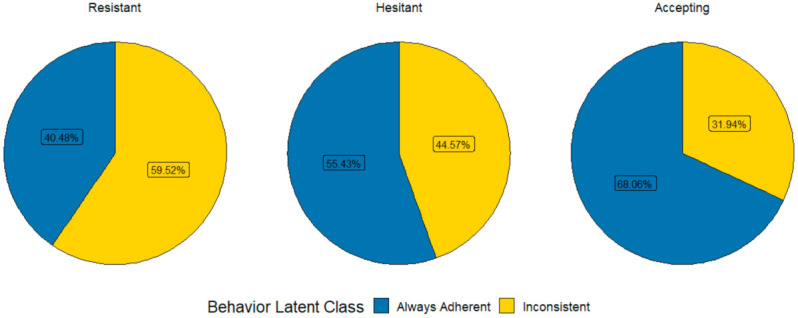
Sexual and gender minority (SGM) and racial or ethnic minority youth at-risk for or living with HIV may have higher risk of SARS-CoV-2 infection. However, there are few data on vaccine hesitancy/acceptance and COVID-19 self-protective behaviors among this population. Youth aged 15-24 years ( = 440), predominantly African American and Latine (73%, = 320) SGM, from Los Angeles and New Orleans reported their vaccine attitudes and COVID-19 and HIV preventive behaviors in October 2020. Latent class analyses categorized individuals into groups based on their vaccine attitudes and preventive behaviors. Relationships between these groups and other factors were analyzed using Fisher's exact tests, ANOVA, and logistic regression. Most youth had accepting vaccine attitudes (70.2%, = 309), with 20.7% hesitant ( = 91), and 9.1% resistant ( = 40). SGM and African Americans were significantly less accepting than their cis-gender and heterosexual peers. About two-thirds (63.2%, = 278) of the respondents reported consistent COVID-19 self-protective behaviors. Youth with pro-vaccine attitudes were most consistently self-protective; however, only 54.4% (= 168/309) intended to take a COVID-19 vaccine. Homelessness history, race, and sexual orientation were associated with vaccine attitudes. Accepting vaccine attitudes and consistent COVID-19 self-protective behaviors were closely related. COVID-19 attitudes/behaviors were not associated with HIV risk and only loosely associated with SARS-CoV-2 vaccine intentions.
面临感染艾滋病毒风险或已感染艾滋病毒的性少数和性别少数(SGM)青年以及少数族裔青年可能感染新冠病毒的风险更高。然而,关于这一人群中疫苗犹豫/接受情况以及新冠病毒自我防护行为的数据很少。2020年10月,来自洛杉矶和新奥尔良的15至24岁青年(n = 440)报告了他们的疫苗态度以及新冠病毒和艾滋病毒预防行为,这些青年主要是非洲裔美国人和拉丁裔(73%,n = 320)SGM。潜在类别分析根据个体的疫苗态度和预防行为将他们分为不同组。使用费舍尔精确检验、方差分析和逻辑回归分析了这些组与其他因素之间的关系。大多数青年对疫苗持接受态度(70.2%,n = 309),20.7%犹豫不决(n = 91),9.1%抗拒(n = 40)。SGM和非洲裔美国人比他们的顺性别和异性恋同龄人接受程度明显更低。约三分之二(63.2%,n = 278)的受访者报告了一致的新冠病毒自我防护行为。对疫苗持支持态度的青年自我防护最为一致;然而,只有54.4%(= 168/309)的人打算接种新冠病毒疫苗。有无无家可归史、种族和性取向与疫苗态度有关。接受疫苗态度和一致的新冠病毒自我防护行为密切相关。对新冠病毒的态度/行为与艾滋病毒风险无关,仅与接种新冠病毒疫苗的意愿有松散关联。