Kashyap Vivek K, Peasah-Darkwah Godwin, Dhasmana Anupam, Jaggi Meena, Yallapu Murali M, Chauhan Subhash C
Department of Immunology and Microbiology, School of Medicine, University of Texas Rio Grande Valley, McAllen, TX 78504, USA.
South Texas Center of Excellence in Cancer Research, School of Medicine, University of Texas Rio Grande Valley, McAllen, TX 78504, USA.
Pharmaceutics. 2022 Mar 10;14(3):611. doi: 10.3390/pharmaceutics14030611.
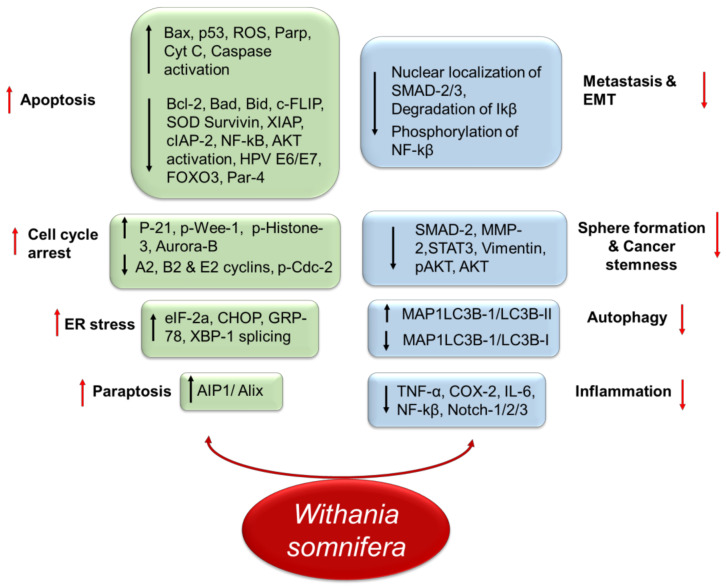
Chemotherapy is one of the prime treatment options for cancer. However, the key issues with traditional chemotherapy are recurrence of cancer, development of resistance to chemotherapeutic agents, affordability, late-stage detection, serious health consequences, and inaccessibility. Hence, there is an urgent need to find innovative and cost-effective therapies that can target multiple gene products with minimal adverse reactions. Natural phytochemicals originating from plants constitute a significant proportion of the possible therapeutic agents. In this article, we reviewed the advances and the potential of (WS) as an anticancer and immunomodulatory molecule. Several preclinical studies have shown the potential of WS to prevent or slow the progression of cancer originating from various organs such as the liver, cervix, breast, brain, colon, skin, lung, and prostate. WS extracts act via various pathways and provide optimum effectiveness against drug resistance in cancer. However, stability, bioavailability, and target specificity are major obstacles in combination therapy and have limited their application. The novel nanotechnology approaches enable solubility, stability, absorption, protection from premature degradation in the body, and increased circulation time and invariably results in a high differential uptake efficiency in the phytochemical's target cells. The present review primarily emphasizes the insights of WS source, chemistry, and the molecular pathways involved in tumor regression, as well as developments achieved in the delivery of WS for cancer therapy using nanotechnology. This review substantiates WS as a potential immunomodulatory, anticancer, and chemopreventive agent and highlights its potential use in cancer treatment.
化疗是癌症的主要治疗选择之一。然而,传统化疗的关键问题包括癌症复发、对化疗药物产生耐药性、可承受性、晚期检测、严重的健康后果以及难以获得治疗。因此,迫切需要找到创新且具有成本效益的疗法,这些疗法能够以最小的不良反应靶向多种基因产物。源自植物的天然植物化学物质占可能的治疗药物的很大比例。在本文中,我们综述了(WS)作为一种抗癌和免疫调节分子的进展及潜力。多项临床前研究表明,WS具有预防或减缓源自肝脏、子宫颈、乳腺、脑、结肠、皮肤、肺和前列腺等各种器官的癌症进展的潜力。WS提取物通过多种途径发挥作用,并对癌症中的耐药性提供最佳疗效。然而,稳定性、生物利用度和靶向特异性是联合治疗中的主要障碍,限制了它们的应用。新型纳米技术方法能够实现溶解性、稳定性、吸收性、保护其在体内不被过早降解、延长循环时间,并始终在植物化学物质的靶细胞中产生高差异摄取效率。本综述主要强调了WS的来源、化学性质以及肿瘤消退所涉及的分子途径的见解,以及在使用纳米技术递送WS用于癌症治疗方面所取得的进展。这篇综述证实了WS作为一种潜在的免疫调节、抗癌和化学预防剂,并突出了其在癌症治疗中的潜在用途。