Quer Josep, Colomer-Castell Sergi, Campos Carolina, Andrés Cristina, Piñana Maria, Cortese Maria Francesca, González-Sánchez Alejandra, Garcia-Cehic Damir, Ibáñez Marta, Pumarola Tomàs, Rodríguez-Frías Francisco, Antón Andrés, Tabernero David
Liver Diseases-Viral Hepatitis, Liver Unit, Vall d'Hebron Institut of Research (VHIR), Vall d'Hebron Hospital Universitari, Vall d'Hebron Barcelona Hospital Campus, Passeig Vall d'Hebron 119-129, 08035 Barcelona, Spain.
Centro de Investigación Biomédica en Red de Enfermedades Hepáticas y Digestivas (CIBERehd), Instituto de Salud Carlos III, Av. Monforte de Lemos 3-5, 28029 Madrid, Spain.
Viruses. 2022 Mar 14;14(3):600. doi: 10.3390/v14030600.
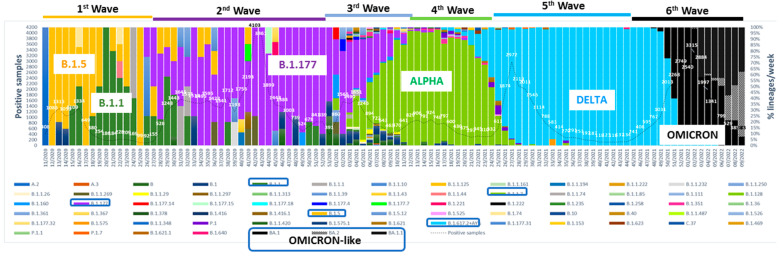
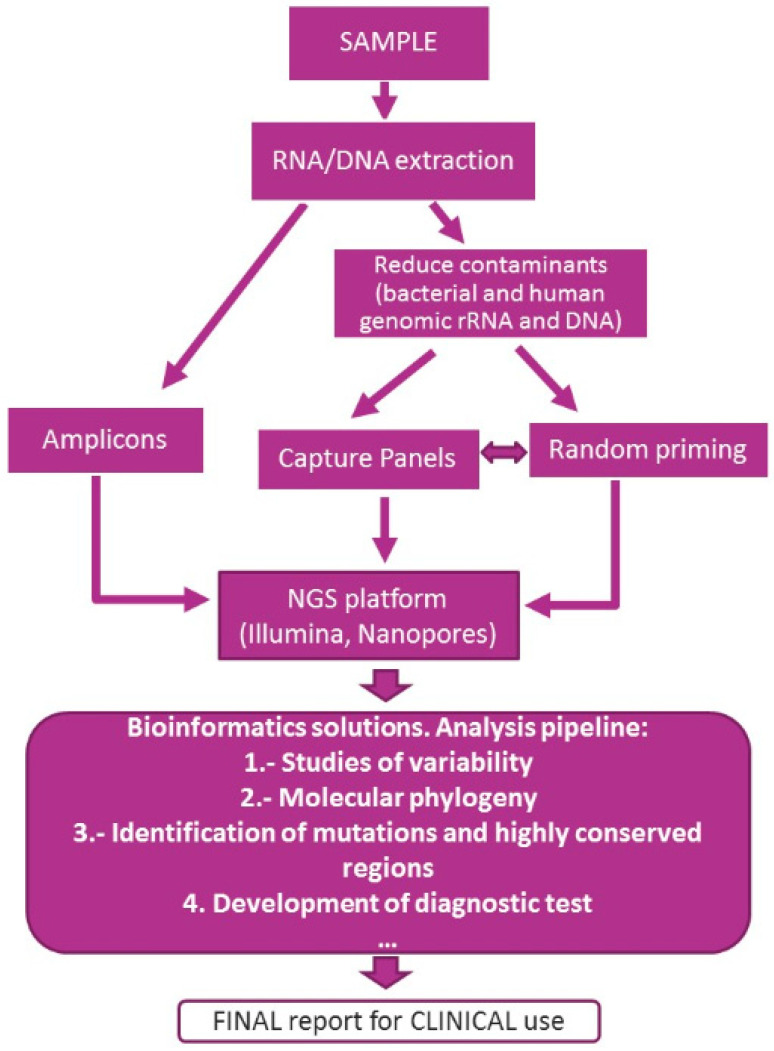
Virus pandemics have happened, are happening and will happen again. In recent decades, the rate of zoonotic viral spillover into humans has accelerated, mirroring the expansion of our global footprint and travel network, including the expansion of viral vectors and the destruction of natural spaces, bringing humans closer to wild animals. Once viral cross-species transmission to humans occurs, transmission cannot be stopped by cement walls but by developing barriers based on knowledge that can prevent or reduce the effects of any pandemic. Controlling a local transmission affecting few individuals is more efficient that confronting a community outbreak in which infections cannot be traced. Genetic detection, identification, and characterization of infectious agents using next-generation sequencing (NGS) has been proven to be a powerful tool allowing for the development of fast PCR-based molecular assays, the rapid development of vaccines based on mRNA and DNA, the identification of outbreaks, transmission dynamics and spill-over events, the detection of new variants and treatment of vaccine resistance mutations, the development of direct-acting antiviral drugs, the discovery of relevant minority variants to improve knowledge of the viral life cycle, strengths and weaknesses, the potential for becoming dominant to take appropriate preventive measures, and the discovery of new routes of viral transmission.
病毒大流行已经发生、正在发生,并且还会再次发生。近几十年来,人畜共患病毒向人类溢出的速度加快,这反映了我们全球足迹和旅行网络的扩张,包括病毒载体的扩散和自然空间的破坏,使人类与野生动物的接触更加密切。一旦病毒跨物种传播给人类,水泥墙无法阻止传播,而应基于相关知识建立屏障,以预防或减轻任何大流行的影响。控制少数个体受影响的局部传播,比应对无法追踪感染源的社区爆发更为有效。利用下一代测序(NGS)对传染源进行基因检测、鉴定和特征分析,已被证明是一种强大的工具,可用于开发基于快速PCR的分子检测方法、基于mRNA和DNA的疫苗的快速研发、疫情的识别、传播动态和溢出事件的监测、新变种的检测以及疫苗抗性突变的治疗、直接作用抗病毒药物的研发、发现相关的少数变种以增进对病毒生命周期、优势和劣势的了解、评估其成为主导变种的可能性以便采取适当的预防措施,以及发现病毒传播的新途径。