• 文献检索
  • 文档翻译
  • 深度研究
  • 学术资讯
  • Suppr Zotero 插件Zotero 插件
  • 邀请有礼
  • 套餐&价格
  • 历史记录
应用&插件
Suppr Zotero 插件Zotero 插件浏览器插件Mac 客户端Windows 客户端微信小程序
定价
高级版会员购买积分包购买API积分包
服务
文献检索文档翻译深度研究API 文档MCP 服务
关于我们
关于 Suppr公司介绍联系我们用户协议隐私条款
关注我们

Suppr 超能文献

核心技术专利:CN118964589B侵权必究
粤ICP备2023148730 号-1Suppr @ 2026

文献检索

告别复杂PubMed语法,用中文像聊天一样搜索,搜遍4000万医学文献。AI智能推荐,让科研检索更轻松。

立即免费搜索

文件翻译

保留排版,准确专业,支持PDF/Word/PPT等文件格式,支持 12+语言互译。

免费翻译文档

深度研究

AI帮你快速写综述,25分钟生成高质量综述,智能提取关键信息,辅助科研写作。

立即免费体验

在新冠疫情第一波和第二波期间,减少重症监护病房广谱抗生素的使用并未对死亡率产生不利影响。

Reducing broad-spectrum antibiotic use in intensive care unit between first and second waves of COVID-19 did not adversely affect mortality.

作者信息

Chan X H S, O'Connor C J, Martyn E, Clegg A J, Choy B J K, Soares A L, Shulman R, Stone N R H, De S, Bitmead J, Hail L, Brealey D, Arulkumaran N, Singer M, Wilson A P R

机构信息

Department of Clinical Microbiology, University College London NHS Foundation Trust, London, UK; Big Data Institute, Nuffield Department of Medicine, University of Oxford, Oxford, UK.

Department of Clinical Microbiology, University College London NHS Foundation Trust, London, UK.

出版信息

J Hosp Infect. 2022 Jun;124:37-46. doi: 10.1016/j.jhin.2022.03.007. Epub 2022 Mar 23.

DOI:10.1016/j.jhin.2022.03.007
PMID:35339638
原文链接:https://pmc.ncbi.nlm.nih.gov/articles/PMC8940720/
Abstract

BACKGROUND

The COVID-19 pandemic increased the use of broad-spectrum antibiotics due to diagnostic uncertainty, particularly in critical care. Multi-professional communication became more difficult, weakening stewardship activities.

AIM

To determine changes in bacterial co-/secondary infections and antibiotics used in COVID-19 patients in critical care, and mortality rates, between the first and second waves.

METHODS

Prospective audit comparing bacterial co-/secondary infections and their treatment during the first two waves of the pandemic in a single-centre teaching hospital intensive care unit. Data on demographics, daily antibiotic use, clinical outcomes, and culture results in patients diagnosed with COVID-19 infection were collected over 11 months.

FINDINGS

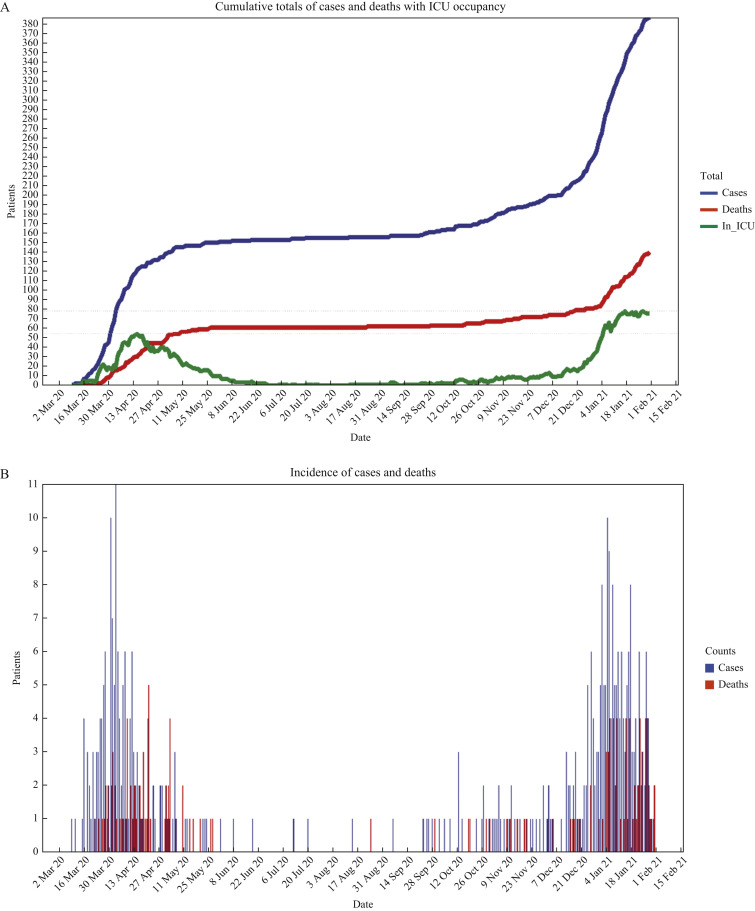
From March 9, 2020 to September 2, 2020 (Wave 1), there were 156 patients and between September 3, 2020 and February 1, 2021 (Wave 2) there were 235 patients with COVID-19 infection admitted to intensive care. No significant difference was seen in mortality or positive blood culture rates between the two waves. The proportion of patients receiving antimicrobial therapy (93.0% vs 81.7%; P < 0.01) and the duration of meropenem use (median (interquartile range): 5 (2-7) vs 3 (2-5) days; P = 0.01) was lower in Wave 2. However, the number of patients with respiratory isolates of Pseudomonas aeruginosa (4/156 vs 21/235; P < 0.01) and bacteraemia from a respiratory source (3/156 vs 20/235; P < 0.01) increased in Wave 2, associated with an outbreak of infection. There was no significant difference between waves with respect to isolation of other pathogens.

CONCLUSION

Reduced broad-spectrum antimicrobial use in the second wave of COVID-19 compared with the first wave was not associated with significant change in mortality.

摘要

背景

由于诊断不确定性,尤其是在重症监护中,新冠疫情增加了广谱抗生素的使用。多专业沟通变得更加困难,削弱了管理活动。

目的

确定在重症监护中,新冠患者在第一波和第二波疫情期间细菌合并/继发感染、使用的抗生素以及死亡率的变化。

方法

在一家单中心教学医院重症监护病房进行前瞻性审计,比较疫情前两波期间细菌合并/继发感染及其治疗情况。在11个月内收集了确诊为新冠感染患者的人口统计学数据、每日抗生素使用情况、临床结局和培养结果。

结果

从2020年3月9日至2020年9月2日(第一波),有156例患者;从2020年9月3日至2021年2月1日(第二波),有235例新冠感染患者入住重症监护病房。两波疫情期间的死亡率或血培养阳性率无显著差异。第二波中接受抗菌治疗的患者比例(93.0%对81.7%;P<0.01)和美罗培南使用时长(中位数(四分位间距):5(2 - 7)天对3(2 - 5)天;P = 0.01)较低。然而,第二波中铜绿假单胞菌呼吸道分离株患者数量(4/156对21/235;P<0.01)和呼吸道来源的菌血症患者数量(3/156对20/235;P<0.01)增加,与感染暴发有关。在分离其他病原体方面,两波之间无显著差异。

结论

与第一波相比,第二波新冠疫情期间广谱抗菌药物使用的减少与死亡率的显著变化无关。

https://cdn.ncbi.nlm.nih.gov/pmc/blobs/d0d2/8940720/86d3d7c07b27/gr2ab_lrg.jpg
https://cdn.ncbi.nlm.nih.gov/pmc/blobs/d0d2/8940720/073223a494ae/gr1_lrg.jpg
https://cdn.ncbi.nlm.nih.gov/pmc/blobs/d0d2/8940720/86d3d7c07b27/gr2ab_lrg.jpg
https://cdn.ncbi.nlm.nih.gov/pmc/blobs/d0d2/8940720/073223a494ae/gr1_lrg.jpg
https://cdn.ncbi.nlm.nih.gov/pmc/blobs/d0d2/8940720/86d3d7c07b27/gr2ab_lrg.jpg

相似文献

1
Reducing broad-spectrum antibiotic use in intensive care unit between first and second waves of COVID-19 did not adversely affect mortality.在新冠疫情第一波和第二波期间,减少重症监护病房广谱抗生素的使用并未对死亡率产生不利影响。
J Hosp Infect. 2022 Jun;124:37-46. doi: 10.1016/j.jhin.2022.03.007. Epub 2022 Mar 23.
2
Secondary Bacterial Infection and Clinical Characteristics in Patients With COVID-19 Admitted to Two Intensive Care Units of an Academic Hospital in Iran During the First Wave of the Pandemic.伊朗一所学术医院的两个重症监护病房在大流行第一波期间收治的 COVID-19 患者中的继发性细菌感染和临床特征。
Front Cell Infect Microbiol. 2022 Feb 23;12:784130. doi: 10.3389/fcimb.2022.784130. eCollection 2022.
3
Survey of antibiotic and antifungal prescribing in patients with suspected and confirmed COVID-19 in Scottish hospitals.苏格兰医院疑似和确诊 COVID-19 患者的抗生素和抗真菌药物处方调查。
J Infect. 2020 Dec;81(6):952-960. doi: 10.1016/j.jinf.2020.09.024. Epub 2020 Sep 26.
4
Bacterial and Fungal Coinfection in Individuals With Coronavirus: A Rapid Review To Support COVID-19 Antimicrobial Prescribing.细菌和真菌合并感染冠状病毒的个体:一项支持 COVID-19 抗菌药物处方的快速综述。
Clin Infect Dis. 2020 Dec 3;71(9):2459-2468. doi: 10.1093/cid/ciaa530.
5
Bacterial and fungal coinfection among hospitalized patients with COVID-19: a retrospective cohort study in a UK secondary-care setting.COVID-19 住院患者的细菌和真菌感染:英国二级保健机构中的回顾性队列研究。
Clin Microbiol Infect. 2020 Oct;26(10):1395-1399. doi: 10.1016/j.cmi.2020.06.025. Epub 2020 Jun 27.
6
Bacterial co-infections with SARS-CoV-2.细菌合并感染 SARS-CoV-2。
IUBMB Life. 2020 Oct;72(10):2097-2111. doi: 10.1002/iub.2356. Epub 2020 Aug 8.
7
Few bacterial co-infections but frequent empiric antibiotic use in the early phase of hospitalized patients with COVID-19: results from a multicentre retrospective cohort study in The Netherlands.在荷兰的一项多中心回顾性队列研究中,COVID-19 住院患者早期的细菌合并感染较少,但经验性抗生素使用频繁。
Infect Dis (Lond). 2021 Feb;53(2):102-110. doi: 10.1080/23744235.2020.1839672. Epub 2020 Oct 24.
8
Impact of antimicrobial stewardship in organisms causing nosocomial infection among COVID-19 critically ill adults.COVID-19 危重症成年患者医院感染病原体的抗菌药物管理干预效果。
Eur J Intern Med. 2024 Jan;119:93-98. doi: 10.1016/j.ejim.2023.08.009. Epub 2023 Aug 12.
9
A Comparative Study on Bacterial Co-Infections and Prevalence of Multidrug Resistant Organisms among Patients in COVID and Non-COVID Intensive Care Units.COVID 和非 COVID 重症监护病房患者的细菌合并感染和多药耐药菌流行的比较研究。
J Prev Med Hyg. 2022 Apr 26;63(1):E19-E26. doi: 10.15167/2421-4248/jpmh2022.63.1.2175. eCollection 2022 Mar.
10
Antibiotic use during the first 6 months of COVID-19 pandemic in Iran: A large-scale multi-centre study.伊朗 COVID-19 大流行期间前 6 个月的抗生素使用情况:一项大规模多中心研究。
J Clin Pharm Ther. 2022 Dec;47(12):2140-2151. doi: 10.1111/jcpt.13761. Epub 2022 Aug 21.

引用本文的文献

1
Candidemia chronicles: Retrospective analysis of candidemia epidemiology, species distribution, and antifungal susceptibility patterns in Bahrain.念珠菌血症纪事:巴林念珠菌血症流行病学、菌种分布及抗真菌药敏模式的回顾性分析
World J Virol. 2024 Dec 25;13(4):98839. doi: 10.5501/wjv.v13.i4.98839.
2
How did the COVID-19 pandemic affect antibiotic consumption within humanitarian emergencies? Results from five humanitarian contexts.新冠疫情如何影响人道主义紧急情况下的抗生素使用?来自五种人道主义背景的结果。
Infect Prev Pract. 2024 Jul 18;6(3):100385. doi: 10.1016/j.infpip.2024.100385. eCollection 2024 Sep.
3
The Impact of Early Antibiotic Use on Clinical Outcomes of Patients Hospitalized with COVID-19: A Propensity Score-Matched Analysis.

本文引用的文献

1
Defining COVID-19-associated pulmonary aspergillosis: systematic review and meta-analysis.定义 COVID-19 相关肺曲霉病:系统评价和荟萃分析。
Clin Microbiol Infect. 2022 Jul;28(7):920-927. doi: 10.1016/j.cmi.2022.01.027. Epub 2022 Feb 10.
2
Risk factors associated with bloodstream infections among critically ill patients with COVID-19.新型冠状病毒肺炎(COVID-19)危重症患者血流感染的相关危险因素。
J Infect. 2021 Nov;83(5):e1-e3. doi: 10.1016/j.jinf.2021.09.010. Epub 2021 Sep 16.
3
National surveillance of bacterial and fungal coinfection and secondary infection in COVID-19 patients in England: lessons from the first wave.
早期使用抗生素对COVID-19住院患者临床结局的影响:一项倾向评分匹配分析。
Infect Drug Resist. 2024 Aug 9;17:3425-3438. doi: 10.2147/IDR.S470957. eCollection 2024.
4
Risk Factors Associated with the Development of Hospital-Acquired Infections in Hospitalized Patients with Severe COVID-19.与重症 COVID-19 住院患者发生医院获得性感染相关的危险因素
Antibiotics (Basel). 2023 Jun 27;12(7):1108. doi: 10.3390/antibiotics12071108.
5
Bacterial and fungal coinfections among patients with COVID-19 in Zanjan, Northwest of Iran; a single-center observational with meta-analysis of the literature.伊朗西北部赞詹新冠肺炎患者的细菌和真菌合并感染;一项单中心观察性研究及文献荟萃分析
Iran J Microbiol. 2022 Oct;14(5):624-635. doi: 10.18502/ijm.v14i5.10955.
6
Antimicrobial stewardship in the post COVID-19 pandemic era: an opportunity for renewed focus on controlling the threat of antimicrobial resistance.新冠疫情后时代的抗菌药物管理:重新聚焦控制抗菌药物耐药性威胁的契机
J Hosp Infect. 2022 Nov;129:121-123. doi: 10.1016/j.jhin.2022.10.001.
7
Carbapenem use correlates with percentage of patients with COVID-19 in intensive care units.碳青霉烯类药物的使用与重症监护病房 COVID-19 患者的比例相关。
Infection. 2023 Apr;51(2):331-336. doi: 10.1007/s15010-022-01867-y. Epub 2022 Jun 18.
英格兰国家监测新冠病毒患者的细菌和真菌合并感染及继发感染:第一波疫情的经验教训。
Clin Microbiol Infect. 2021 Nov;27(11):1658-1665. doi: 10.1016/j.cmi.2021.05.040. Epub 2021 Jun 8.
4
Dexamethasone and tocilizumab treatment considerably reduces the value of C-reactive protein and procalcitonin to detect secondary bacterial infections in COVID-19 patients.地塞米松和托珠单抗治疗显著降低了 C 反应蛋白和降钙素原检测 COVID-19 患者继发细菌性感染的价值。
Crit Care. 2021 Aug 5;25(1):281. doi: 10.1186/s13054-021-03717-z.
5
Antibiotic usage and stewardship in patients with COVID-19: too much antibiotic in uncharted waters?2019冠状病毒病患者的抗生素使用与管理:在未知水域使用了过多抗生素?
J Infect Prev. 2021 May;22(3):119-125. doi: 10.1177/1757177420976813. Epub 2020 Dec 10.
6
Antibiotic prescribing for respiratory tract infection in patients with suspected and proven COVID-19: results from an antibiotic point prevalence survey in Scottish hospitals.疑似和确诊新型冠状病毒肺炎患者呼吸道感染的抗生素处方:苏格兰医院抗生素现患率调查结果
JAC Antimicrob Resist. 2021 Jun 18;3(2):dlab078. doi: 10.1093/jacamr/dlab078. eCollection 2021 Jun.
7
Antibacterial use in the age of SARS-CoV-2.2019冠状病毒病时代的抗菌药物使用
JAC Antimicrob Resist. 2021 Jun 9;3(2):dlab073. doi: 10.1093/jacamr/dlab073. eCollection 2021 Jun.
8
The potential impact of the COVID-19 pandemic on global antimicrobial and biocide resistance: an AMR Insights global perspective.2019年冠状病毒病大流行对全球抗菌药物和消毒剂耐药性的潜在影响:抗菌药物耐药性洞察全球视角
JAC Antimicrob Resist. 2021 Apr 8;3(2):dlab038. doi: 10.1093/jacamr/dlab038. eCollection 2021 Jun.
9
Hand hygiene compliance of healthcare workers before and during the COVID-19 pandemic: A long-term follow-up study.医护人员在 COVID-19 大流行前后的手部卫生依从性:一项长期随访研究。
Am J Infect Control. 2021 Sep;49(9):1118-1122. doi: 10.1016/j.ajic.2021.06.014. Epub 2021 Jun 25.
10
Multidrug-resistant Acinetobacter baumannii infections in COVID-19 patients hospitalized in intensive care unit.COVID-19 患者重症监护病房中耐多药鲍曼不动杆菌感染。
Infection. 2022 Feb;50(1):83-92. doi: 10.1007/s15010-021-01643-4. Epub 2021 Jun 27.