Hong Jin Young, Kim Su Hee, Seo Yoojin, Jeon Jooik, Davaa Ganchimeg, Hyun Jung Keun, Kim Soo Hyun
Department of Nanobiomedical Science and BK21 NBM Global Research Center for Regenerative Medicine, Dankook University, Cheonan, Republic of Korea.
Institute of Tissue Regeneration Engineering, Dankook University, Cheonan, Republic of Korea.
J Tissue Eng. 2022 Mar 22;13:20417314221086491. doi: 10.1177/20417314221086491. eCollection 2022 Jan-Dec.
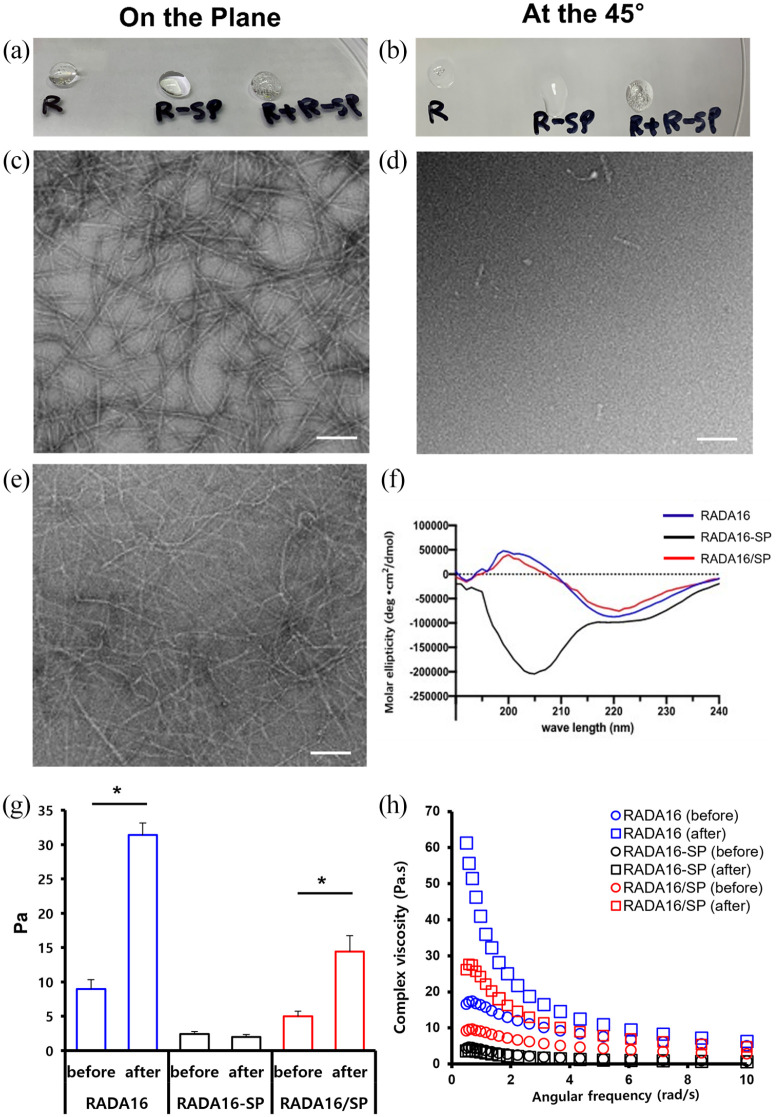
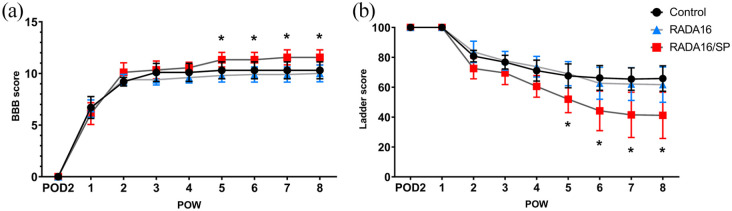
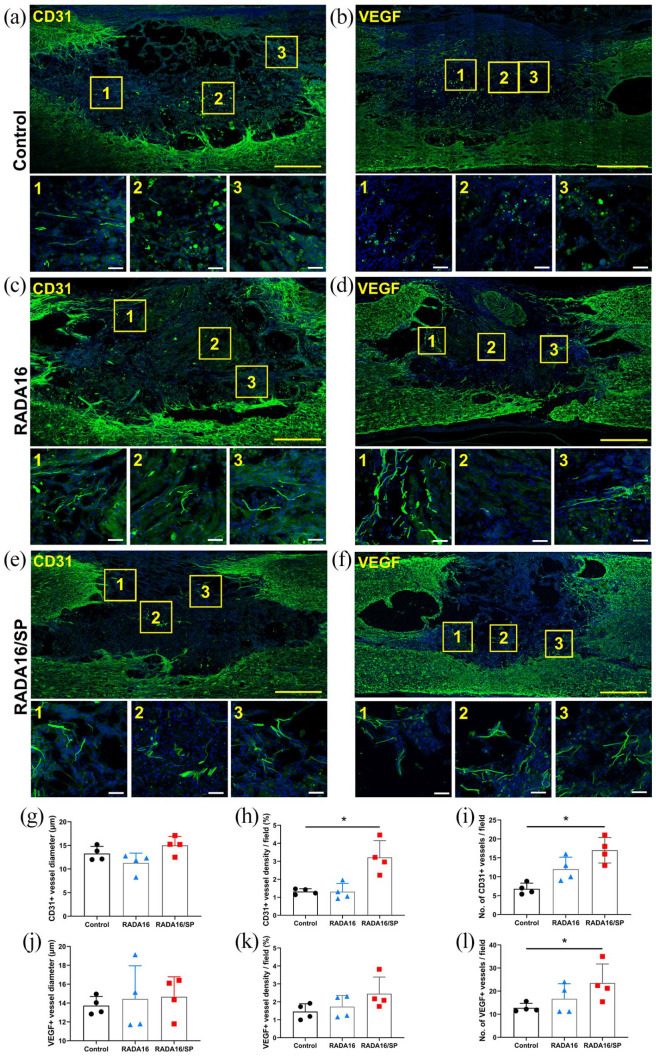
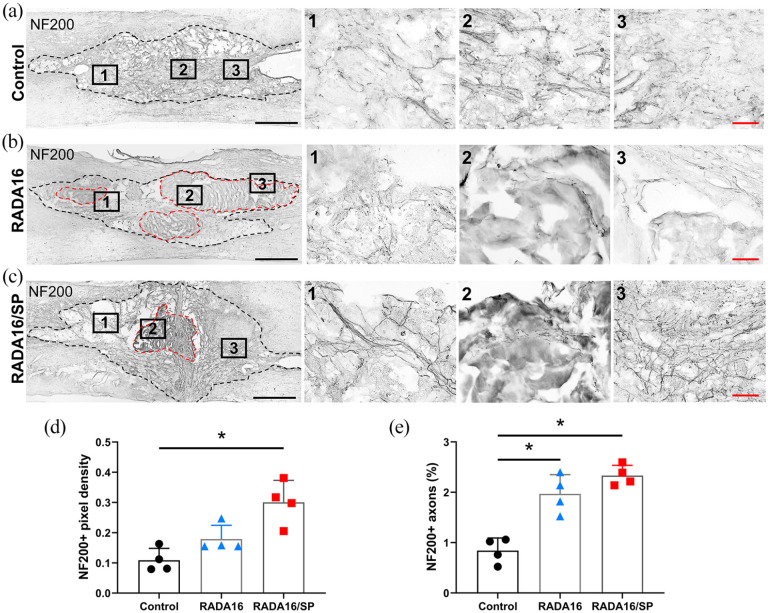
Spinal cord injury (SCI) leads to disruption of the blood-spinal cord barrier, hemorrhage, and tissue edema, which impair blood circulation and induce ischemia. Angiogenesis after SCI is an important step in the repair of damaged tissues, and the extent of angiogenesis strongly correlates with the neural regeneration. Various biomaterials have been developed to promote angiogenesis signaling pathways, and angiogenic self-assembling peptides are useful for producing diverse supramolecular structures with tunable functionality. RADA16 (Ac-RARADADARARADADA-NH2), which forms nanofiber networks under physiological conditions, is a self-assembling peptide that can provide mechanical support for tissue regeneration and reportedly has diverse roles in wound healing. In this study, we applied an injectable form of RADA16 with or without the neuropeptide substance P to the contused spinal cords of rats and examined angiogenesis within the damaged spinal cord and subsequent functional improvement. Histological and immunohistochemical analyses revealed that the inflammatory cell population in the lesion cavity was decreased, the vessel number and density around the damaged spinal cord were increased, and the levels of neurofilaments within the lesion cavity were increased in SCI rats that received RADA16 and RADA16 with substance P (rats in the RADA16/SP group). Moreover, real-time PCR analysis of damaged spinal cord tissues showed that IL-10 expression was increased and that locomotor function (as assessed by the Basso, Beattie, and Bresnahan (BBB) scale and the horizontal ladder test) was significantly improved in the RADA16/SP group compared to the control group. Our findings indicate that RADA16 modified with substance P effectively stimulates angiogenesis within the damaged spinal cord and is a candidate agent for promoting functional recovery post-SCI.
脊髓损伤(SCI)会导致血脊髓屏障破坏、出血和组织水肿,进而损害血液循环并引发局部缺血。SCI后的血管生成是受损组织修复的重要步骤,血管生成的程度与神经再生密切相关。人们已研发出多种生物材料来促进血管生成信号通路,而血管生成自组装肽可用于构建具有可调功能的多种超分子结构。RADA16(Ac-RARADADARARADADA-NH2)在生理条件下可形成纳米纤维网络,是一种能为组织再生提供机械支持的自组装肽,据报道在伤口愈合中具有多种作用。在本研究中,我们将注射用的RADA16单独或与神经肽P物质一起应用于大鼠的挫伤脊髓,检测受损脊髓内的血管生成及随后的功能改善情况。组织学和免疫组织化学分析显示,在接受RADA16和RADA16与P物质(RADA16/SP组大鼠)的SCI大鼠中,损伤腔内的炎性细胞数量减少,受损脊髓周围的血管数量和密度增加,损伤腔内神经丝的水平升高。此外,对受损脊髓组织的实时PCR分析表明,RADA16/SP组与对照组相比,IL-10表达增加,运动功能(通过Basso、Beattie和Bresnahan(BBB)评分量表和水平阶梯试验评估)显著改善。我们的研究结果表明,用P物质修饰的RADA16能有效刺激受损脊髓内的血管生成,是促进SCI后功能恢复的候选药物。