Department of Biomedical Sciences and Pathobiology, College of Veterinary Medicine, Virginia Tech, Blacksburg, VA 24061, USA.
Rev Cardiovasc Med. 2022 Mar 12;23(3):97. doi: 10.31083/j.rcm2303097.
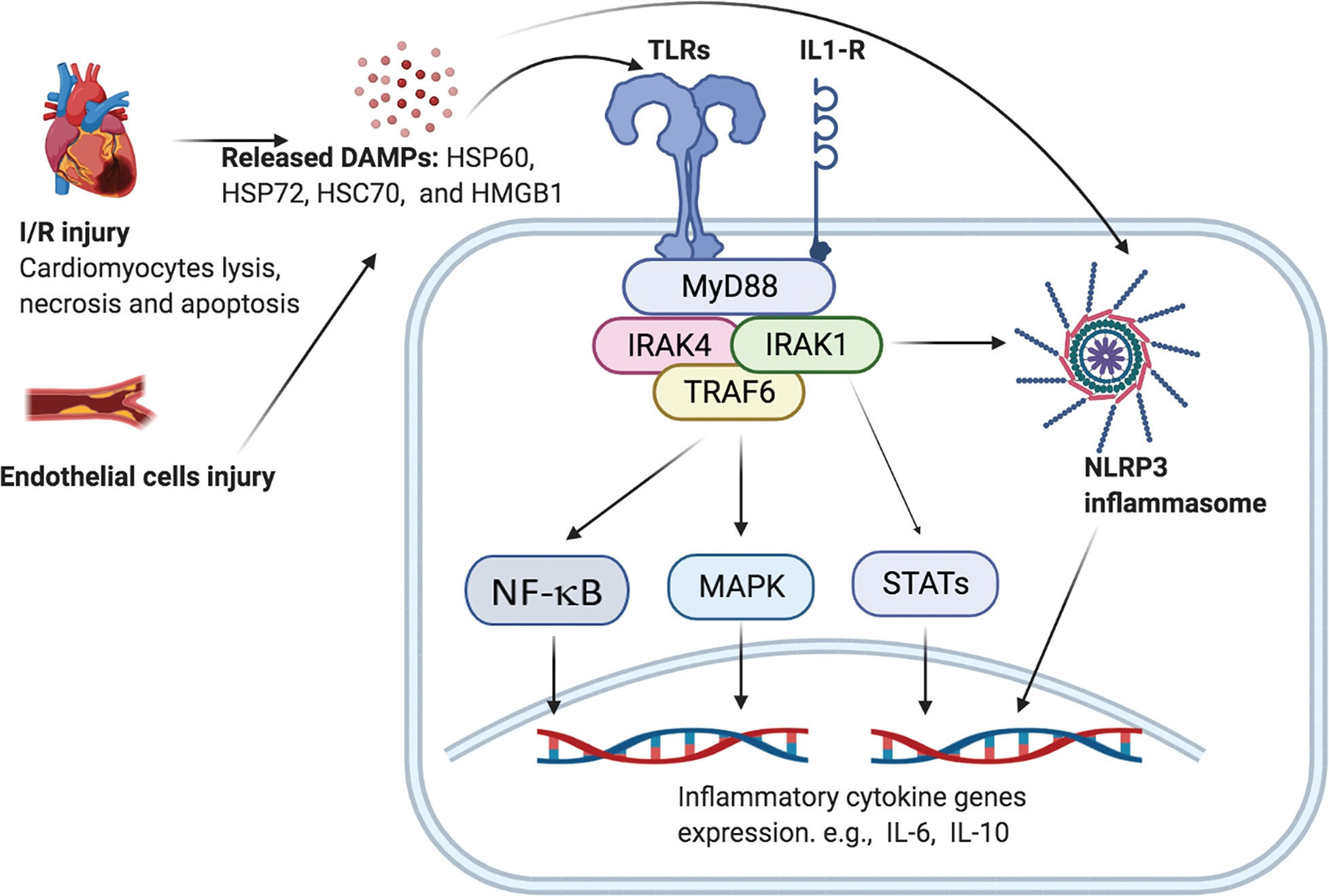
Toll-like receptors (TLRs) and interleukin-1 receptor (IL-1R) directly interact with intracellular interleukin receptor associated kinase (IRAK) family members to initialize innate immune and inflammatory responses following activation by pathogen-associated or host-derived elements. Although four IRAK family members [IRAK1, 2, 3 ( IRAK-M), and 4] are involved in TLR and IL-1R signaling pathways, IL-1R > IRAK1 signaling appears to be the most studied pathway, with sufficient evidence to support its central role linking the innate immune response to the pathogenesis of various diseases, including cancers, metabolic disorders, and non-infectious immune disorders. However, IRAK1's involvement in cardiovascular diseases was only recently revealed and the detailed mechanism underling the pathogenesis of cardiovascular diseases, such as atherosclerosis, myocardial infarction, and heart failure (all non-infectious disorders), remains largely unknown with very limited publications to date. This review aims to summarize the overall roles of the IRAK family, especially IRAK1, in mediating the development of cardiovascular diseases.
Toll 样受体 (TLRs) 和白介素-1 受体 (IL-1R) 可直接与细胞内白介素受体相关激酶 (IRAK) 家族成员相互作用,在被病原体相关或宿主来源的成分激活后,启动先天免疫和炎症反应。尽管有四个 IRAK 家族成员 [IRAK1、2、3(IRAK-M)和 4] 参与 TLR 和 IL-1R 信号通路,但 IL-1R>IRAK1 信号通路似乎是研究最多的通路,有充分的证据支持其作为连接先天免疫反应与各种疾病(包括癌症、代谢紊乱和非传染性免疫紊乱)发病机制的核心作用。然而,IRAK1 参与心血管疾病的作用直到最近才被揭示,而心血管疾病(如动脉粥样硬化、心肌梗死和心力衰竭)发病机制的详细机制在很大程度上仍然未知,迄今为止只有非常有限的出版物。本综述旨在总结 IRAK 家族,特别是 IRAK1,在介导心血管疾病发展中的总体作用。