Ray Sourav, Haque Mohaiminul, Ahmed Tanvir, Mita Ayesha Ferdous, Saikat Md Hadiuzzaman, Alom Md Mafus
Department of Civil and Environmental Engineering, Shahjalal University of Science and Technology, Sylhet, Bangladesh.
Heliyon. 2022 Mar 18;8(3):e09129. doi: 10.1016/j.heliyon.2022.e09129. eCollection 2022 Mar.
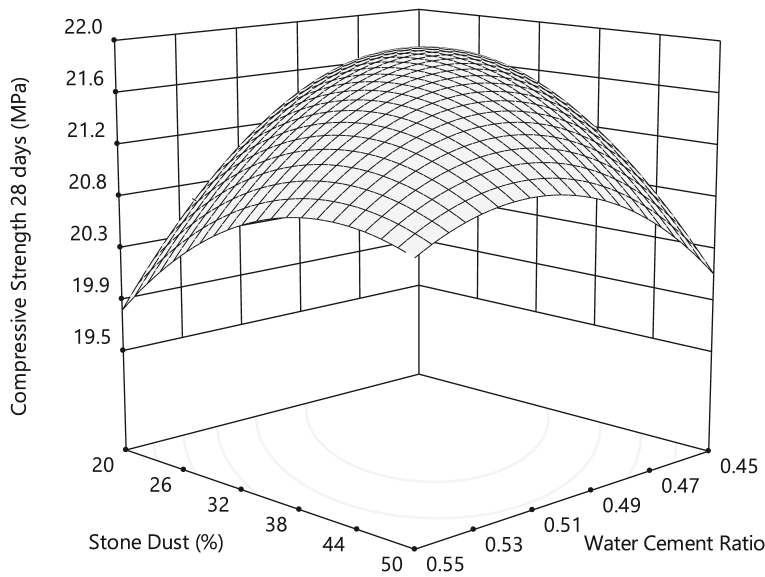
Excessive demand of concrete is causing depletion of natural sand resources. Especially, the extraction of river sand negatively affects its surrounding environment. A sustainable solution to this problem can be the proper utilization of waste materials and by-products like stone dust (SD) as fine aggregate replacement in concrete. The recycling of stone dust as a construction material lessens the use of natural resources and helps to solve landfill scarcity as well as environmental problems. Addition of nylon fiber (NF) as fiber reinforcement can also attribute to enhance the properties of concrete. This research aims at utilizing SD as fine aggregate along with NF, and assessing the compressive strength and splitting tensile strength of concrete. Although the individual effects of incorporating stone dust and nylon fiber in concrete have been investigated in previous researches, their combined effects, as well as effects of water cement (WC) ratio on concrete strength, have not been studied yet. In this study, volumetric percentages of stone dust (20%-50%) and nylon fiber (0.25%-0.75%) and three different water cement ratio (0.45, 0.50 and 0.55) have been considered as three independent variables to develop probabilistic models for compressive strength and splitting tensile strength of concrete using artificial neural network (ANN). The values of coefficient of determination (R) and other statistical parameters of the developed probabilistic models indicate the accuracy of the models to predict the concrete strength. In terms of compressive strength at early age, the optimal percentages of SD and NF have been found as 20% and 0.25%, respectively. However, the strength gradually drops as water cement ratio elevates from 0.45 to 0.55. The reduction of the splitting tensile strength has been observed for increasing SD from 20% to 50%, whereas, strength increases for rising NF and WC up to mid-level.
对混凝土的过度需求正导致天然砂资源的枯竭。特别是,河砂的开采对其周边环境产生负面影响。解决这一问题的可持续方案可以是合理利用废料和副产品,如石粉(SD)作为混凝土中的细集料替代品。将石粉作为建筑材料进行回收利用,减少了自然资源的使用,并有助于解决垃圾填埋场短缺以及环境问题。添加尼龙纤维(NF)作为纤维增强材料也有助于提高混凝土的性能。本研究旨在利用石粉作为细集料并添加尼龙纤维,并评估混凝土的抗压强度和劈裂抗拉强度。尽管先前的研究已经探讨了在混凝土中掺入石粉和尼龙纤维的单独效果,但它们的综合效果以及水灰比(WC)对混凝土强度的影响尚未得到研究。在本研究中,石粉(20%-50%)和尼龙纤维(0.25%-0.75%)的体积百分比以及三种不同的水灰比(0.45、0.50和0.55)被视为三个独立变量,以使用人工神经网络(ANN)建立混凝土抗压强度和劈裂抗拉强度的概率模型。决定系数(R)的值以及所建立概率模型的其他统计参数表明了模型预测混凝土强度的准确性。就早期抗压强度而言,已发现石粉和尼龙纤维的最佳百分比分别为20%和0.25%。然而,随着水灰比从0.45提高到0.55,强度逐渐下降。当石粉从20%增加到50%时,劈裂抗拉强度降低,而随着尼龙纤维和水灰比增加至中等水平,强度增加。