Department of Urology, The Second Affiliated Hospital of Guangzhou University of Chinese Medicine, Fangcun Branch, 36 Chong'an Street, North Dongjiao Road, Guangzhou, 510370, China.
From Department of Andrology, The Second Affiliated Hospital of Guangzhou University of Chinese Medicine, Zhuhai, China.
BMC Urol. 2022 Mar 28;22(1):46. doi: 10.1186/s12894-022-00988-8.
To analyze the risk factors for progression of urolith associated with obstructive urosepsis to severe sepsis or septic shock, we had done the retrospective cross-sectional study, which would facilitate the early identification of high-risk patients.
Datas were retrospectively reviewed from 160 patients, suffering from obstructive urosepsis associated with urolith between December 2013 and December 2019. There were 49 patients complicating by severe sepsis (severe sepsis group), 12 patients complicating by septic shock (septic shock group), and 99 patients without progressing to severe sepsis or septic shock (sepsis group). The data covered age, gender, BMI (body mass index), time interval from ED (emergency department) to admission, WBC count (white blood cell count), NLR (neutrophil/lymphocyte ratio), HGB (hemoglobin), etc. Datas were analyzed by univariate analyses and multivariate logistic regression analysis. The corresponding nomogram prediction model was drawn according to the regression coefficients.
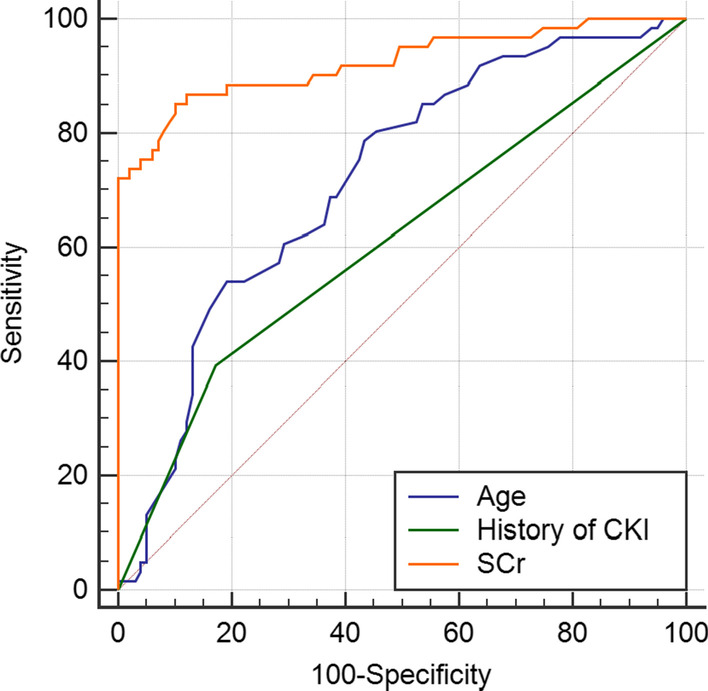
Univariate analysis showed that the differences of age, the time interval from ED to admission, history of diabetes mellitus, history of CKI (chronic kidney disease), NLR, HGB, platelet count, TBil (total bilirubin), SCr (serum creatinine), ALB (albumin), PT (prothrombin time), APTT (activated partial thromboplastin time), INR (international normalized ratio), PCT (procalcitonin), and positive rate of pathogens in blood culture were statistically significant (P < 0.05). Multivariatelogistic regression analysis showed that age, SCr, and history of CKI were independent risk factors for progression to severe sepsis, or septic shock (P < 0.05).
Aged ≥ 65 years, SCr ≥ 248 mol/L, and history of CKI were independent risk factors for progression of urolith associated with obstructive urosepsis to severe sepsis or septic shock. We need to pay more attention to these aspects, when coming across the patients with urolithic sepsis.
为分析与梗阻性尿脓毒症相关的尿石症进展为严重脓毒症或感染性休克的危险因素,我们进行了回顾性横断面研究,以便早期识别高危患者。
回顾性分析了 2013 年 12 月至 2019 年 12 月期间 160 例梗阻性尿脓毒症合并尿石症患者的数据。其中 49 例并发严重脓毒症(严重脓毒症组),12 例并发感染性休克(感染性休克组),99 例未进展为严重脓毒症或感染性休克(脓毒症组)。数据包括年龄、性别、BMI(体重指数)、从急诊到入院的时间间隔、白细胞计数、NLR(中性粒细胞/淋巴细胞比值)、HGB(血红蛋白)等。采用单因素分析和多因素 logistic 回归分析进行数据分析。根据回归系数绘制相应的列线图预测模型。
单因素分析显示,年龄、从急诊到入院的时间间隔、糖尿病史、CKI(慢性肾脏病)史、NLR、HGB、血小板计数、总胆红素、血肌酐、白蛋白、凝血酶原时间、活化部分凝血活酶时间、国际标准化比值、降钙素原和血培养阳性率的差异均有统计学意义(P<0.05)。多因素 logistic 回归分析显示,年龄、血肌酐和 CKI 史是进展为严重脓毒症或感染性休克的独立危险因素(P<0.05)。
年龄≥65 岁、血肌酐≥248μmol/L、CKI 病史是与梗阻性尿脓毒症相关的尿石症进展为严重脓毒症或感染性休克的独立危险因素。在遇到尿石症脓毒症患者时,我们需要更加关注这些方面。