Li Kang, Liu Jun, Wu Lin, Xiao Yajie, Li Jia, Du Haijian, Zhao Zhikun, Sun Chao, Zhao Yongtian, Yang Jie, Wu Dongfang, Zhao Zhuxiang, Chen Bolin
Thoracic Medicine Department 2, Hunan Cancer Hospital/the Affiliated Cancer Hospital of Xiangya School of Medicine, Central South University, Changsha, China.
Department of Respiratory Medicine, The First Affiliated Hospital of Jinan University, Guangzhou, China.
Cancer Cell Int. 2022 Mar 27;22(1):138. doi: 10.1186/s12935-022-02488-z.
Although PD-L1 expression is a crucial predictive biomarker for immunotherapy, it can be influenced by many factors.
A total of 248 Chinese patients with lung adenocarcinoma was retrospectively identified. Data for clinical features, gene alternations, signaling pathways and immune signatures was analyzed among negative expression group (TPS < 1%, n = 124), intermediate expression group (1% ≤ TPS < 50%, n = 93), and high expression group (TPS ≥ 50%, n = 38). Clinical outcomes among different expression groups were also evaluated from public database.
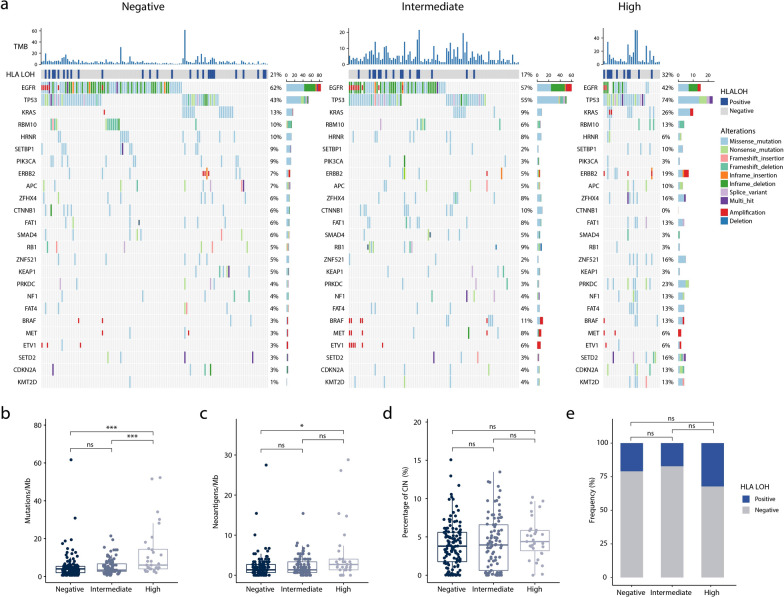
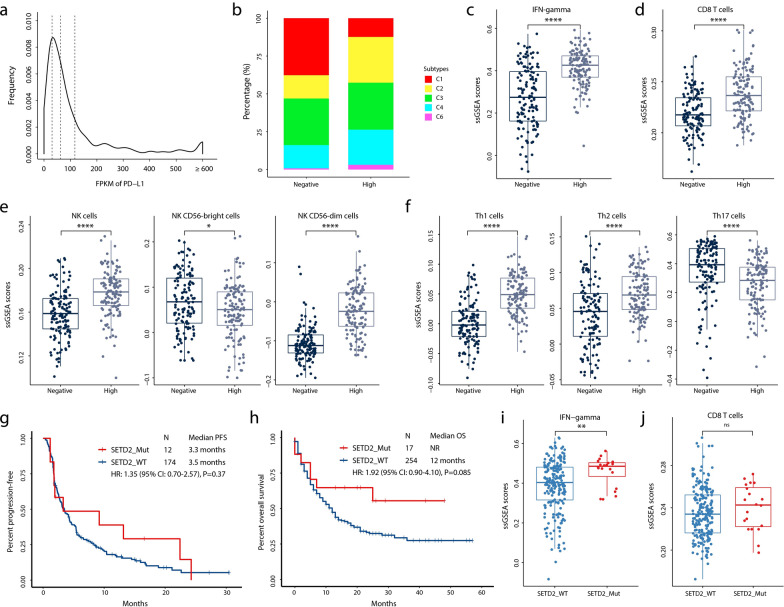
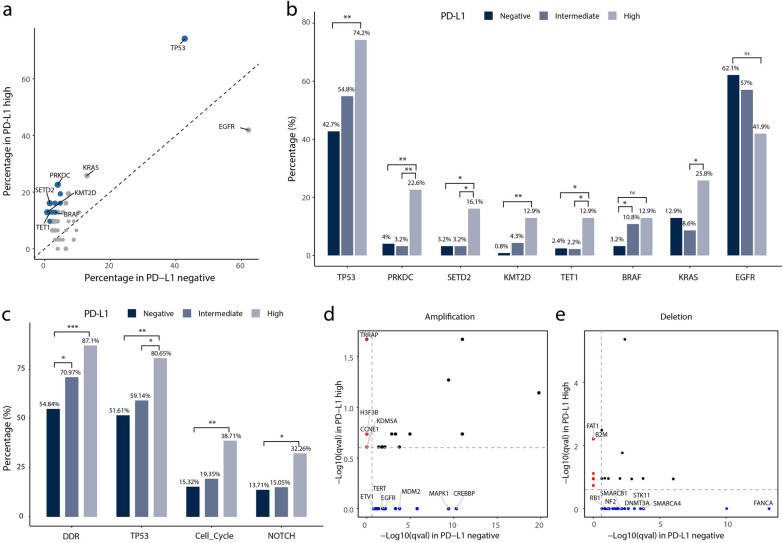
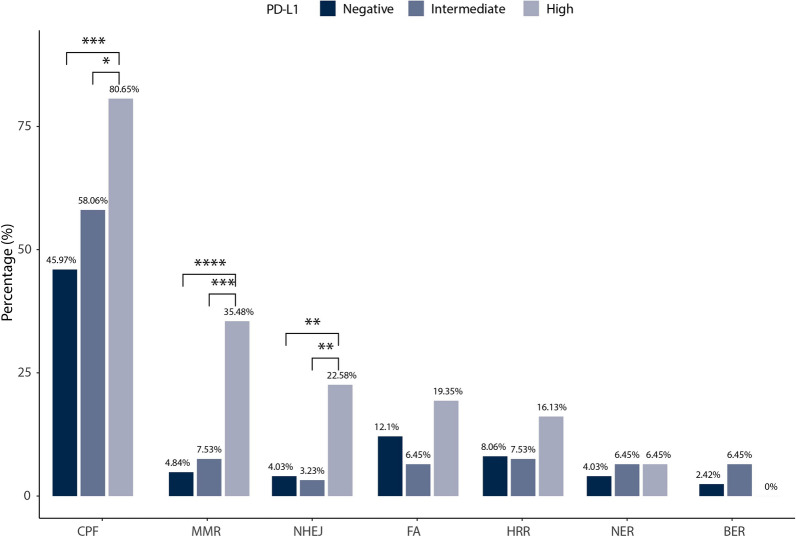
Firstly, high tumor mutation burden was significantly associated with high PD-L1 expression in these Chinese patients with lung adenocarcinoma. In addition, gene alternations including TP53, PRKDC, KMT2D, TET1 and SETD2 apparently occurred in high PD-L1 expression group. Moreover, pathway analysis showed that mutations involving in DDR pathway, TP53 pathway, cell-cycle pathway and NOTCH pathway were obviously varied among three PD-L1 expression groups. Besides, most of patients in high PD-L1 expression group from TCGA database were determined as high-grade immune subtypes (C2-C4), showing significant higher proportions of IFN-gamma, CD8+ T-cells, NK cells, NK CD56 dim cells, Th1 cells, Th2 cells (P < 0.0001). Moreover, SETD2 mutation slightly correlated with overall survival from MSKCC cohort (HR 1.92 [95%CI 0.90-4.10], P = 0.085), and the percentage of IFN-gamma was significantly higher in SETD2 mutant group than in wild-type group (P < 0.01).
This study illustrated in-depth genomic correlates of PD-L1 expression in Chinese lung adenocarcinoma patients and relevant immune signatures from public database, which might interpret more potential molecular mechanisms for immunotherapy in NSCLC.
尽管程序性死亡受体配体1(PD-L1)表达是免疫治疗的关键预测生物标志物,但其可受多种因素影响。
回顾性纳入248例中国肺腺癌患者。分析阴性表达组(肿瘤比例评分[TPS]<1%,n=124)、中度表达组(1%≤TPS<50%,n=93)和高表达组(TPS≥50%,n=38)的临床特征、基因改变、信号通路和免疫特征数据。还从公共数据库评估不同表达组的临床结局。
首先,在这些中国肺腺癌患者中,高肿瘤突变负荷与高PD-L1表达显著相关。此外,包括TP53、蛋白激酶DNA激活催化亚基(PRKDC)、赖氨酸甲基转移酶2D(KMT2D)、 Tet甲基胞嘧啶双加氧酶1(TET1)和SET结构域含蛋白2(SETD2)在内的基因改变明显出现在高PD-L1表达组。此外,通路分析显示,在三个PD-L1表达组中,涉及DNA损伤修复(DDR)通路、TP53通路、细胞周期通路和Notch通路的突变明显不同。此外,来自癌症基因组图谱(TCGA)数据库的高PD-L1表达组中的大多数患者被确定为高级免疫亚型(C2-C4),显示干扰素-γ、CD8+T细胞、自然杀伤(NK)细胞、NK CD56dim细胞、辅助性T细胞1(Th1)细胞、辅助性T细胞2(Th2)细胞的比例显著更高(P<0.0001)。此外,SETD2突变与纪念斯隆凯特琳癌症中心(MSKCC)队列的总生存期略有相关(风险比[HR]1.92[95%置信区间(CI)0.90-4.10],P=0.085),且SETD2突变组中的干扰素-γ百分比显著高于野生型组(P<0.01)。
本研究阐述了中国肺腺癌患者中PD-L1表达的深入基因组相关性以及来自公共数据库的相关免疫特征,这可能为非小细胞肺癌免疫治疗解释更多潜在分子机制。