Division of General Medicine, Columbia University Medical Centre, New York, NY, USA.
Centre for Multidisciplinary Research in Health Science, University of Milan, Via Francesco Sforza, 35, 20122, Milan, Italy.
Sci Rep. 2022 Mar 28;12(1):5272. doi: 10.1038/s41598-022-09286-7.
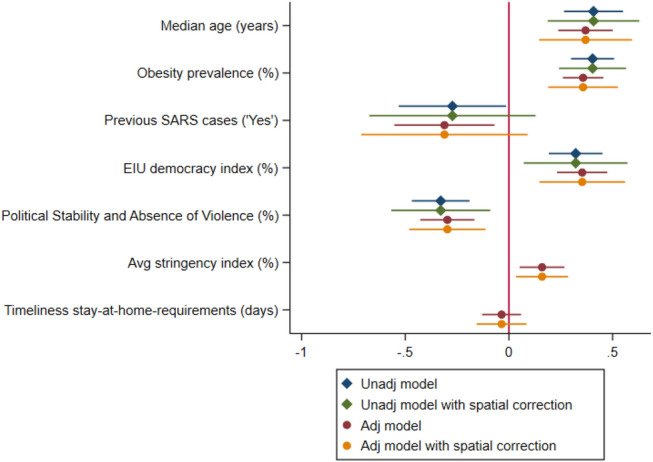
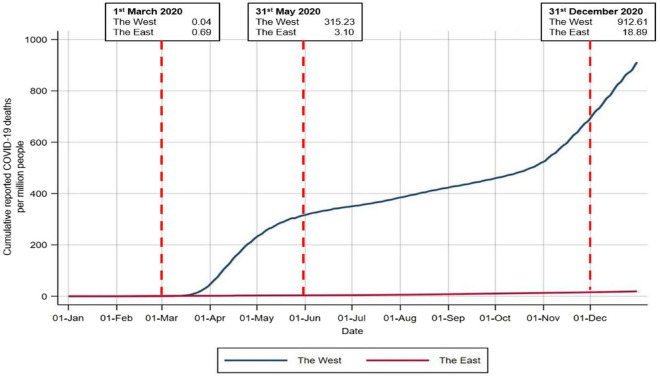
Although SARS-CoV-2 was first reported in China and neighbouring countries, the pandemic quickly spread around the globe. This paper explores national drivers of the pandemic and the radically different epidemiology and response in the West and in the East. We studied coronavirus disease (COVID-19) mortality until 31st December 2020, using an ecological study design, considering baseline characteristics and responses that might account for the uneven impact of the pandemic. A multivariable regression model was developed to explore key determinants. Key variables in the West were contrasted with those in the East, and speed of response was examined. Worldwide, 2.24 million COVID-19 deaths were documented in 2020. Western countries reported a median mortality 114 times that of the East (684 vs. 6.0 per million). Significant correlates of mortality in countries with at least 1 million population were median age, obesity prevalence, and democracy index; political stability and experience of SARS in 2002-2003 were protective; health system variables and income inequality were not associated. Outputs of the model were consistent when adjusted for stringency index, timeliness of stay-at-home requirements, and geographical autocorrelation. The West experiences a much higher COVID-19 mortality than the East. Despite structural advantages in the West, delays in national responses early on resulted in a loss of control over the spread of SARS-CoV-2. Although the early success of the East was sustained in the second half of 2020, the region remains extremely vulnerable to COVID-19 until enough people are immunized.
尽管 SARS-CoV-2 最初是在中国和周边国家报告的,但该大流行很快在全球范围内蔓延。本文探讨了大流行的国家驱动因素以及西方和东方在流行病学和应对方面的根本差异。我们研究了截至 2020 年 12 月 31 日的冠状病毒病 (COVID-19) 死亡率,采用生态研究设计,考虑了可能导致大流行影响不均的基线特征和应对措施。开发了一个多变量回归模型来探讨关键决定因素。将西方的关键变量与东方的关键变量进行了对比,并检查了应对速度。在 2020 年,全球范围内记录了 224 万例 COVID-19 死亡。西方国家报告的死亡率中位数是东方的 114 倍(684 与 60 每百万人)。至少有 100 万人口的国家中死亡率的显著相关因素是中值年龄、肥胖患病率和民主指数;政治稳定和 2002-2003 年 SARS 经验具有保护作用;卫生系统变量和收入不平等与死亡率无关。当根据严格指数、居家令的及时性和地理自相关进行调整时,模型的输出结果保持一致。西方的 COVID-19 死亡率远高于东方。尽管西方在结构上具有优势,但在大流行早期,国家应对措施的延迟导致对 SARS-CoV-2 传播的控制丧失。尽管 2020 年下半年东方的早期成功得以维持,但该地区在足够多的人接种疫苗之前仍极易受到 COVID-19 的影响。