Wang Qian, Chen Fang-Yu, Ling Zhuo-Min, Su Wen-Feng, Zhao Ya-Yu, Chen Gang, Wei Zhong-Ya
Key Laboratory of Neuroregeneration of Jiangsu and Ministry of Education, Jiangsu Clinical Medicine Center of Tissue Engineering and Nerve Injury Repair, Co-innovation Center of Neuroregeneration, Nantong University, Nantong, China.
Medical School of Nantong University, Nantong, China.
Front Cell Neurosci. 2022 Mar 8;16:836931. doi: 10.3389/fncel.2022.836931. eCollection 2022.
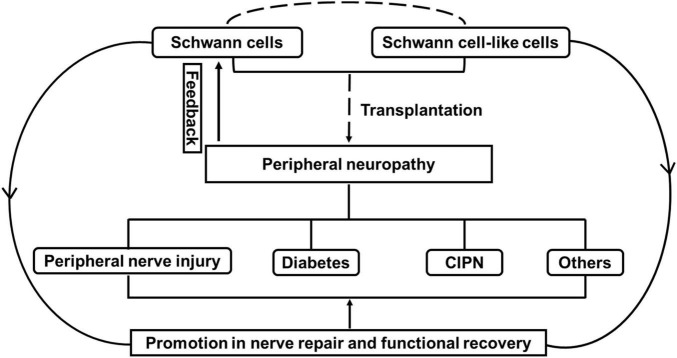
Peripheral neuropathy is a common neurological issue that leads to sensory and motor disorders. Over time, the treatment for peripheral neuropathy has primarily focused on medications for specific symptoms and surgical techniques. Despite the different advantages of these treatments, functional recovery remains less than ideal. Schwann cells, as the primary glial cells in the peripheral nervous system, play crucial roles in physiological and pathological conditions by maintaining nerve structure and functions and secreting various signaling molecules and neurotrophic factors to support both axonal growth and myelination. In addition, stem cells, including mesenchymal stromal cells, skin precursor cells and neural stem cells, have the potential to differentiate into Schwann-like cells to perform similar functions as Schwann cells. Therefore, accumulating evidence indicates that Schwann cell transplantation plays a crucial role in the resolution of peripheral neuropathy. In this review, we summarize the literature regarding the use of Schwann cell/Schwann cell-like cell transplantation for different peripheral neuropathies and the potential role of promoting nerve repair and functional recovery. Finally, we discuss the limitations and challenges of Schwann cell/Schwann cell-like cell transplantation in future clinical applications. Together, these studies provide insights into the effect of Schwann cells/Schwann cell-like cells on cell therapy and uncover prospective therapeutic strategies for peripheral neuropathy.
周围神经病变是一种常见的神经问题,可导致感觉和运动障碍。随着时间的推移,周围神经病变的治疗主要集中在针对特定症状的药物和手术技术上。尽管这些治疗方法各有优势,但功能恢复仍不尽人意。雪旺细胞作为周围神经系统中的主要神经胶质细胞,通过维持神经结构和功能以及分泌各种信号分子和神经营养因子来支持轴突生长和髓鞘形成,在生理和病理条件下发挥着关键作用。此外,包括间充质基质细胞、皮肤前体细胞和神经干细胞在内的干细胞有分化为类雪旺细胞以执行与雪旺细胞类似功能的潜力。因此,越来越多的证据表明雪旺细胞移植在周围神经病变的解决中起着关键作用。在本综述中,我们总结了有关使用雪旺细胞/类雪旺细胞移植治疗不同周围神经病变以及促进神经修复和功能恢复的潜在作用的文献。最后,我们讨论了雪旺细胞/类雪旺细胞移植在未来临床应用中的局限性和挑战。这些研究共同为雪旺细胞/类雪旺细胞对细胞治疗的影响提供了见解,并揭示了周围神经病变的前瞻性治疗策略。