Vazquez Sara E, Mann Sabrina A, Bodansky Aaron, Kung Andrew F, Quandt Zoe, Ferré Elise M N, Landegren Nils, Eriksson Daniel, Bastard Paul, Zhang Shen-Ying, Liu Jamin, Mitchell Anthea, Mandel-Brehm Caleigh, Miao Brenda, Sowa Gavin, Zorn Kelsey, Chan Alice Y, Shimizu Chisato, Tremoulet Adriana, Lynch Kara, Wilson Michael R, Kampe Olle, Dobbs Kerry, Delmonte Ottavia M, Notarangelo Luigi D, Burns Jane C, Casanova Jean-Laurent, Lionakis Michail S, Torgerson Troy R, Anderson Mark S, DeRisi Joseph L
Department of Biochemistry and Biophysics, University of California, San Francisco, San Francisco, United States.
Diabetes Center, University of California, San Francisco, San Francisco, United States.
bioRxiv. 2022 Mar 24:2022.03.23.485509. doi: 10.1101/2022.03.23.485509.
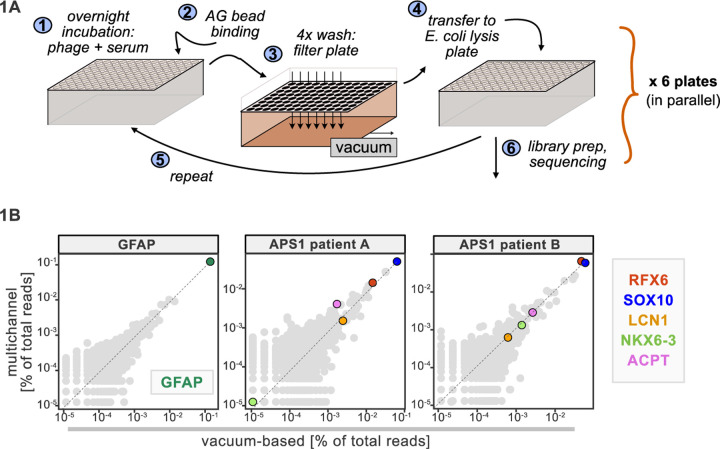
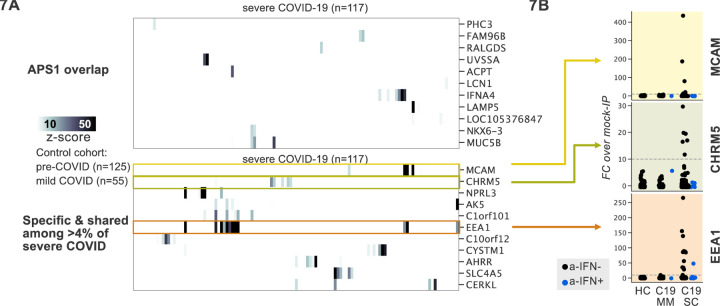
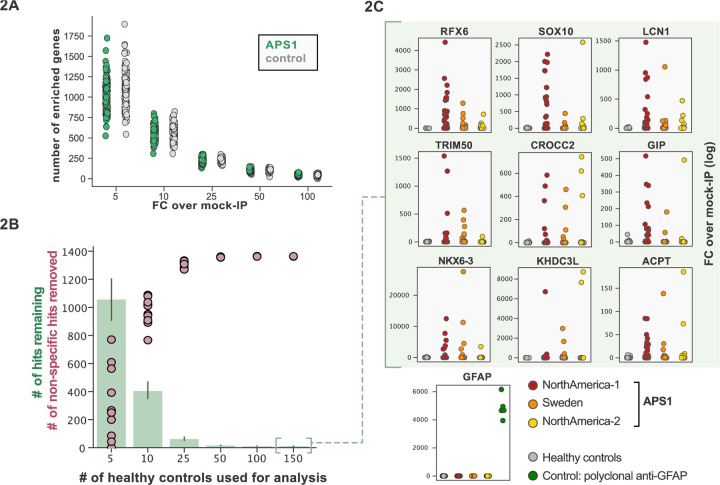
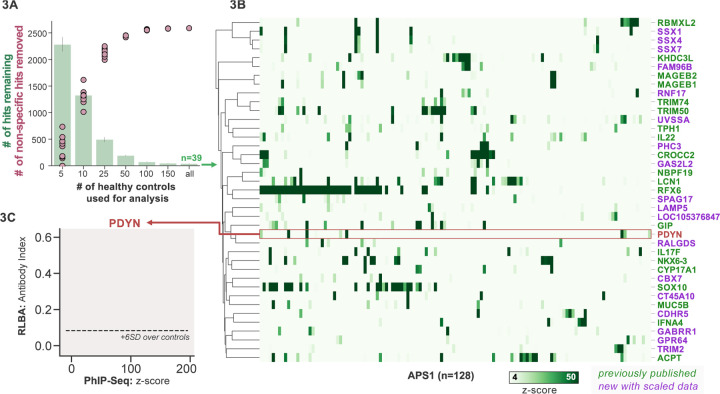
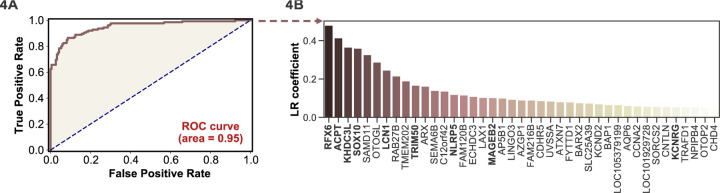
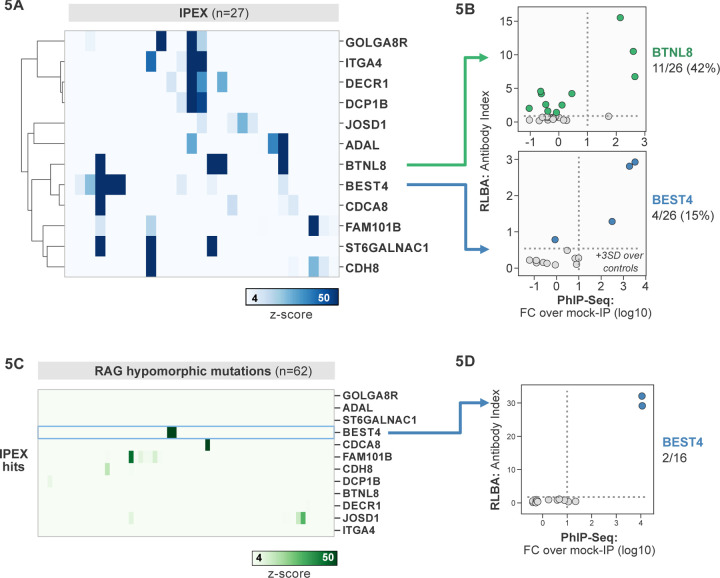
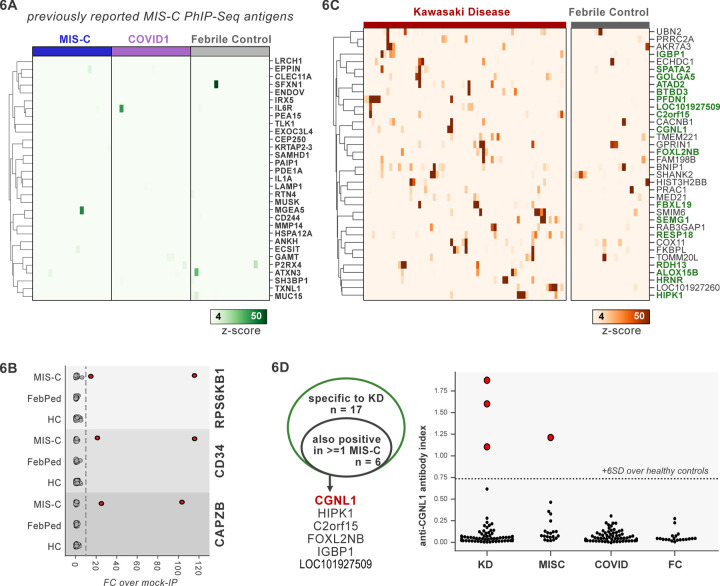
Phage Immunoprecipitation-Sequencing (PhIP-Seq) allows for unbiased, proteome-wide autoantibody discovery across a variety of disease settings, with identification of disease-specific autoantigens providing new insight into previously poorly understood forms of immune dysregulation. Despite several successful implementations of PhIP-Seq for autoantigen discovery, including our previous work (Vazquez et al. 2020), current protocols are inherently difficult to scale to accommodate large cohorts of cases and importantly, healthy controls. Here, we develop and validate a high throughput extension of PhIP-seq in various etiologies of autoimmune and inflammatory diseases, including APS1, IPEX, RAG1/2 deficiency, Kawasaki Disease (KD), Multisystem Inflammatory Syndrome in Children (MIS-C), and finally, mild and severe forms of COVID19. We demonstrate that these scaled datasets enable machine-learning approaches that result in robust prediction of disease status, as well as the ability to detect both known and novel autoantigens, such as PDYN in APS1 patients, and intestinally expressed proteins BEST4 and BTNL8 in IPEX patients. Remarkably, BEST4 antibodies were also found in 2 patients with RAG1/2 deficiency, one of whom had very early onset IBD. Scaled PhIP-Seq examination of both MIS-C and KD demonstrated rare, overlapping antigens, including CGNL1, as well as several strongly enriched putative pneumonia-associated antigens in severe COVID19, including the endosomal protein EEA1. Together, scaled PhIP-Seq provides a valuable tool for broadly assessing both rare and common autoantigen overlap between autoimmune diseases of varying origins and etiologies.
噬菌体免疫沉淀测序(PhIP-Seq)能够在各种疾病背景下进行无偏倚的全蛋白质组自身抗体发现,疾病特异性自身抗原的鉴定为先前了解甚少的免疫失调形式提供了新的见解。尽管PhIP-Seq在自身抗原发现方面有多个成功的应用实例,包括我们之前的工作(巴斯克斯等人,2020年),但目前的方案本质上难以扩展以适应大量病例群体,重要的是,难以适应健康对照群体。在此,我们开发并验证了PhIP-seq在自身免疫性和炎性疾病的各种病因中的高通量扩展,包括自身免疫性多内分泌腺病-念珠菌病-外胚层营养不良(APS1)、免疫失调多内分泌腺病肠病X连锁综合征(IPEX)、RAG1/2缺陷、川崎病(KD)、儿童多系统炎症综合征(MIS-C),以及最后,轻度和重度形式的新型冠状病毒肺炎(COVID-19)。我们证明,这些经过扩展的数据集能够采用机器学习方法,从而实现对疾病状态的可靠预测,以及检测已知和新型自身抗原的能力,例如APS1患者中的前动力蛋白(PDYN),以及IPEX患者中肠道表达的蛋白质Bestrophin 4(BEST4)和Butyrophilin样蛋白8(BTNL8)。值得注意的是,在2例RAG1/2缺陷患者中也发现了BEST4抗体,其中1例患有极早发型炎症性肠病(IBD)。对MIS-C和KD进行的扩展PhIP-Seq检测显示出罕见的重叠抗原,包括卷曲螺旋结构域蛋白1(CGNL1),以及在重度COVID-19中几种高度富集的推定肺炎相关抗原,包括内体蛋白早期内体抗原1(EEA1)。总之,扩展的PhIP-Seq为广泛评估不同起源和病因的自身免疫性疾病之间罕见和常见的自身抗原重叠提供了一个有价值的工具。