Assisted Reproductive Technology Unit, Department of Obstetrics and Gynaecology, Faculty of Medicine, The Chinese University of Hong Kong, Hong Kong, China.
School of Biomedical Sciences, Faculty of Medicine, The Chinese University of Hong Kong, Hong Kong, China.
Reprod Fertil. 2022 Feb 21;3(1):R19-R33. doi: 10.1530/RAF-21-0024. eCollection 2022 Jan 1.
To summarize the currently available phase I and II clinical trials of the effects of nonoxynol-9 (N-9) on human sperm structure and functions.
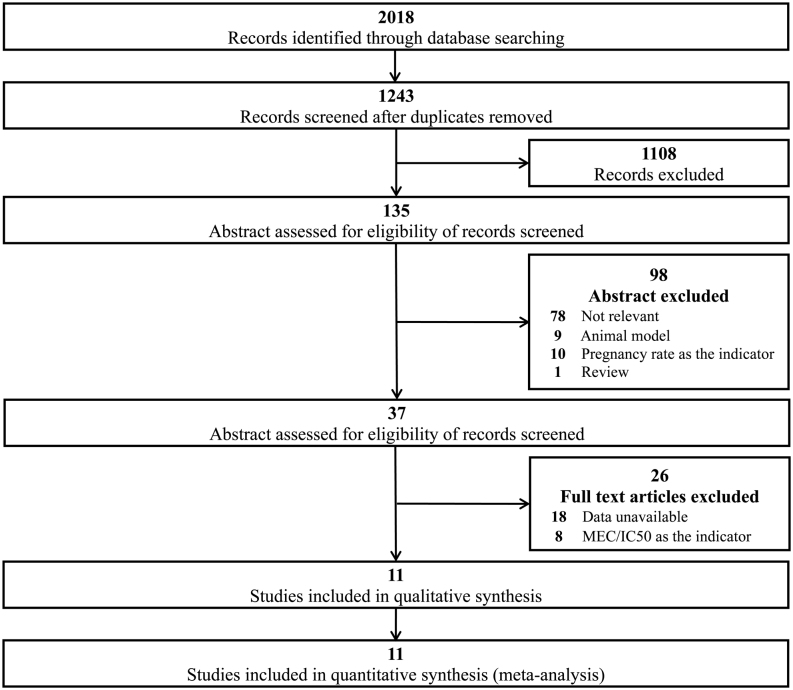
A systematic review and meta-analysis aiming to evaluate the spermicidal activity of N-9 on motility, was conducted in PubMed, EMBASE, and Cochrane databases by 10 March 2021. The counted numbers of progressive motile (PR) sperm in cervical mucus and the vanguard sperm penetration distances were analyzed. Other effects on sperm structures and physiological activities were reviewed as well.
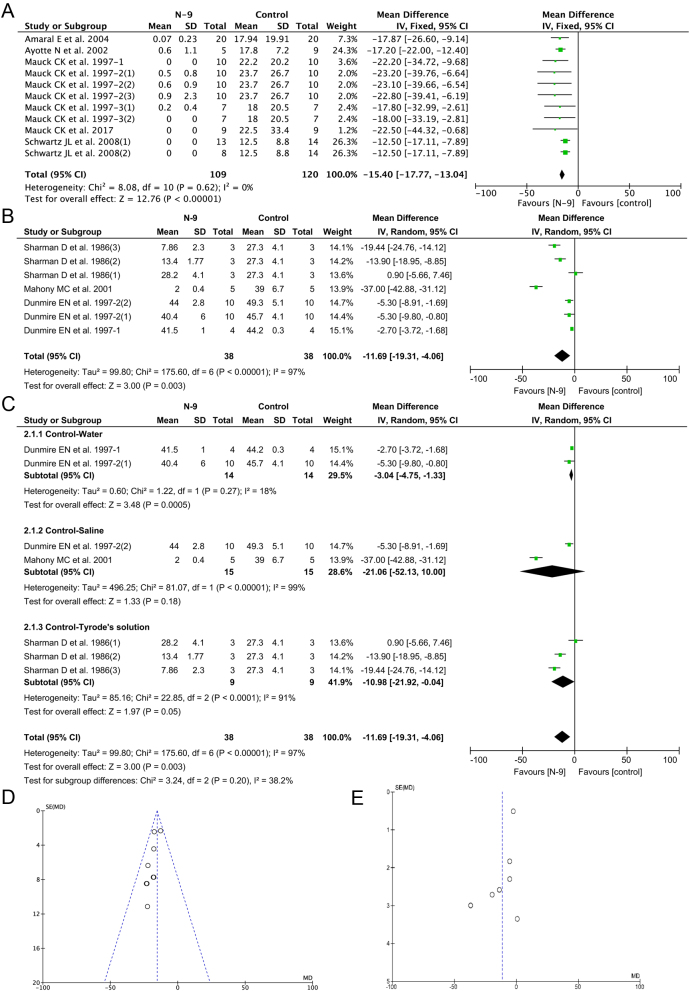
In the pooled results, percentages or counted numbers of PR sperm decreased after the treatment of N-9. Vanguard sperm penetration distance was shortened in treated groups. N-9 has been confirmed to damage the structures of sperm, as well as other organelles like acrosome and mitochondria. The physiological activities such as generation of reactive oxygen species, superoxide dismutase activity, acrosin activity, and hemizona binding were all inhibited in the reviewed studies.
N-9 has several impacts on sperm owing to its potency in reducing sperm motility and cervical mucus penetration, as well as other functional competencies.
Nonoxynol-9 (N-9) has been used worldwide as a spermicide to kill sperm for more than 60 years but can cause side effects including vaginal irritation and can increase the rate of contraceptive failure. A detailed analysis of published literature aiming to evaluate the spermicidal activity of N-9 on sperm was carried out. In the pooled results, N-9 reduced the number of active sperm and the distance they traveled. It also caused damage to the structures of sperm and to the way the sperm acted and interacted with the egg. In conclusion, N-9 impacts on sperm in a number of ways that lead to sperm death and dysfunction.
总结目前关于壬苯醇醚-9(N-9)对人类精子结构和功能的影响的 I 期和 II 期临床试验。
通过系统回顾和荟萃分析,评估 N-9 对精子活力的杀精作用,检索 2021 年 3 月 10 日前的 PubMed、EMBASE 和 Cochrane 数据库,分析宫颈黏液中渐进性运动(PR)精子的计数和先锋精子穿透距离。还回顾了对精子结构和生理活性的其他影响。
在汇总结果中,N-9 处理后 PR 精子的百分比或计数减少,处理组中先锋精子穿透距离缩短。已经证实 N-9 会破坏精子的结构以及顶体和线粒体等其他细胞器。在综述研究中,活性氧物质的生成、超氧化物歧化酶活性、顶体酶活性和半透明带结合等生理活性均受到抑制。
N-9 由于降低精子活力和宫颈黏液穿透能力以及其他功能能力,对精子有多种影响。
壬苯醇醚-9(N-9)作为一种杀精剂已在全球范围内使用超过 60 年,用于杀死精子以避孕,但会引起阴道刺激等副作用,并可能增加避孕失败的风险。对旨在评估 N-9 对精子的杀精活性的已发表文献进行了详细分析。在汇总结果中,N-9 减少了活跃精子的数量及其行进的距离。它还会导致精子结构受损,并改变精子的作用方式以及与卵子的相互作用方式。总之,N-9 通过多种方式影响精子,导致精子死亡和功能障碍。