INSERM, CNRS, Institut de la Vision, Sorbonne Université, 75012 Paris, France.
Proc Natl Acad Sci U S A. 2022 Apr 5;119(14):e2200205119. doi: 10.1073/pnas.2200205119. Epub 2022 Mar 30.
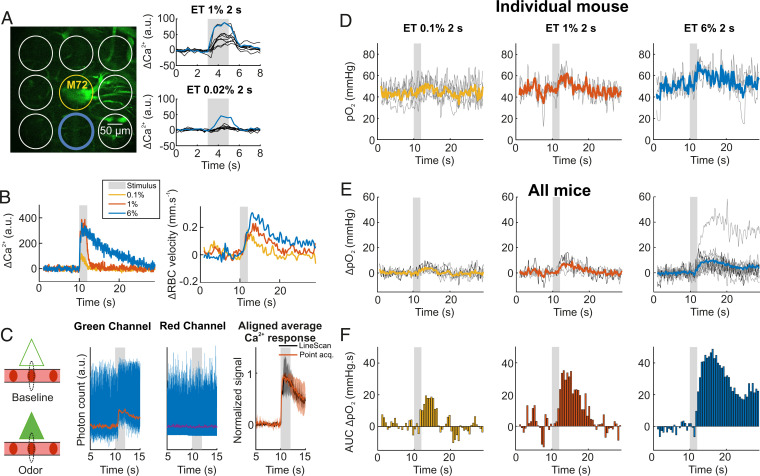
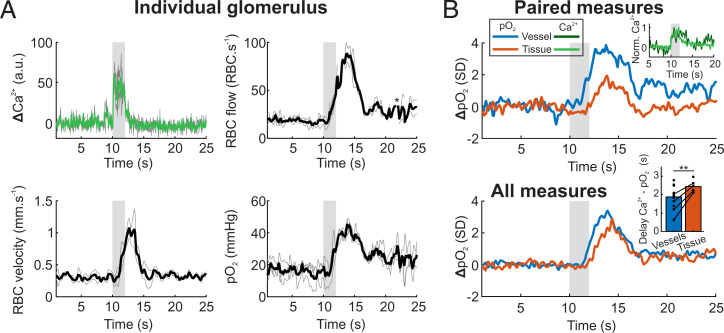
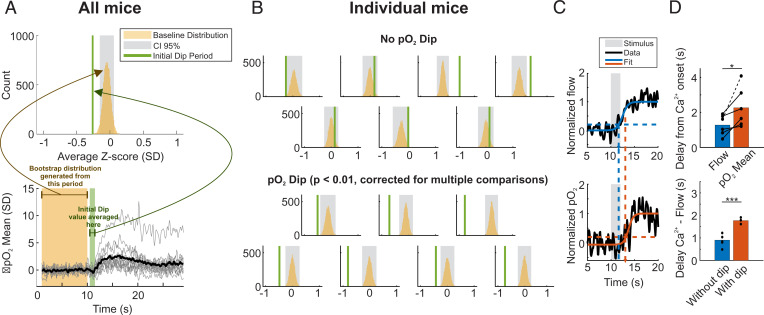
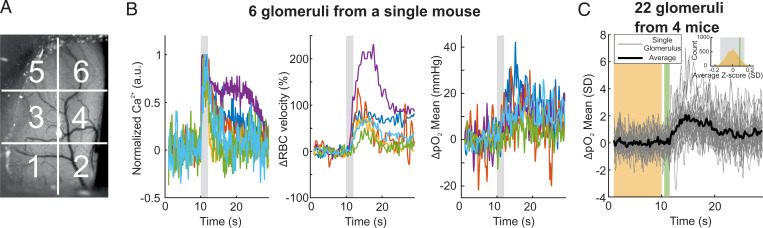
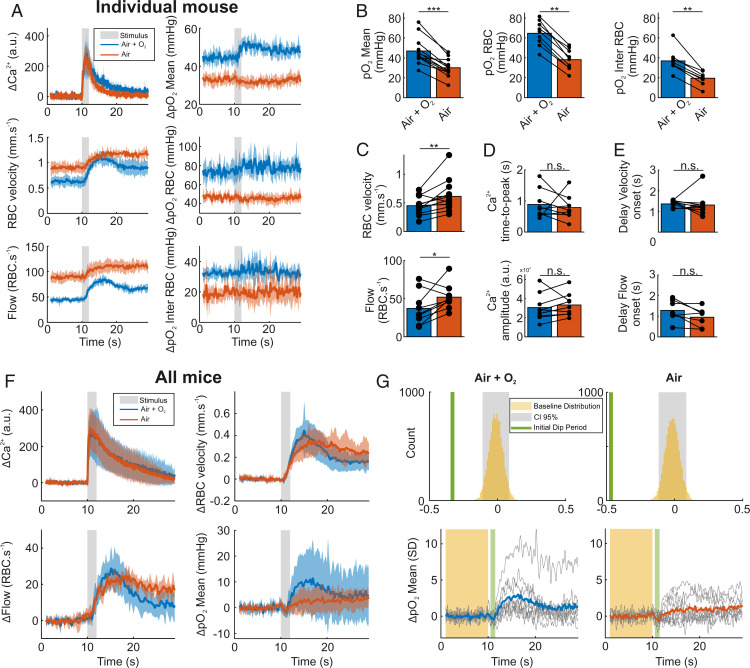
An ongoing controversy in brain metabolism is whether increases in neural activity cause a local and rapid decrease in oxygen concentration (i.e., the “initial dip”) preceding functional hyperemia. This initial dip has been suggested to cause a transient increase in vascular deoxyhemoglobin with several imaging techniques and stimulation paradigms, but not consistently. Here, we investigate contributors to this initial dip in a distinct neuronal network, an olfactory bulb (OB) glomerulus most sensitive to a specific odorant (ethyl tiglate [ET]) and a site of strong activation and energy consumption upon ET stimulation. Combining two-photon fluorescence and phosphorescence lifetime microscopy, and calcium, blood flow, and pO2 measurements, we characterized this initial dip in pO2 in mice chronically implanted with a glass cranial window, during both awake and anesthetized conditions. In anesthetized mice, a transient dip in vascular pO2 was detected in this glomerulus when functional hyperemia was slightly delayed, but its amplitude was minute (0.3 SD of resting baseline). This vascular pO2 dip was not observed in other glomeruli responding nonspecifically to ET, and it was poorly influenced by resting pO2. In awake mice, the dip in pO2 was absent in capillaries as well as, surprisingly, in the neuropil. These high-resolution pO2 measurements demonstrate that in awake mice recovered from brain surgery, neurovascular coupling was too fast and efficient to reveal an initial dip in pO2.
大脑代谢中一个持续存在的争议是,神经活动的增加是否会导致局部和快速的氧浓度降低(即“初始下降”),然后是功能充血。这种初始下降被认为会导致几种成像技术和刺激范式中血管去氧血红蛋白的短暂增加,但并非始终如此。在这里,我们在一个独特的神经元网络中研究了这个初始下降的贡献者,即嗅球(OB)小球体,它对特定气味(乙基 tiglate [ET])最敏感,并且在 ET 刺激时是强烈激活和能量消耗的部位。结合双光子荧光和磷光寿命显微镜以及钙、血流和 pO2 测量,我们在慢性植入玻璃颅窗的小鼠中对清醒和麻醉状态下的这个 pO2 初始下降进行了特征描述。在麻醉小鼠中,当功能性充血略有延迟时,在这个小球体中检测到血管 pO2 的短暂下降,但幅度很小(休息基线的 0.3 SD)。在对 ET 产生非特异性反应的其他小球体中未观察到这种血管 pO2 下降,其对静息 pO2 的影响也很小。在清醒的小鼠中,pO2 的下降在毛细血管中以及在神经胶中都不存在,这令人惊讶。这些高分辨率的 pO2 测量表明,在从脑部手术中恢复的清醒小鼠中,神经血管耦合太快且效率太高,以至于无法显示 pO2 的初始下降。