Department of Medicine, University Hospitals Cleveland Medical Center, Cleveland, OH; School of Medicine, Case Western Reserve University, Cleveland, OH.
UT Southwestern University, Dallas, TX.
Curr Probl Cardiol. 2023 Aug;48(8):101182. doi: 10.1016/j.cpcardiol.2022.101182. Epub 2022 Mar 27.
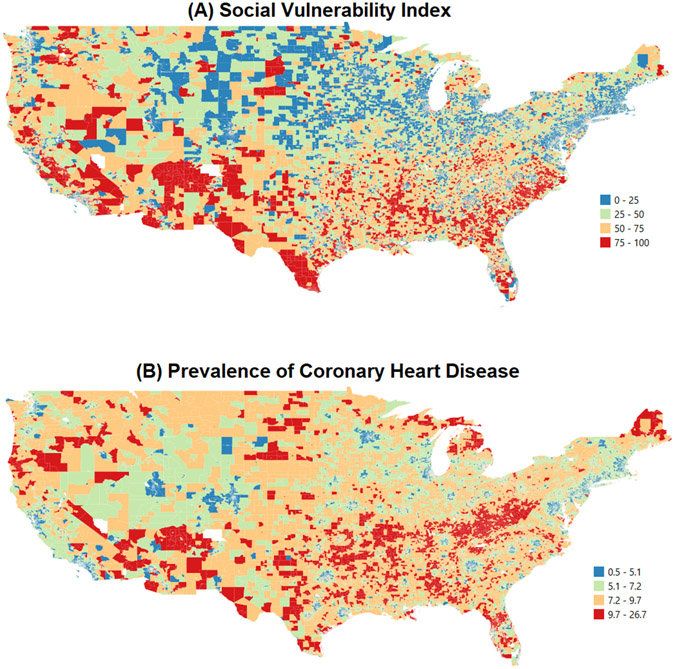
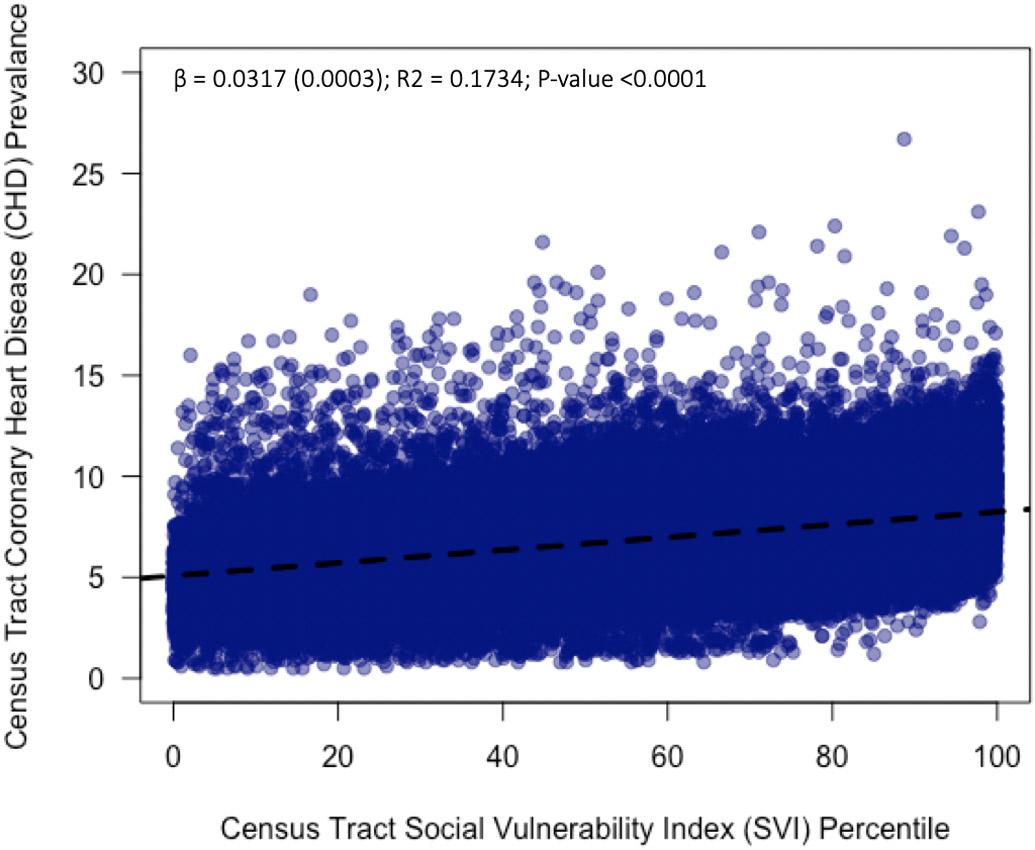
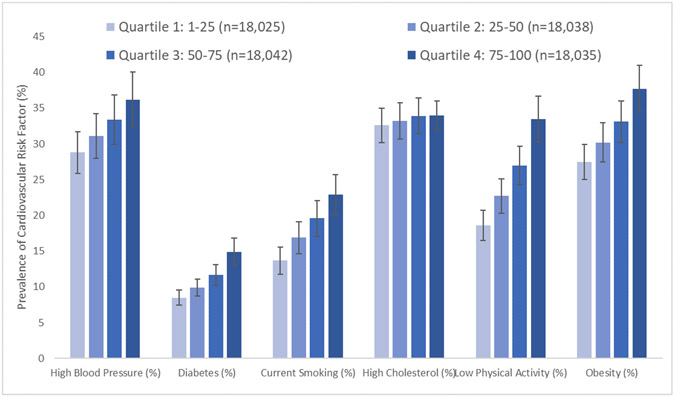
Social determinants of health are implicated in the geographic variation in cardiovascular diseases (CVDs). The social vulnerability index (SVI) is an estimate of a neighborhood's potential for deleterious outcomes when faced with natural disasters or disease outbreaks. We sought to investigate the association of the SVI with cardiovascular risk factors and the prevalence of coronary heart disease (CHD) in the United States at the census tract level. We linked census tract SVI with prevalence of census tract CVD risk factors (smoking, high cholesterol, diabetes, high blood pressure, low physical activity and obesity), and prevalence of CHD obtained from the behavioral risk factor surveillance system. We evaluated the association between SVI, its sub-scales, CVD risk factors and CHD prevalence using linear regression. Among 72,173 census tracts, prevalence of all cardiovascular risk factors increased linearly with SVI. A higher SVI was associated with a higher CHD prevalence (R = 0.17, P < 0.0001). The relationship between SVI and CHD was stronger when accounting for census-tract median age (R = 0.57, P < 0.0001). A multivariable linear regression model including 4 SVI themes separately explained considerably more variation in CHD prevalence than the composite SVI alone (50.0% vs 17.3%). Socioeconomic status and household composition and disability were the SVI themes most closely associated with cardiovascular risk factors and CHD prevalence. In the United States, social vulnerability can explain significant portion of geographic variation in CHD, and its risk factors. Neighborhoods with high social vulnerability are at disproportionately increased risk of CHD and its risk factors. Social determinants of health are implicated in the geographic variation in cardiovascular diseases (CVDs). We investigated the association of social vulnerability index (SVI) with cardiovascular risk factors and the prevalence of coronary heart disease (CHD) in the United States at the census tract level. We show that cardiovascular risk factors and CHD were more common with higher SVI. A multivariable linear regression model including 4 SVI themes separately explained considerably more variation in CHD prevalence than the composite SVI alone (50.0% vs 17.3%). Socioeconomic status and household composition and/or disability were the SVI themes most closely associated with cardiovascular risk factors and CHD prevalence.
社会决定因素与心血管疾病(CVD)的地理变异有关。社会脆弱性指数(SVI)是衡量社区在面临自然灾害或疾病爆发时可能产生不良后果的指标。我们试图调查 SVI 与美国普查区水平的心血管危险因素和冠心病(CHD)患病率之间的关联。我们将 SVI 与普查区 CVD 危险因素(吸烟、高胆固醇、糖尿病、高血压、体力活动不足和肥胖)的患病率以及从行为风险因素监测系统获得的 CHD 患病率联系起来。我们使用线性回归评估 SVI、其亚量表、CVD 危险因素和 CHD 患病率之间的关联。在 72,173 个普查区中,所有心血管危险因素的患病率均随 SVI 呈线性增加。较高的 SVI 与较高的 CHD 患病率相关(R=0.17,P<0.0001)。当考虑到普查区的中位数年龄时,SVI 与 CHD 之间的关系更强(R=0.57,P<0.0001)。一个包含 4 个 SVI 主题的多变量线性回归模型单独解释了 CHD 患病率的变化,比仅包含 SVI 复合模型解释的变化要多得多(50.0% 比 17.3%)。社会经济地位、家庭构成和残疾是与心血管危险因素和 CHD 患病率最密切相关的 SVI 主题。在美国,社会脆弱性可以解释 CHD 及其危险因素的地理变异的重要部分。社会脆弱性高的社区患 CHD 及其危险因素的风险不成比例地增加。社会决定因素与心血管疾病(CVD)的地理变异有关。我们在普查区层面上调查了社会脆弱性指数(SVI)与美国心血管危险因素和冠心病(CHD)患病率的关系。我们表明,SVI 越高,心血管危险因素和 CHD 越常见。一个包含 4 个 SVI 主题的多变量线性回归模型单独解释了 CHD 患病率的变化,比仅包含 SVI 复合模型解释的变化要多得多(50.0% 比 17.3%)。社会经济地位和家庭构成和/或残疾是与心血管危险因素和 CHD 患病率最密切相关的 SVI 主题。