The First People's Hospital of Kashgar, No.66, Yingbin Avenue, Xinjiang, Kashgar, 844000, Kashgar City, China.
BMC Infect Dis. 2022 Mar 30;22(1):312. doi: 10.1186/s12879-022-07307-4.
Kashgar prefecture is an important transportation and trade hub with a high incidence of tuberculosis. The following study analyzed the composition and differences in Mycobacterium tuberculosis (M.tb) lineage and specific tags to distinguish the lineage of the M.tb in Kashgar prefecture, thus providing a basis for the classification and diagnosis of tuberculosis in this area.
Whole-genome sequencing (WGS) of 161 M.tb clinical strains was performed. The phylogenetic tree was constructed using Maximum Likelihood (ML) based on single nucleotide polymorphisms (SNPs) and verified through principal component analysis (PCA). The composition structure of M.tb in different regions was analyzed by combining geographic information.
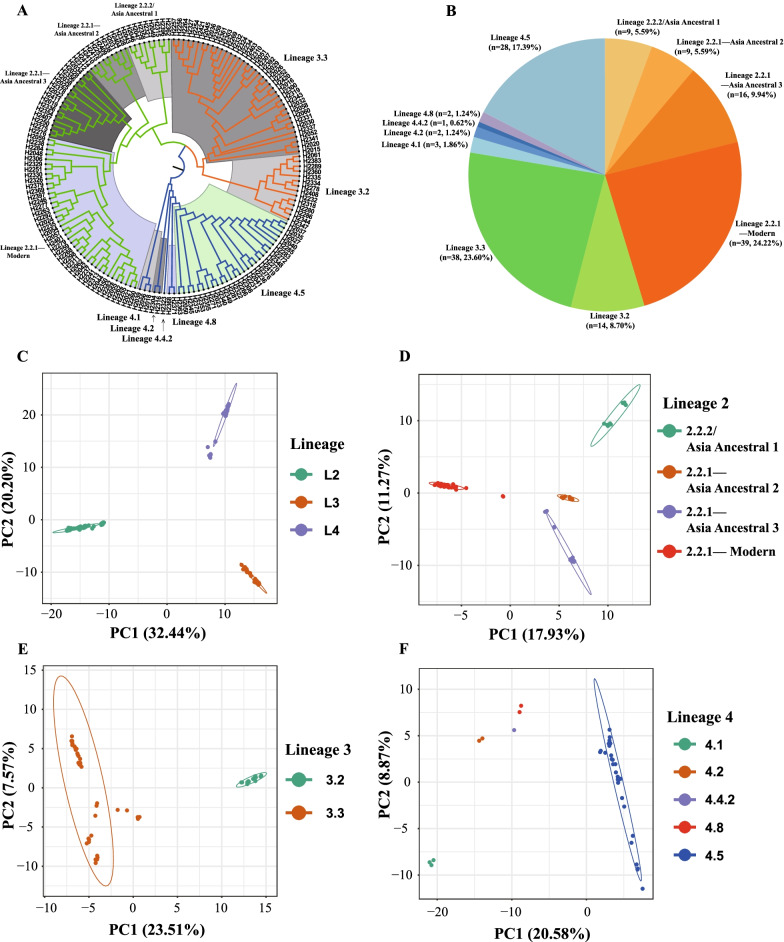
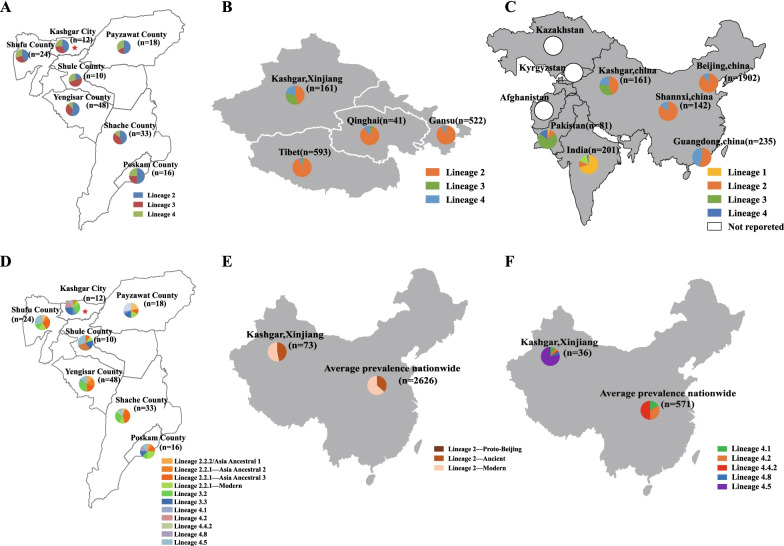
M.tb clinical strains were composed of lineage 2 (73/161, 45.34%), lineage 3 (52/161, 32.30%) and lineage 4 (36/161, 22.36%). Moreover, the 3 lineages were subdivided into 11 sublineages, among which lineage 2 included lineage 2.2.2/Asia Ancestral 1 (9/73, 12.33%), lineage 2.2.1-Asia Ancestral 2 (9/73, 12.33%), lineage 2.2.1-Asia Ancestral 3 (18/73, 24.66%), and lineage 2.2.1-Modern Beijing (39/73, 53.42%). Lineage 3 included lineage 3.2 (14/52, 26.92%) and lineage 3.3 (38/52, 73.08%), while lineage 4 included lineage 4.1 (3/36, 8.33%), lineage 4.2 (2/36, 5.66%), lineage 4.4.2 (1/36, 2.78%), lineage 4.5 (28/36, 77.78%) and lineage 4.8 (2/36, 5.66%), all of which were consistent with the PCA results. One hundred thirty-six markers were proposed for discriminating known circulating strains. Reconstruction of a phylogenetic tree using the 136 SNPs resulted in a tree with the same number of delineated clades. Based on geographical location analysis, the composition of Lineage 2 in Kashgar prefecture (45.34%) was lower compared to other regions in China (54.35%-90.27%), while the composition of Lineage 3 (32.30%) was much higher than in other regions of China (0.92%-2.01%), but lower compared to the bordering Pakistan (70.40%).
Three lineages were identified in M.tb clinical strains from Kashgar prefecture, with 136 branch-specific SNP. Kashgar borders with countries that have a high incidence of tuberculosis, such as Pakistan and India, which results in a large difference between the M.tb lineage and sublineage distribution in this region and other provinces of China.
喀什地区是重要的交通和贸易枢纽,结核病发病率较高。本研究旨在分析结核分枝杆菌(M.tb)谱系的组成和差异,以及特定的标记物,以区分喀什地区 M.tb 的谱系,从而为该地区结核病的分类和诊断提供依据。
对 161 株 M.tb 临床株进行全基因组测序(WGS)。基于单核苷酸多态性(SNPs)构建最大似然法(ML)的系统发育树,并通过主成分分析(PCA)进行验证。结合地理信息分析不同地区 M.tb 的组成结构。
M.tb 临床株由谱系 2(73/161,45.34%)、谱系 3(52/161,32.30%)和谱系 4(36/161,22.36%)组成。此外,这 3 个谱系进一步细分为 11 个亚谱系,其中谱系 2 包括谱系 2.2.2/亚洲祖先 1(9/73,12.33%)、谱系 2.2.1-亚洲祖先 2(9/73,12.33%)、谱系 2.2.1-亚洲祖先 3(18/73,24.66%)和谱系 2.2.1-现代北京(39/73,53.42%)。谱系 3 包括谱系 3.2(14/52,26.92%)和谱系 3.3(38/52,73.08%),而谱系 4 包括谱系 4.1(3/36,8.33%)、谱系 4.2(2/36,5.66%)、谱系 4.4.2(1/36,2.78%)、谱系 4.5(28/36,77.78%)和谱系 4.8(2/36,5.66%),均与 PCA 结果一致。提出了 136 个标记物用于区分已知的循环株。使用 136 个 SNPs 构建的系统发育树,得到了具有相同数量的划定分支的树。基于地理位置分析,喀什地区 M.tb 谱系 2(45.34%)的组成比例低于中国其他地区(54.35%-90.27%),而谱系 3(32.30%)的组成比例则远高于中国其他地区(0.92%-2.01%),但低于毗邻的巴基斯坦(70.40%)。
喀什地区 M.tb 临床株中发现了 3 个谱系,有 136 个分支特异性 SNP。喀什地区与结核病发病率较高的国家接壤,如巴基斯坦和印度,这导致该地区 M.tb 谱系和亚谱系的分布与中国其他省份存在很大差异。