Ming Lee Hwee, Chin Chan Soo, Yang Chung Tze, Suhaimi Anwar
Department of Rehabilitation Medicine, Taiping Hospital, Perak, Malaysia.
Department of Rehabilitation Medicine, Universiti Malaya, Kuala Lumpur, Malaysia.
Korean J Pain. 2022 Apr 1;35(2):191-201. doi: 10.3344/kjp.2022.35.2.191.
This study aimed to assess the efficacy of the adductor canal block (ACB) in comparison to intra-articular steroid-lidocaine injection (IASLI) to control chronic knee osteoarthritis (KOA) pain.
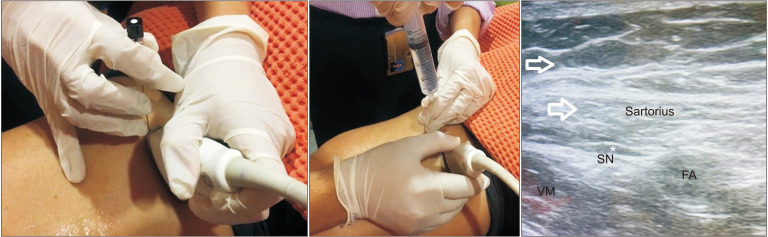
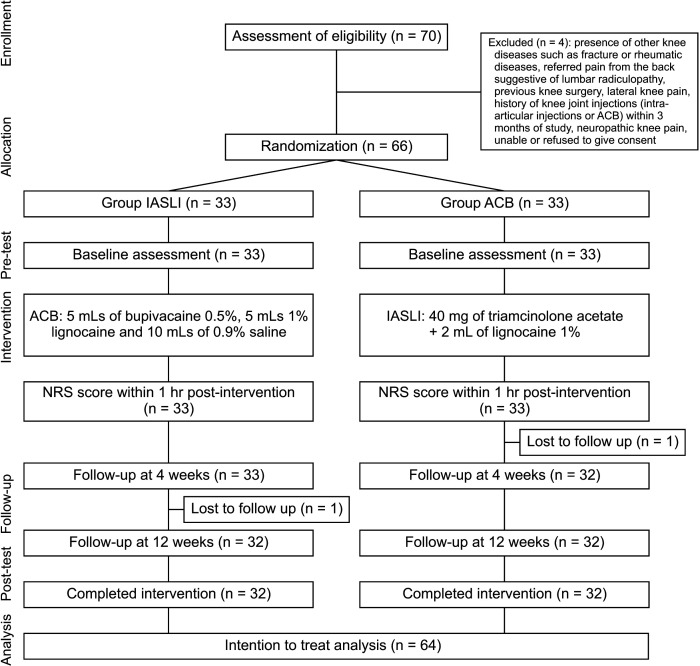
A randomized, single-blinded trial in an outpatient rehabilitation clinic recruiting chronic KOA with pain ≥ 6 months over one year. Following randomization, subjects received either a single ACB or IASLI under ultrasound guidance. Numerical rating scale (NRS) scores for pain, and Knee Injury and Osteoarthritis Outcome Scores (KOOS) were recorded at baseline, 1 hour, 1 month, and 3 months postinjection.
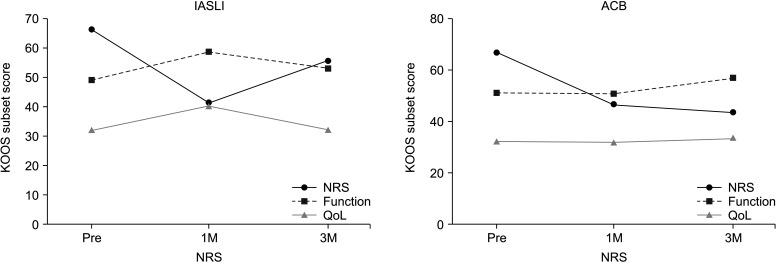
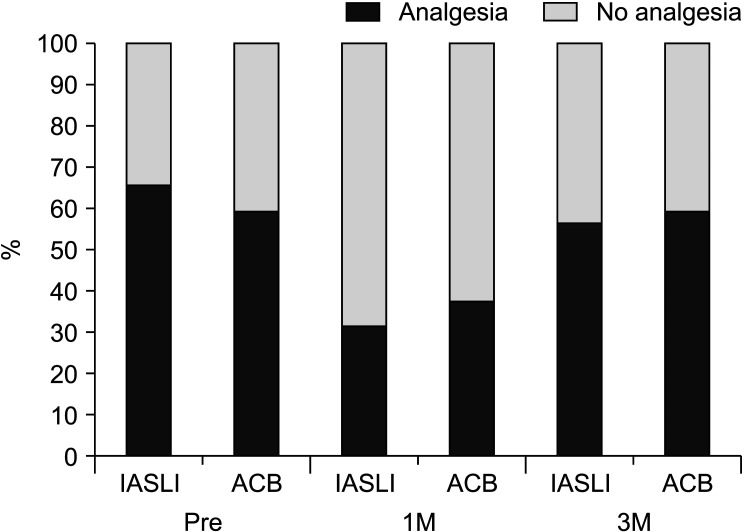
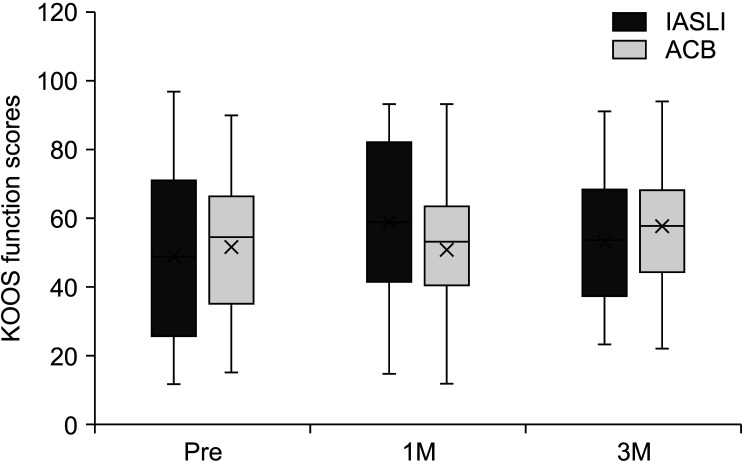
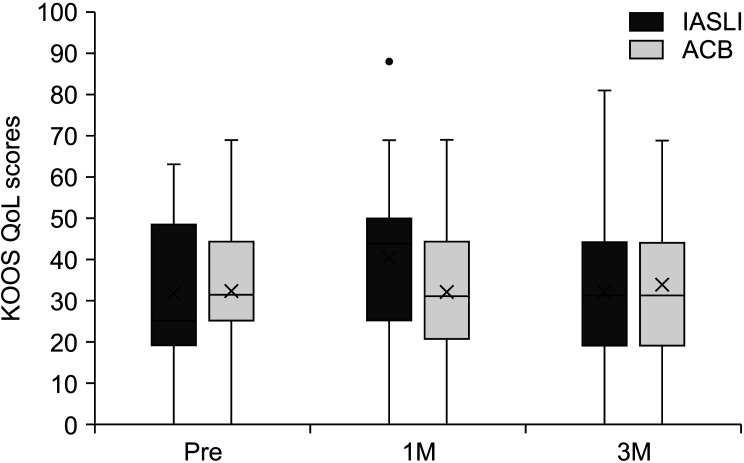
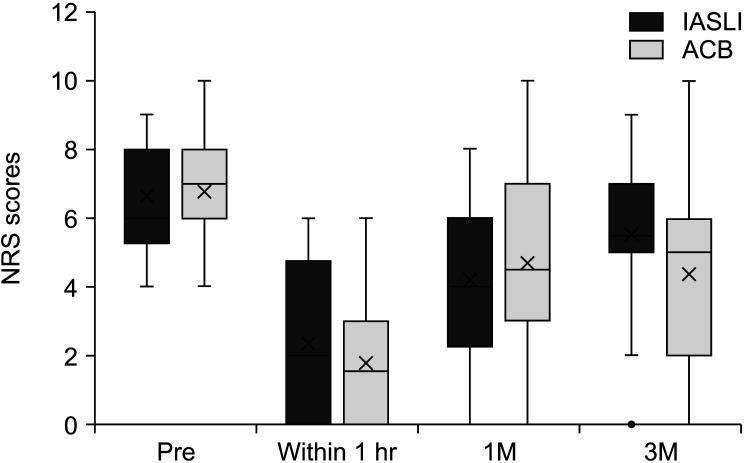
Sixty-six knees were recruited; 2 were lost to follow-up. Age was normally distributed ( = 0.463), with more female subjects in both arms ( = 0.564). NRS scores improved significantly for both arms at 1 hour, with better pain scores for the IASLI arm ( = 0.416) at 1st month and ACB arm at 3rd month ( = 0.077) with larger effect size (Cohen's d = 1.085). Lower limb function improved significantly in the IASLI arm at 1 month; the ACB subjects showed greater functional improvement at 3 months (Cohen's d = 0.3, = 0.346). Quality of life (QoL) improvement mirrored the functional scores whereby the IASLI group fared better at the 1st month ( = 0.071) but at the 3rd month the ACB group scored better (Cohen's d = 0.08, = 0.710).
ACB provides longer lasting analgesia which improves function and QoL in chronic KOA patients up to 3 months without any significant side effects.
本研究旨在评估内收肌管阻滞(ACB)与关节内注射类固醇-利多卡因(IASLI)相比,在控制慢性膝关节骨关节炎(KOA)疼痛方面的疗效。
在一家门诊康复诊所进行的一项随机、单盲试验,招募患有慢性KOA且疼痛≥6个月达一年以上的患者。随机分组后,受试者在超声引导下接受单次ACB或IASLI。在注射前基线、注射后1小时、1个月和3个月记录疼痛的数字评定量表(NRS)评分以及膝关节损伤和骨关节炎疗效评分(KOOS)。
共招募了66个膝关节;2例失访。年龄呈正态分布(P = 0.463),两组女性受试者均更多(P = 0.564)。两组在1小时时NRS评分均显著改善,IASLI组在第1个月疼痛评分更好(P = 0.416),ACB组在第3个月疼痛评分更好(P = 0.077),效应量更大(科恩d值 = 1.085)。IASLI组在1个月时下肢功能显著改善;ACB组受试者在3个月时功能改善更大(科恩d值 = 0.3, P = 0.346)。生活质量(QoL)改善情况与功能评分相似,IASLI组在第1个月表现更好(P = 0.071),但在第3个月ACB组得分更高(科恩d值 = 0.08, P = 0.710)。
ACB可提供更持久的镇痛效果,改善慢性KOA患者的功能和QoL长达3个月且无任何明显副作用。