Klinik und Poliklinik für Kardiologie, Universitätsklinikum Leipzig, Liebigstrasse 20, 04103, Leipzig, Germany.
Klinik und Poliklinik für Diagnostische und Interventionelle Radiologie, Universitätsklinikum Leipzig, Liebigstrasse 20, 04103, Leipzig, Germany.
Clin Res Cardiol. 2023 Mar;112(3):334-342. doi: 10.1007/s00392-022-02005-2. Epub 2022 Mar 31.
Cardiac magnetic resonance (CMR) with parametric mapping can improve the characterization of myocardial tissue. We studied the diagnostic value of native T1 mapping to detect cardiac amyloidosis in patients with left ventricular (LV) hypertrophy.
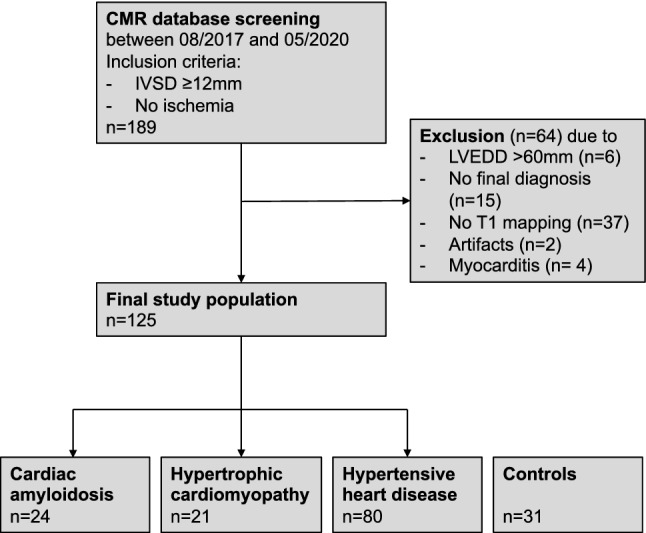
One hundred twenty-five patients with increased LV wall thickness (≥ 12 mm end-diastole) who received clinical CMR in a 3 T scanner between 2017 and 2020 were included. 31 subjects without structural heart disease served as controls. Native T1 was measured as global mean value from 3 LV short axis slices. The study was registered at German clinical trial registry (DRKS00022048).
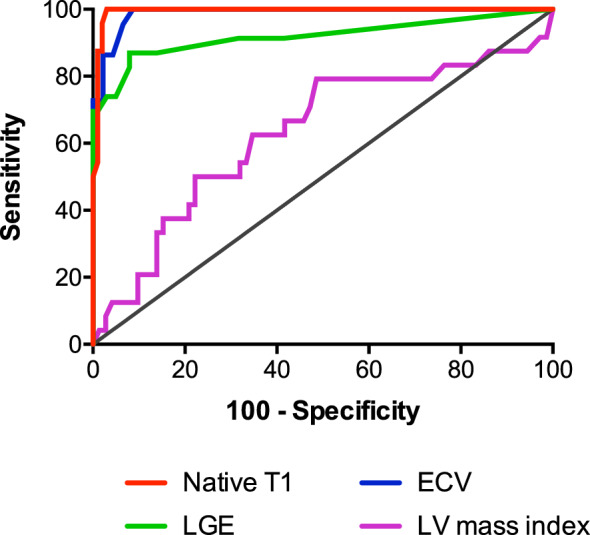
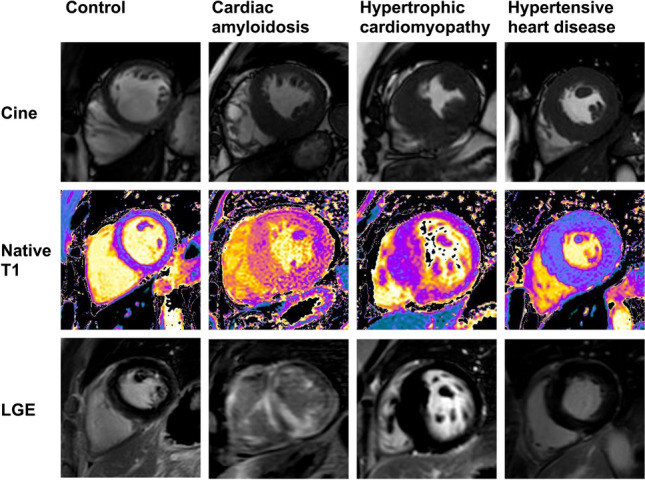
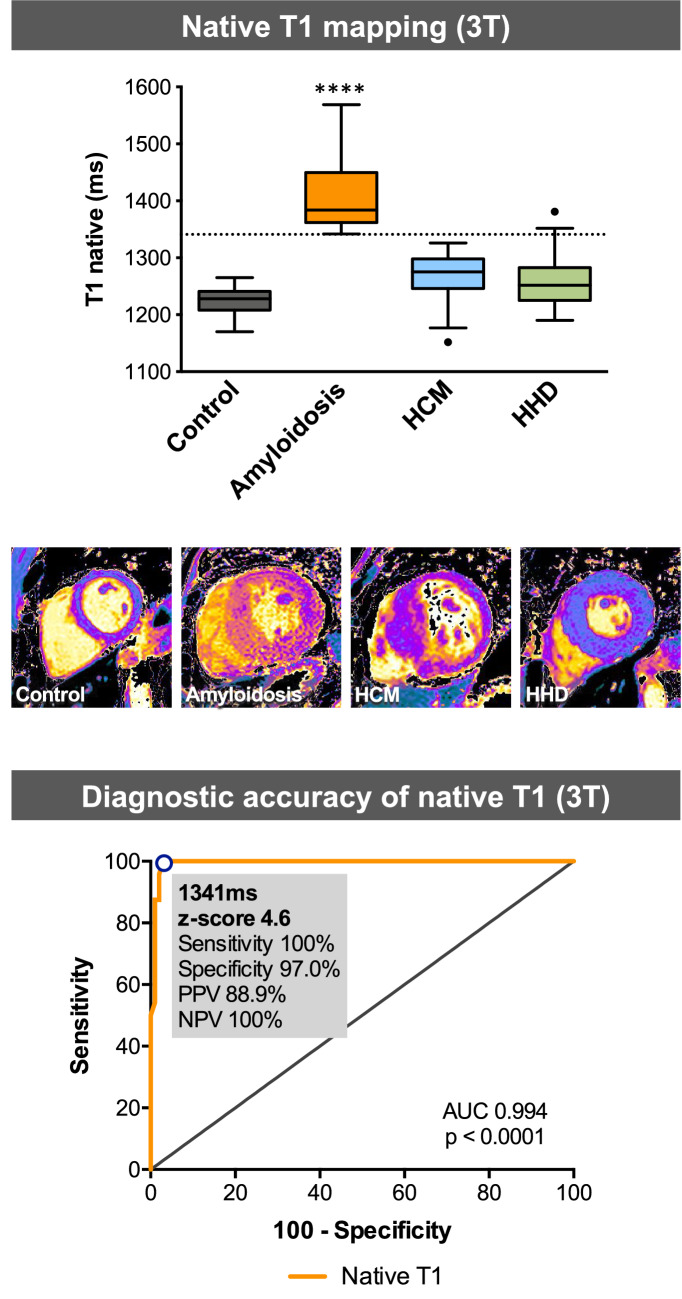
Mean age of the patients was 66 ± 14 years, 83% were males. CA was present in 24 patients, 21 patients had hypertrophic cardiomyopathy (HCM), 80 patients suffered from hypertensive heart disease (HHD). Native T1 times were higher in patients with CA (1409 ± 59 ms, p < 0.0001) compared to healthy controls (1225 ± 21 ms), HCM (1266 ± 44 ms) and HHD (1257 ± 41 ms). HCM and HHD patients did not differ in their native T1 times but were increased compared to control (p < 0.01). ROC analysis of native T1 demonstrated an area under the curve for the detection of CA vs. HCM and HHD of 0.9938 (p < 0.0001), which was higher than that of extracellular volume (0.9876) or quantitative late gadolinium enhancement (0.9406; both p < 0.0001). The optimal cut-off value of native T1 to diagnose CA was 1341 ms (sensitivity 100%, specificity 97%).
Non-contrast CMR imaging with native T1 mapping provides high diagnostic accuracy to diagnose cardiac amyloidosis in patients with left ventricular hypertrophy.
心脏磁共振(CMR)结合参数图可提高心肌组织特征描述的准确性。我们研究了心脏磁共振的心肌 T1 mapping 技术在诊断左心室肥厚患者心脏淀粉样变性中的作用。
2017 年至 2020 年期间,在 3T 扫描仪中进行临床 CMR 检查的 125 例左心室壁增厚(舒张末期≥12mm)的患者被纳入研究。31 例无结构性心脏病的患者作为对照组。从 3 个左心室短轴切片中测量整体平均 T1 值。该研究在德国临床试验注册中心(DRKS00022048)注册。
患者的平均年龄为 66±14 岁,83%为男性。24 例患者存在心脏淀粉样变性,21 例患者患有肥厚型心肌病(HCM),80 例患者患有高血压性心脏病(HHD)。与健康对照组(1225±21ms)、HCM(1266±44ms)和 HHD(1257±41ms)相比,心脏淀粉样变性患者的 T1 值更高(1409±59ms,p<0.0001)。HCM 和 HHD 患者的 T1 值无差异,但均高于对照组(p<0.01)。T1 值的 ROC 分析显示,用于检测心脏淀粉样变性与 HCM 和 HHD 的曲线下面积为 0.9938(p<0.0001),高于细胞外容积(0.9876)或定量延迟钆增强(0.9406;均 p<0.0001)。诊断心脏淀粉样变性的 T1 值最佳截断值为 1341ms(敏感性 100%,特异性 97%)。
非对比增强心脏磁共振成像 T1 mapping 可提供诊断左心室肥厚患者心脏淀粉样变性的高准确性。