Åstrand Laboratory, Department of Physiology, Nutrition and Biomechanics, The Swedish School of Sport and Health Sciences, GIH, Stockholm, Sweden.
Eur J Appl Physiol. 2022 Aug;122(8):1751-1772. doi: 10.1007/s00421-022-04935-1. Epub 2022 Mar 30.
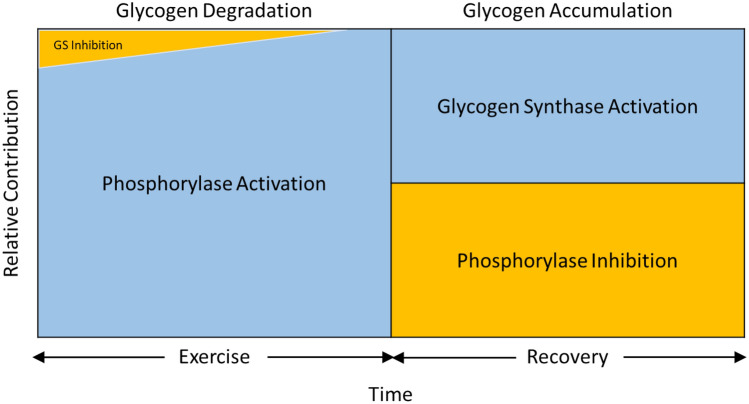
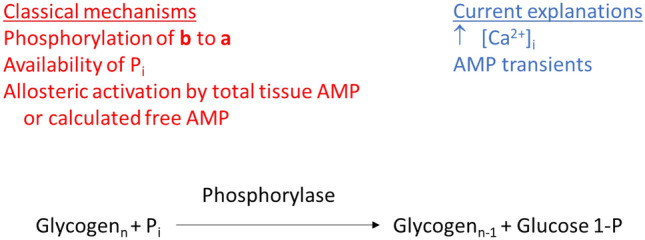
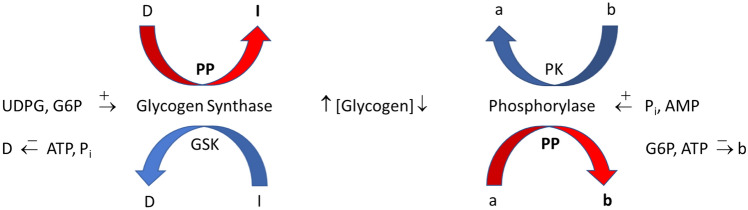
Glycogen is a branched, glucose polymer and the storage form of glucose in cells. Glycogen has traditionally been viewed as a key substrate for muscle ATP production during conditions of high energy demand and considered to be limiting for work capacity and force generation under defined conditions. Glycogenolysis is catalyzed by phosphorylase, while glycogenesis is catalyzed by glycogen synthase. For many years, it was believed that a primer was required for de novo glycogen synthesis and the protein considered responsible for this process was ultimately discovered and named glycogenin. However, the subsequent observation of glycogen storage in the absence of functional glycogenin raises questions about the true role of the protein. In resting muscle, phosphorylase is generally considered to be present in two forms: non-phosphorylated and inactive (phosphorylase b) and phosphorylated and constitutively active (phosphorylase a). Initially, it was believed that activation of phosphorylase during intense muscle contraction was primarily accounted for by phosphorylation of phosphorylase b (activated by increases in AMP) to a, and that glycogen synthesis during recovery from exercise occurred solely through mechanisms controlled by glucose transport and glycogen synthase. However, it now appears that these views require modifications. Moreover, the traditional roles of glycogen in muscle function have been extended in recent years and in some instances, the original concepts have undergone revision. Thus, despite the extensive amount of knowledge accrued during the past 100 years, several critical questions remain regarding the regulation of glycogen metabolism and its role in living muscle.
糖原是一种分支的葡萄糖聚合物,是细胞中葡萄糖的储存形式。糖原传统上被视为高能需求条件下肌肉 ATP 产生的关键底物,并且在定义条件下被认为是工作能力和力量产生的限制因素。糖原分解由磷酸化酶催化,而糖原合成由糖原合酶催化。多年来,人们一直认为从头合成糖原需要引物,负责这个过程的蛋白质最终被发现并命名为糖原蛋白。然而,随后观察到在没有功能性糖原蛋白的情况下储存糖原,这引发了关于该蛋白质真实作用的问题。在休息的肌肉中,磷酸化酶通常被认为存在两种形式:非磷酸化和无活性(磷酸化酶 b)和磷酸化和组成性激活(磷酸化酶 a)。最初,人们认为在剧烈的肌肉收缩过程中磷酸化酶的激活主要是由于磷酸化酶 b 的磷酸化(由 AMP 的增加激活)到 a,并且运动恢复期间的糖原合成仅通过葡萄糖转运和糖原合酶控制的机制发生。然而,现在看来,这些观点需要修改。此外,近年来,糖原在肌肉功能中的传统作用已经扩展,在某些情况下,原始概念已经经过修订。因此,尽管在过去的 100 年中积累了大量的知识,但关于糖原代谢的调节及其在活体肌肉中的作用仍存在几个关键问题。