Du Rui, Han Ruili, Niu Kun, Xu Jiaqiao, Zhao Zihou, Lu Guofang, Shang Yulong
Institute for Biomedical Sciences of Pain, Tangdu Hospital, Fourth Military Medical University, Xi'an, China.
Department of Anaesthesiology, Tangdu Hospital, Fourth Military Medical University, Xi'an, China.
Front Psychiatry. 2022 Mar 9;13:813103. doi: 10.3389/fpsyt.2022.813103. eCollection 2022.
Post-traumatic stress disorder (PTSD) is a serious stress-related disorder caused by traumatic experiences. However, identifying a key therapy that can be used for PTSD treatment remains difficult. Ketamine, a well-known dissociative anesthetic, is considered safe to be used in anesthesia, pain management, and antidepressant actions since 1970. At present, it is still controversial whether PTSD can be treated with ketamine. The authors performed a meta-analysis to determine whether the use of perioperative ketamine lowers the incidence of PTSD.
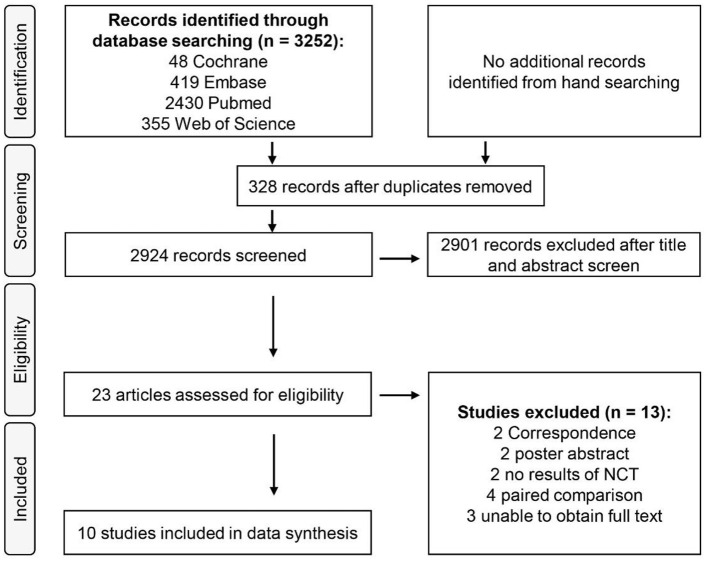
Cochrane Central Register of Controlled Trials, Embase, PubMed, and Web of Science were searched to examine the use of ketamine for the treatment of PTSD among soldiers with combating experience. Studies were included if they were randomized placebo-controlled, case-control, and cohort studies. The primary outcome was the incidence of PTSD in the later stage of the wounded or burn soldiers. The secondary outcome was the influence of ketamine on PTSD-scale scores for early and chronic PTSD, respectively.
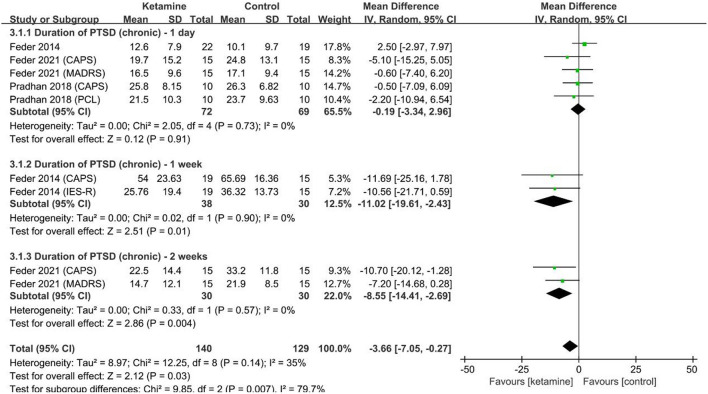
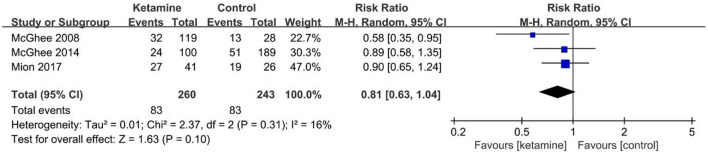
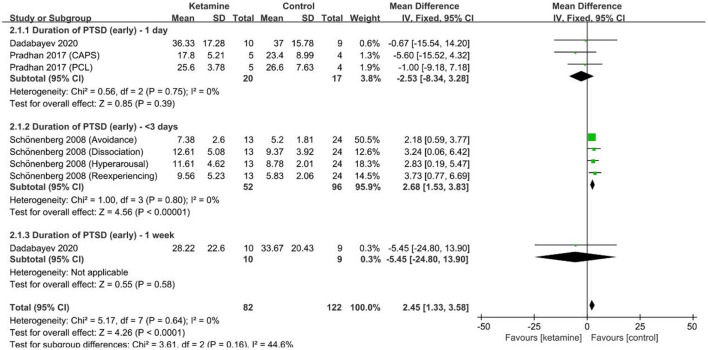
Our search yielded a total of three studies ( = 503 patients) comparing the use of ketamine ( = 349) to control ( = 154). The available evidence showed no significant difference in the incidence of PTSD between combatant soldiers on the battlefield with or without ketamine treatment (risk ratio = 0.81, 95% CI, 0.63-1.04; = 0.10). In 65 patients from three trials, ketamine was not only ineffective in treating early PTSD but also lead to exacerbation of the disease (risk ratio = 2.45, 95% CI, 1.33-3.58; < 0.001). However, in 91 patients from the other three trials, ketamine is effective in treating chronic PTSD (risk ratio = -3.66, 95% CI, -7.05 to -0.27; = 0.03).
Ketamine was not effective on lower the PTSD incidence for soldiers on the battlefield, nor on the PTSD-scale scores in early PTSD patients. However, it may improve the PTSD-scale scores for chronic conditions.
https://www.crd.york.ac.uk/prospero/display_record.php?ID=CRD42021255516, PROSPERO, identifier: CRD42021255516.
创伤后应激障碍(PTSD)是一种由创伤经历引起的严重应激相关障碍。然而,确定一种可用于PTSD治疗的关键疗法仍然困难。氯胺酮是一种著名的解离麻醉剂,自1970年以来被认为在麻醉、疼痛管理和抗抑郁作用方面使用安全。目前,氯胺酮是否可用于治疗PTSD仍存在争议。作者进行了一项荟萃分析,以确定围手术期使用氯胺酮是否能降低PTSD的发生率。
检索Cochrane对照试验中央登记库、Embase、PubMed和科学网,以研究氯胺酮在有战斗经历的士兵中治疗PTSD的应用。纳入的研究需为随机安慰剂对照、病例对照和队列研究。主要结局是受伤或烧伤士兵后期PTSD的发生率。次要结局是氯胺酮分别对早期和慢性PTSD的PTSD量表评分的影响。
我们的检索共得到三项研究(n = 503例患者),比较了氯胺酮(n = 349)与对照组(n = 154)的使用情况。现有证据表明,战场上接受或未接受氯胺酮治疗的参战士兵中,PTSD的发生率没有显著差异(风险比 = 0.81,95%CI,0.63 - 1.04;P = 0.10)。在三项试验的65例患者中,氯胺酮不仅对治疗早期PTSD无效,而且导致疾病恶化(风险比 = 2.45,95%CI,1.33 - 3.58;P < 0.001)。然而,在另外三项试验的91例患者中,氯胺酮对治疗慢性PTSD有效(风险比 = -3.66,95%CI,-7.05至-0.27;P = 0.03)。
氯胺酮对降低战场上士兵的PTSD发生率无效,对早期PTSD患者的PTSD量表评分也无效。然而,它可能会改善慢性PTSD患者的PTSD量表评分。