• 文献检索
  • 文档翻译
  • 深度研究
  • 学术资讯
  • Suppr Zotero 插件Zotero 插件
  • 邀请有礼
  • 套餐&价格
  • 历史记录
应用&插件
Suppr Zotero 插件Zotero 插件浏览器插件Mac 客户端Windows 客户端微信小程序
定价
高级版会员购买积分包购买API积分包
服务
文献检索文档翻译深度研究API 文档MCP 服务
关于我们
关于 Suppr公司介绍联系我们用户协议隐私条款
关注我们

Suppr 超能文献

核心技术专利:CN118964589B侵权必究
粤ICP备2023148730 号-1Suppr @ 2026

文献检索

告别复杂PubMed语法,用中文像聊天一样搜索,搜遍4000万医学文献。AI智能推荐,让科研检索更轻松。

立即免费搜索

文件翻译

保留排版,准确专业,支持PDF/Word/PPT等文件格式,支持 12+语言互译。

免费翻译文档

深度研究

AI帮你快速写综述,25分钟生成高质量综述,智能提取关键信息,辅助科研写作。

立即免费体验

移动应用程序在心力衰竭自我管理中的应用:实验性和定性研究的系统评价

The Use of Mobile Apps for Heart Failure Self-management: Systematic Review of Experimental and Qualitative Studies.

作者信息

Bezerra Giordan Leticia, Tong Huong Ly, Atherton John J, Ronto Rimante, Chau Josephine, Kaye David, Shaw Tim, Chow Clara, Laranjo Liliana

机构信息

Westmead Applied Research Centre, Faculty of Medicine and Health, University of Sydney, Sydney, Australia.

Department of Health Sciences, Macquarie University, Sydney, Australia.

出版信息

JMIR Cardio. 2022 Mar 31;6(1):e33839. doi: 10.2196/33839.

DOI:10.2196/33839
PMID:35357311
原文链接:https://pmc.ncbi.nlm.nih.gov/articles/PMC9015755/
Abstract

BACKGROUND

Heart failure self-management is essential to avoid decompensation and readmissions. Mobile apps seem promising in supporting heart failure self-management, and there has been a rapid growth in publications in this area. However, to date, systematic reviews have mostly focused on remote monitoring interventions using nonapp types of mobile technologies to transmit data to health care providers, rarely focusing on supporting patient self-management of heart failure.

OBJECTIVE

This study aims to systematically review the evidence on the effect of heart failure self-management apps on health outcomes, patient-reported outcomes, and patient experience.

METHODS

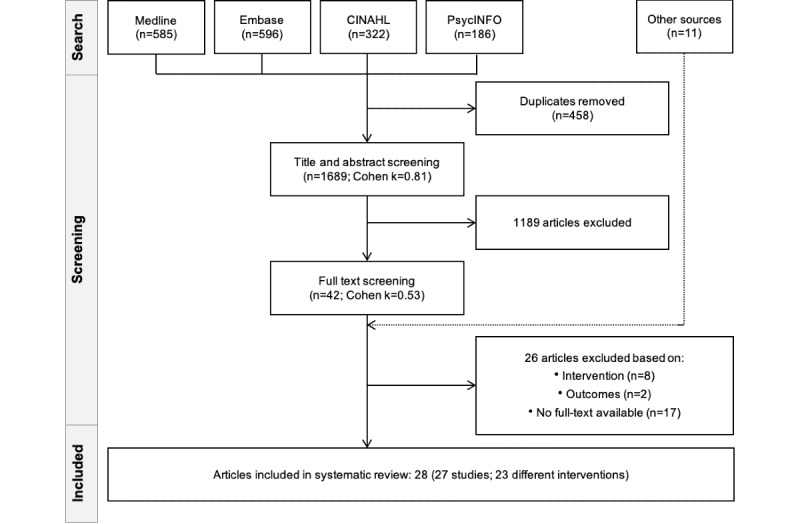
Four databases (PubMed, Embase, CINAHL, and PsycINFO) were searched for studies examining interventions that comprised a mobile app targeting heart failure self-management and reported any health-related outcomes or patient-reported outcomes or perspectives published from 2008 to December 2021. The studies were independently screened. The risk of bias was appraised using Cochrane tools. We performed a narrative synthesis of the results. The protocol was registered on PROSPERO (International Prospective Register of Systematic Reviews; CRD42020158041).

RESULTS

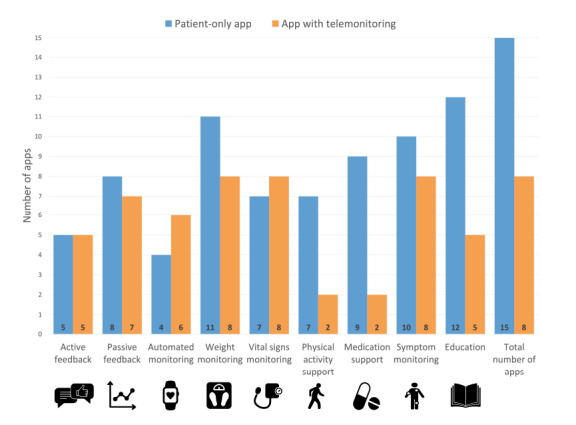
A total of 28 articles (randomized controlled trials [RCTs]: n=10, 36%), assessing 23 apps, and a total of 1397 participants were included. The most common app features were weight monitoring (19/23, 83%), symptom monitoring (18/23, 78%), and vital sign monitoring (15/23, 65%). Only 26% (6/23) of the apps provided all guideline-defined core components of heart failure self-management programs: education, symptom monitoring, medication support, and physical activity support. RCTs were small, involving altogether 717 participants, had ≤6 months of follow-up, and outcomes were predominantly self-reported. Approximately 20% (2/10) of RCTs reported a significant improvement in their primary outcomes: heart failure knowledge (P=.002) and self-care (P=.004). One of the RCTs found a significant reduction in readmissions (P=.02), and 20% (2/10) of RCTs reported higher unplanned clinic visits. Other experimental studies also found significant improvements in knowledge, self-care, and readmissions, among others. Less than half of the studies involved patients and clinicians in the design of apps. Engagement with the intervention was poorly reported, with only 11% (3/28) of studies quantifying app engagement metrics such as frequency of use over the study duration. The most desirable app features were automated self-monitoring and feedback, personalization, communication with clinicians, and data sharing and integration.

CONCLUSIONS

Mobile apps may improve heart failure self-management; however, more robust evaluation studies are needed to analyze key end points for heart failure. On the basis of the results of this review, we provide a road map for future studies in this area.

摘要

背景

心力衰竭自我管理对于避免失代偿和再入院至关重要。移动应用程序在支持心力衰竭自我管理方面似乎很有前景,并且该领域的出版物数量迅速增长。然而,迄今为止,系统评价大多集中在使用非应用类型的移动技术进行远程监测干预,以将数据传输给医疗保健提供者,很少关注支持患者对心力衰竭的自我管理。

目的

本研究旨在系统评价心力衰竭自我管理应用程序对健康结局、患者报告结局和患者体验影响的证据。

方法

检索了四个数据库(PubMed、Embase、CINAHL和PsycINFO),以查找研究针对心力衰竭自我管理的移动应用程序干预措施并报告2008年至2021年12月期间发表的任何健康相关结局、患者报告结局或观点的研究。对这些研究进行独立筛选。使用Cochrane工具评估偏倚风险。我们对结果进行了叙述性综合分析。该方案已在PROSPERO(国际系统评价前瞻性注册库;CRD42020158041)上注册。

结果

共纳入28篇文章(随机对照试验[RCT]:n = 10,36%),评估了23个应用程序,共有1397名参与者。最常见的应用程序功能是体重监测(19/23,83%)、症状监测(18/23,78%)和生命体征监测(15/23,65%)。只有26%(6/23)的应用程序提供了心力衰竭自我管理计划的所有指南定义的核心组成部分:教育、症状监测、药物支持和身体活动支持。随机对照试验规模较小,总共涉及717名参与者,随访时间≤6个月,结局主要是自我报告的。大约20%(2/10)的随机对照试验报告其主要结局有显著改善:心力衰竭知识(P = .002)和自我护理(P = .004)。其中一项随机对照试验发现再入院率显著降低(P = .02),20%(2/10)的随机对照试验报告计划外门诊就诊次数增加。其他实验研究也发现知识、自我护理和再入院等方面有显著改善。不到一半的研究让患者和临床医生参与应用程序的设计。对干预措施的参与情况报告不佳,只有11%(3/28)的研究对应用程序参与指标进行了量化,如研究期间的使用频率。最理想的应用程序功能是自动自我监测和反馈、个性化、与临床医生沟通以及数据共享和整合。

结论

移动应用程序可能会改善心力衰竭自我管理;然而,需要更有力的评估研究来分析心力衰竭的关键终点。基于本综述的结果,我们为该领域的未来研究提供了路线图。
https://cdn.ncbi.nlm.nih.gov/pmc/blobs/0e22/9015755/8d000532a26c/cardio_v6i1e33839_fig2.jpg
https://cdn.ncbi.nlm.nih.gov/pmc/blobs/0e22/9015755/ca43e289b1bf/cardio_v6i1e33839_fig1.jpg
https://cdn.ncbi.nlm.nih.gov/pmc/blobs/0e22/9015755/8d000532a26c/cardio_v6i1e33839_fig2.jpg
https://cdn.ncbi.nlm.nih.gov/pmc/blobs/0e22/9015755/ca43e289b1bf/cardio_v6i1e33839_fig1.jpg
https://cdn.ncbi.nlm.nih.gov/pmc/blobs/0e22/9015755/8d000532a26c/cardio_v6i1e33839_fig2.jpg

相似文献

1
The Use of Mobile Apps for Heart Failure Self-management: Systematic Review of Experimental and Qualitative Studies.移动应用程序在心力衰竭自我管理中的应用:实验性和定性研究的系统评价
JMIR Cardio. 2022 Mar 31;6(1):e33839. doi: 10.2196/33839.
2
Use of Mobile Apps in Heart Failure Self-management: Qualitative Study Exploring the Patient and Primary Care Clinician Perspective.移动应用程序在心力衰竭自我管理中的应用:探索患者和初级保健临床医生观点的定性研究
JMIR Cardio. 2022 Apr 20;6(1):e33992. doi: 10.2196/33992.
3
Mobile Apps to Improve Medication Adherence in Cardiovascular Disease: Systematic Review and Meta-analysis.移动应用程序改善心血管疾病患者的药物依从性:系统评价和荟萃分析。
J Med Internet Res. 2021 May 25;23(5):e24190. doi: 10.2196/24190.
4
Smartphone and tablet self management apps for asthma.用于哮喘的智能手机和平板电脑自我管理应用程序。
Cochrane Database Syst Rev. 2013 Nov 27;2013(11):CD010013. doi: 10.1002/14651858.CD010013.pub2.
5
Mobile Phone Apps to Support Heart Failure Self-Care Management: Integrative Review.支持心力衰竭自我护理管理的手机应用程序:综合综述。
JMIR Cardio. 2018 May 2;2(1):e10057. doi: 10.2196/10057.
6
Review and Analysis of Existing Mobile Phone Apps to Support Heart Failure Symptom Monitoring and Self-Care Management Using the Mobile Application Rating Scale (MARS).使用移动应用程序评分量表(MARS)对支持心力衰竭症状监测和自我护理管理的现有手机应用程序进行回顾与分析。
JMIR Mhealth Uhealth. 2016 Jun 14;4(2):e74. doi: 10.2196/mhealth.5882.
7
Use of Mobile Apps for Self-care in People With Parkinson Disease: Systematic Review.使用移动应用程序进行帕金森病患者的自我护理:系统评价。
JMIR Mhealth Uhealth. 2022 Jan 21;10(1):e33944. doi: 10.2196/33944.
8
Effectiveness of Mobile Apps to Promote Health and Manage Disease: Systematic Review and Meta-analysis of Randomized Controlled Trials.移动应用程序在促进健康和疾病管理方面的有效性:随机对照试验的系统评价和荟萃分析。
JMIR Mhealth Uhealth. 2021 Jan 11;9(1):e21563. doi: 10.2196/21563.
9
The Use of Dietary Approaches to Stop Hypertension (DASH) Mobile Apps for Supporting a Healthy Diet and Controlling Hypertension in Adults: Systematic Review.使用饮食方法预防高血压(DASH)移动应用程序支持成人健康饮食和控制高血压:系统评价
JMIR Cardio. 2022 Nov 2;6(2):e35876. doi: 10.2196/35876.
10
The Effectiveness of Self-Management Mobile Phone and Tablet Apps in Long-term Condition Management: A Systematic Review.自我管理手机和平板应用程序在长期疾病管理中的有效性:一项系统综述。
J Med Internet Res. 2016 May 16;18(5):e97. doi: 10.2196/jmir.4883.

引用本文的文献

1
Device-based Strategies for Monitoring Congestion and Guideline-directed Therapy in Heart Failure: The Who, When and How of Personalised Care.用于监测心力衰竭充血情况及指导治疗的基于设备的策略:个性化护理的对象、时机和方式。
Card Fail Rev. 2025 May 13;11:e11. doi: 10.15420/cfr.2025.01. eCollection 2025.
2
Digital health intervention to imise eart ailure management after hospital discharge in Brazil (OPT-HF): a randomised clinical trial protocol.巴西出院后优化心力衰竭管理的数字健康干预措施(OPT-HF):一项随机临床试验方案。
BMJ Open. 2025 Apr 17;15(4):e091046. doi: 10.1136/bmjopen-2024-091046.
3
Perception and Evaluation of a Knowledge Transfer Concept in a Digital Health Application for Patients With Heart Failure: Mixed Methods Study.

本文引用的文献

1
Smartphone-Delivered Ecological Momentary Interventions Based on Ecological Momentary Assessments to Promote Health Behaviors: Systematic Review and Adapted Checklist for Reporting Ecological Momentary Assessment and Intervention Studies.基于生态瞬时评估的智能手机推送的生态瞬时干预措施,以促进健康行为:系统评价和报告生态瞬时评估和干预研究的适应性清单。
JMIR Mhealth Uhealth. 2021 Nov 19;9(11):e22890. doi: 10.2196/22890.
2
Predictive performance and impact of algorithms in remote monitoring of chronic conditions: A systematic review and meta-analysis.预测算法在慢性病远程监测中的性能和影响:系统评价和荟萃分析。
Int J Med Inform. 2021 Dec;156:104620. doi: 10.1016/j.ijmedinf.2021.104620. Epub 2021 Oct 16.
3
心力衰竭患者数字健康应用中知识转移概念的认知与评估:混合方法研究
JMIR Hum Factors. 2025 Mar 31;12:e56798. doi: 10.2196/56798.
4
The effectiveness of nursing interventions to improve self-care for patients with heart failure at home: a systematic review and meta-analysis.在家中改善心力衰竭患者自我护理的护理干预措施的有效性:一项系统评价和荟萃分析。
BMC Nurs. 2025 Mar 14;24(1):286. doi: 10.1186/s12912-025-02867-7.
5
Effect of Telemedicine Interventions on Heart Failure Hospitalizations: A Randomized Trial.远程医疗干预对心力衰竭住院治疗的影响:一项随机试验。
J Am Heart Assoc. 2025 Mar 18;14(6):e036241. doi: 10.1161/JAHA.124.036241. Epub 2025 Mar 7.
6
Remote monitoring and heart failure.远程监测与心力衰竭
Eur Heart J Suppl. 2025 Feb 19;27(Suppl 1):i126-i131. doi: 10.1093/eurheartjsupp/suae116. eCollection 2025 Feb.
7
Digital Health Interventions for Atherosclerotic Cardiovascular Disease: The Current Impact and Future Directions for Prevention and Management.用于动脉粥样硬化性心血管疾病的数字健康干预措施:当前的影响以及预防和管理的未来方向
J Atheroscler Thromb. 2025 Apr 1;32(4):395-404. doi: 10.5551/jat.RV22032. Epub 2025 Jan 31.
8
Standardized assessment of evidence supporting the adoption of mobile health solutions: A Clinical Consensus Statement of the ESC Regulatory Affairs Committee: Developed in collaboration with the European Heart Rhythm Association (EHRA), the Association of Cardiovascular Nursing & Allied Professions (ACNAP) of the ESC, the Heart Failure Association (HFA) of the ESC, the ESC Young Community, the ESC Working Group on e-Cardiology, the ESC Council for Cardiology Practice, the ESC Council of Cardio-Oncology, the ESC Council on Hypertension, the ESC Patient Forum, the ESC Digital Health Committee, and the European Association of Preventive Cardiology (EAPC).支持采用移动健康解决方案的证据的标准化评估:欧洲心脏病学会监管事务委员会的临床共识声明:与欧洲心律协会(EHRA)、欧洲心脏病学会心血管护理与相关专业协会(ACNAP)、欧洲心脏病学会心力衰竭协会(HFA)、欧洲心脏病学会青年社区、欧洲心脏病学会电子心脏病学工作组、欧洲心脏病学会心脏病学实践委员会、欧洲心脏病学会心脏肿瘤学委员会、欧洲心脏病学会高血压委员会、欧洲心脏病学会患者论坛、欧洲心脏病学会数字健康委员会以及欧洲预防心脏病学协会(EAPC)合作制定。
Eur Heart J Digit Health. 2024 Jun 4;5(5):509-523. doi: 10.1093/ehjdh/ztae042. eCollection 2024 Sep.
9
Exploring the barriers and facilitators experienced by patients with heart failure when using popular exergaming platforms for self-management-a systematic review.探索心力衰竭患者在使用流行的运动游戏平台进行自我管理时所经历的障碍和促进因素——一项系统综述
Digit Health. 2024 Jul 25;10:20552076241249823. doi: 10.1177/20552076241249823. eCollection 2024 Jan-Dec.
10
Evaluating a New Digital App-Based Program for Heart Health: Feasibility and Acceptability Pilot Study.评估一项基于数字应用程序的心脏健康新计划:可行性和可接受性试点研究。
JMIR Form Res. 2024 May 24;8:e50446. doi: 10.2196/50446.
Experiences of Using a Self-management Mobile App Among Individuals With Heart Failure: Qualitative Study.
心力衰竭患者使用自我管理移动应用程序的体验:定性研究
JMIR Nurs. 2021 Aug 9;4(3):e28139. doi: 10.2196/28139.
4
Mobile Health Self-management Interventions for Patients With Heart Failure: A Pilot Study.移动医疗自我管理干预心力衰竭患者:一项初步研究。
J Cardiovasc Nurs. 2022;37(5):E149-E159. doi: 10.1097/JCN.0000000000000846. Epub 2021 Aug 9.
5
The PRISMA 2020 statement: an updated guideline for reporting systematic reviews.PRISMA 2020 声明:系统评价报告的更新指南。
BMJ. 2021 Mar 29;372:n71. doi: 10.1136/bmj.n71.
6
Personalized mobile technologies for lifestyle behavior change: A systematic review, meta-analysis, and meta-regression.个性化移动技术在生活方式行为改变中的应用:系统评价、荟萃分析和荟萃回归。
Prev Med. 2021 Jul;148:106532. doi: 10.1016/j.ypmed.2021.106532. Epub 2021 Mar 24.
7
Proof-of-concept trial results of the HeartMan mobile personal health system for self-management in congestive heart failure.充血性心力衰竭自我管理的 HeartMan 移动个人健康系统的概念验证试验结果。
Sci Rep. 2021 Mar 11;11(1):5663. doi: 10.1038/s41598-021-84920-4.
8
A Personal Health System for Self-Management of Congestive Heart Failure (HeartMan): Development, Technical Evaluation, and Proof-of-Concept Randomized Controlled Trial.一种用于充血性心力衰竭自我管理的个人健康系统(HeartMan):开发、技术评估及概念验证随机对照试验
JMIR Med Inform. 2021 Mar 5;9(3):e24501. doi: 10.2196/24501.
9
Habits Heart App for Patient Engagement in Heart Failure Management: Pilot Feasibility Randomized Trial.Habits Heart 应用程序在心力衰竭管理中用于患者参与:试点可行性随机试验。
JMIR Mhealth Uhealth. 2021 Jan 20;9(1):e19465. doi: 10.2196/19465.
10
2020 ESC Guidelines for the diagnosis and management of atrial fibrillation developed in collaboration with the European Association for Cardio-Thoracic Surgery (EACTS): The Task Force for the diagnosis and management of atrial fibrillation of the European Society of Cardiology (ESC) Developed with the special contribution of the European Heart Rhythm Association (EHRA) of the ESC.2020年欧洲心脏病学会(ESC)与欧洲心胸外科学会(EACTS)合作制定的心房颤动诊断和管理指南:欧洲心脏病学会(ESC)心房颤动诊断和管理特别工作组,由ESC欧洲心律协会(EHRA)特别贡献制定。
Eur Heart J. 2021 Feb 1;42(5):373-498. doi: 10.1093/eurheartj/ehaa612.