Eye Hospital and School of Ophthalmology and Optometry, Wenzhou Medical University, Wenzhou, Zhejiang, China.
National Clinical Research Center for Ocular Diseases, Wenzhou, Zhejiang, China.
JAMA Ophthalmol. 2022 May 1;140(5):472-478. doi: 10.1001/jamaophthalmol.2022.0401.
Reducing myopia progression can reduce the risk of associated ocular pathologies.
To evaluate whether spectacle lenses with higher lenslet asphericity have a higher myopia control efficacy throughout 2 years.
DESIGN, SETTING, AND PARTICIPANTS: This double-masked randomized clinical trial was conducted between July 2018 and October 2020 at the Eye Hospital of Wenzhou Medical University in Wenzhou, China. Children aged 8 to 13 years with a cycloplegic spherical equivalent refraction (SER) of -0.75 D to -4.75 D and astigmatism with less than -1.50 D were recruited. A data and safety monitoring committee reviewed findings from a planned interim analysis in 2019.
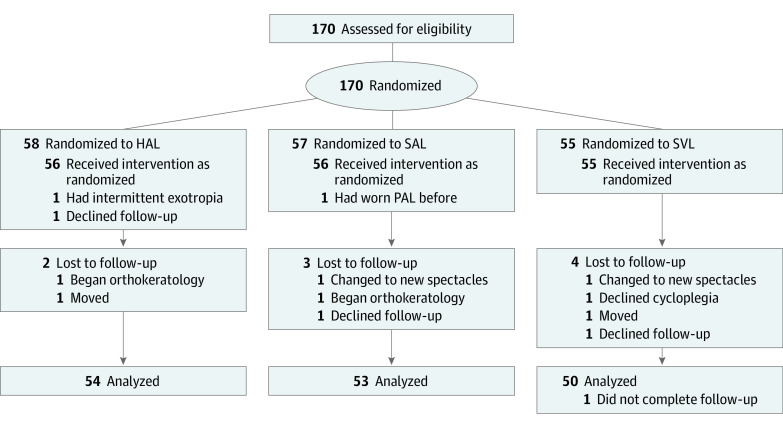
Participants were randomly assigned in a 1:1:1 ratio to receive spectacle lenses with highly aspherical lenslets (HAL), spectacle lenses with slightly aspherical lenslets (SAL), or single-vision spectacle lenses (SVL).
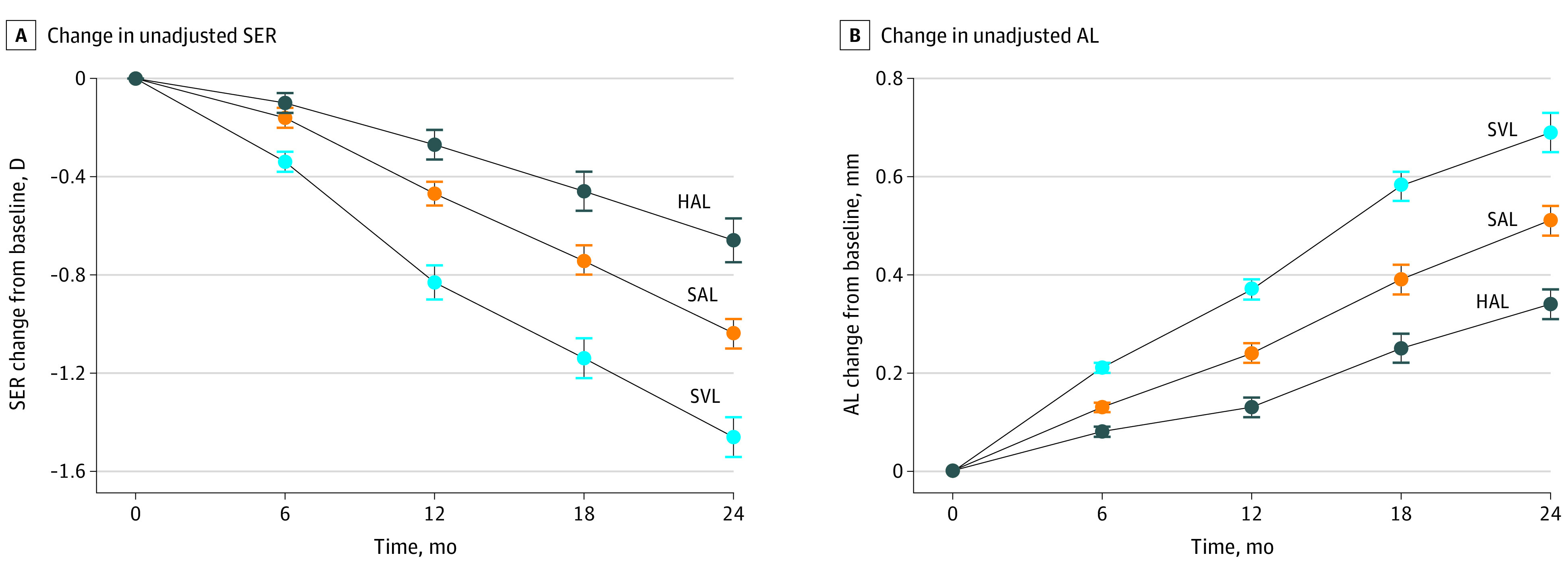
Two-year changes in SER and axial length and their differences between groups.
Of 157 participants who completed each visit (mean [SD] age, 10.4 [1.2] years), 54 were analyzed in the HAL group, 53 in the SAL group, and 50 in the SVL group. Mean (SE) 2-year myopia progression in the SVL group was 1.46 (0.09) D. Compared with SVL, the mean (SE) change in SER was less for HAL (by 0.80 [0.11] D) and SAL (by 0.42 [0.11] D; P ≤ .001). The mean (SE) increase in axial length was 0.69 (0.04) mm for SVL. Compared with SVL, increase in axial length was slowed by a mean (SE) of 0.35 (0.05) mm for HAL and 0.18 (0.05) mm for SAL (P ≤ .001). Compared with SVL, for children who wore HAL at least 12 hours every day, the mean (SE) change in SER was slowed by 0.99 (0.12) D, and increase in axial length slowed by 0.41 (0.05) mm.
In this study, HAL and SAL reduced the rate of myopia progression and axial elongation throughout 2 years, with higher efficacy for HAL. Longer wearing hours resulted in better myopia control efficacy for HAL.
Chinese Clinical Trial Registry Identifier: ChiCTR1800017683.
降低近视进展可以降低相关眼部疾病的风险。
评估透镜更高的透镜非球面度是否会在 2 年内提高近视控制效果。
设计、设置和参与者:这是一项 2018 年 7 月至 2020 年 10 月在中国温州医科大学附属眼视光医院进行的双盲随机临床试验。招募了年龄在 8 至 13 岁之间、散瞳球镜等效屈光度(SER)为-0.75 D 至-4.75 D 且散光小于-1.50 D 的儿童。数据和安全监测委员会在 2019 年对一项计划中的中期分析结果进行了审查。
参与者按照 1:1:1 的比例随机分配接受高度非球面透镜(HAL)、轻度非球面透镜(SAL)或单视光学镜片(SVL)的眼镜。
2 年 SER 和眼轴的变化及其组间差异。
157 名完成每次就诊的参与者(平均[标准差]年龄为 10.4[1.2]岁)中,54 名在 HAL 组、53 名在 SAL 组和 50 名在 SVL 组进行了分析。SVL 组 2 年近视进展的平均(SE)为 1.46(0.09)D。与 SVL 相比,HAL(减少 0.80[0.11]D)和 SAL(减少 0.42[0.11]D;P≤.001)的 SER 变化均值(SE)更小。SVL 眼轴平均(SE)增加 0.69(0.04)mm。与 SVL 相比,HAL 眼轴平均(SE)增加 0.35(0.05)mm,SAL 眼轴平均(SE)增加 0.18(0.05)mm,这两种情况均能减缓眼轴的增长(P≤.001)。对于每天至少佩戴 HAL 12 小时的儿童,与 SVL 相比,SER 的平均(SE)变化减慢了 0.99(0.12)D,眼轴增长减缓了 0.41(0.05)mm。
在这项研究中,HAL 和 SAL 在 2 年内降低了近视进展和眼轴伸长的速度,HAL 的效果更高。更长的佩戴时间使 HAL 对近视的控制效果更好。
中国临床试验注册中心标识符:ChiCTR1800017683。