Department of Cellular and Molecular Biophysics, Max-Planck Institute of Biochemistry, Martinsried, Germany.
Computational Systems Biochemistry Research Group, Max-Planck Institute of Biochemistry, Martinsried, Germany.
PLoS One. 2022 Mar 31;17(3):e0266395. doi: 10.1371/journal.pone.0266395. eCollection 2022.
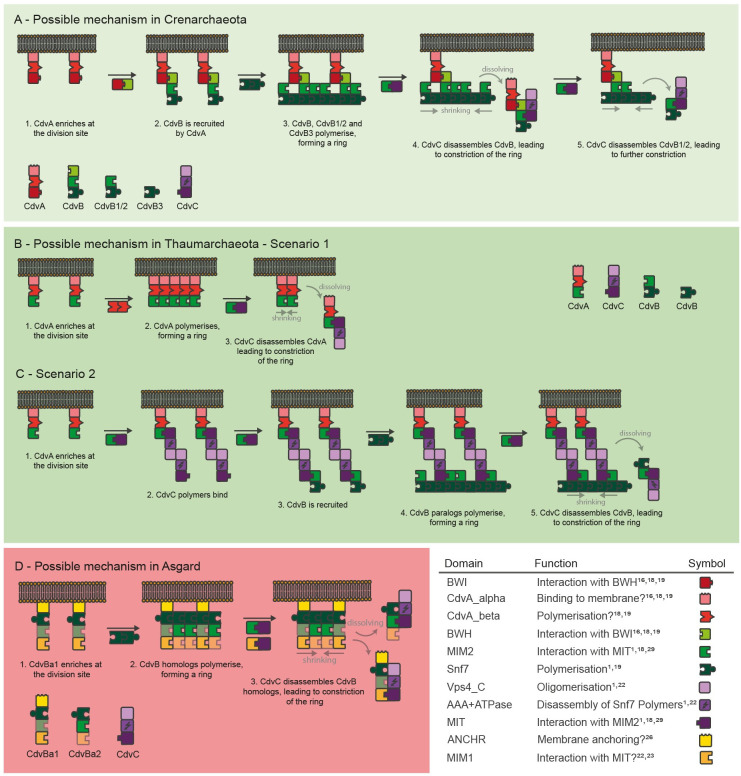
The Endosomal Sorting Complex Required for Transport (ESCRT) system is a multi-protein machinery that is involved in cell division of both Eukaryotes and Archaea. This spread across domains of life suggests that a precursor ESCRT machinery existed already at an evolutionary early stage of life, making it a promising candidate for the (re)construction of a minimal cell division machinery. There are, however, only few experimental data about ESCRT machineries in Archaea, due to high technical challenges in cultivation and microscopy. Here, we analyse the proteins of ESCRT machineries in archaea bioinformatically on a protein domain level, to enable mechanistical comparison without such challenging experiments. First, we infer that there are at least three different cell division mechanisms utilizing ESCRT proteins in archaea, probably similar in their constriction mechanisms but different in membrane tethering. Second, we show that ESCRT proteins in the archaeal super-phylum Asgard are highly similar to eukaryotic ESCRT proteins, strengthening the recently developed idea that all Eukaryotes descended from archaea. Third, we reconstruct a plausible evolutionary development of ESCRT machineries and suggest that a simple ESCRT-based constriction machinery existed in the last archaeal common ancestor. These findings not only give very interesting insights into the likely evolution of cell division in Archaea and Eukaryotes, but also offer new research avenues by suggesting hypothesis-driven experiments for both, cell biology and bottom-up synthetic biology.
内体分选复合物运输所需(ESCRT)系统是一种多蛋白机器,参与真核生物和古菌的细胞分裂。这种在生命领域的传播表明,在生命的早期进化阶段就已经存在前体 ESCRT 机器,这使其成为构建最小细胞分裂机器的有前途的候选者。然而,由于培养和显微镜技术的高挑战性,古菌中 ESCRT 机器的实验数据很少。在这里,我们在蛋白质结构域水平上对古菌中的 ESCRT 机器的蛋白质进行生物信息学分析,以便在没有这些具有挑战性的实验的情况下进行机械比较。首先,我们推断至少有三种不同的细胞分裂机制在古菌中利用 ESCRT 蛋白,其收缩机制可能相似,但膜连接方式不同。其次,我们表明古菌中超古菌门的 ESCRT 蛋白与真核 ESCRT 蛋白高度相似,这加强了最近提出的所有真核生物都起源于古菌的观点。第三,我们重建了 ESCRT 机器的合理进化发展,并提出在最后一个古菌共同祖先中存在一种简单的基于 ESCRT 的收缩机制。这些发现不仅为古菌和真核生物的细胞分裂可能进化提供了非常有趣的见解,而且还通过为细胞生物学和自下而上的合成生物学提供假设驱动的实验,为新的研究途径提供了建议。