de França Elias, Dos Santos Ronaldo V T, Baptista Liliana C, Da Silva Marco A R, Fukushima André R, Hirota Vinícius B, Martins Raul A, Caperuto Erico C
Human Movement Laboratory, São Judas University, São Paulo, Brazil.
Departamento de Biociências, Universidade Federal de São Paulo, São Paulo, Brazil.
Front Physiol. 2022 Mar 10;13:843784. doi: 10.3389/fphys.2022.843784. eCollection 2022.
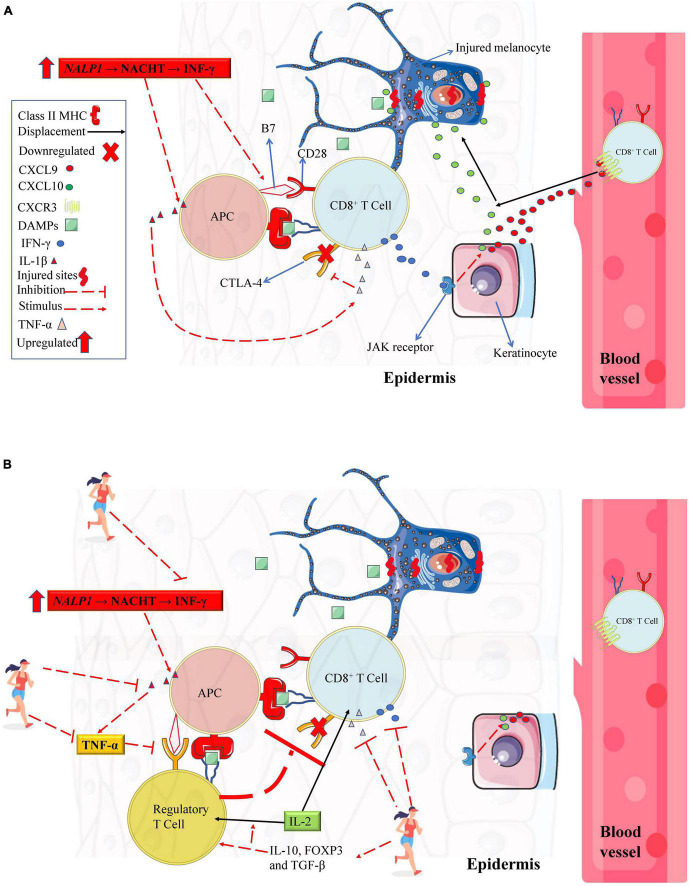
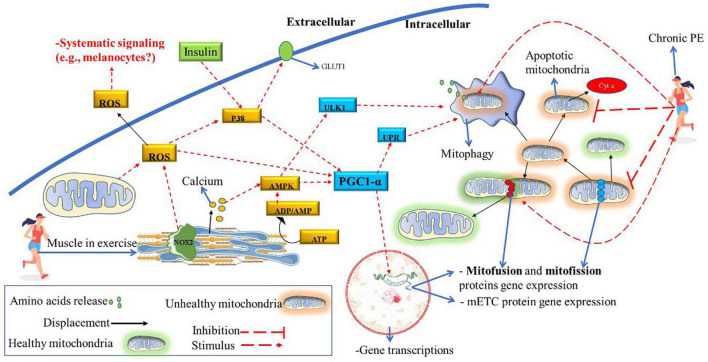
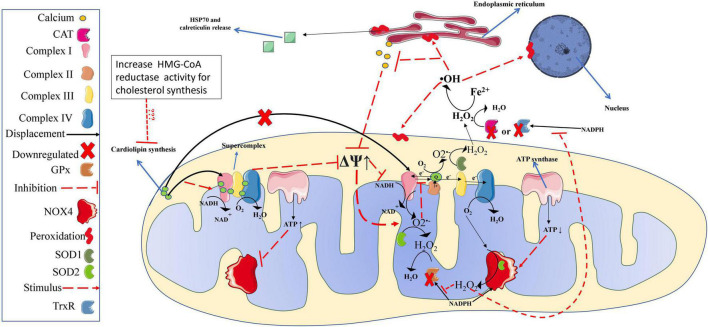
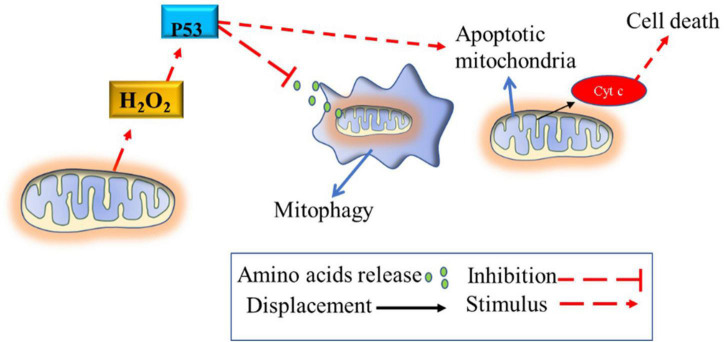
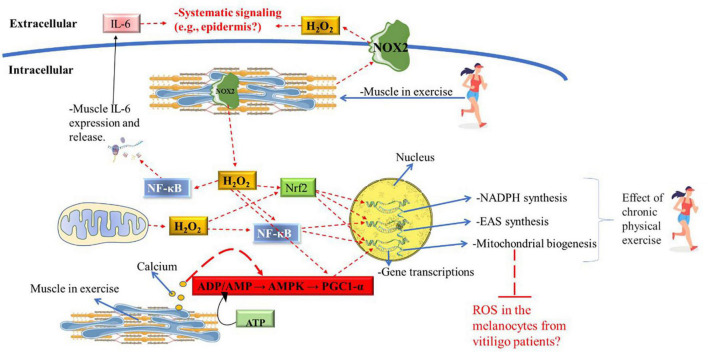
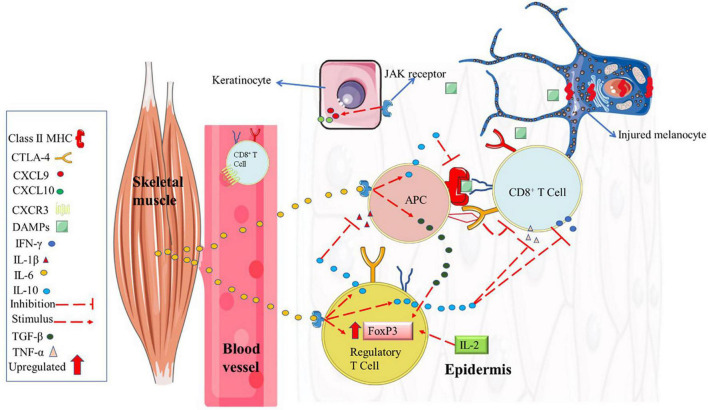
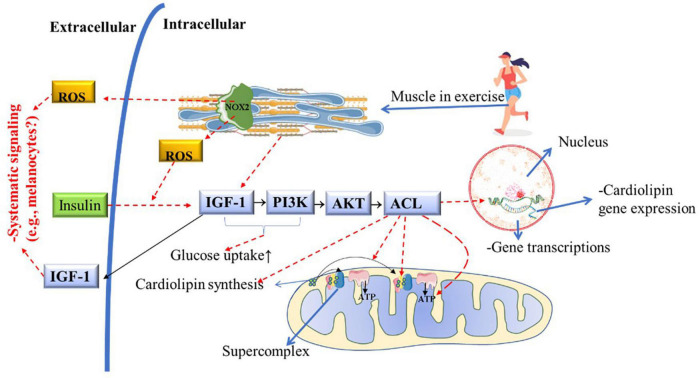
is an autoimmune disease characterized by progressive skin depigmentation and the appearance of white patches throughout the body caused by significant apoptosis of epidermal melanocytes. Despite not causing any physical pain, vitiligo can originate several psychosocial disorders, drastically reducing patients' quality of life. Emerging evidence has shown that vitiligo is associated with several genetic polymorphisms related to auto-reactivity from the immune system to melanocytes. Melanocytes from vitiligo patients suffer from excess reactive oxygen species (ROS) produced by defective mitochondria besides a poor endogenous antioxidant system (EAS). This redox imbalance results in dramatic melanocyte oxidative stress (OS), causing significant damage in proteins, lipid membranes, and DNA. The damaged melanocytes secret damage-associated molecular pattern (DAMPs), inducing and increasing inflammatory gene expression response that ultimately leads to melanocytes apoptosis. Vitiligo severity has been also associated with increasing the prevalence and incidence of metabolic syndrome (MetS) or associated disorders such as insulin resistance and hypercholesterolemia. Thus, suggesting that in genetically predisposed individuals, the environmental context that triggers MetS (i.e., sedentary lifestyle) may also be an important trigger for the development and severity of vitiligo disease. This paper will discuss the relationship between the immune system and epidermal melanocytes and their interplay with the redox system. Based on state-of-the-art evidence from the vitiligo research, physical exercise (PE) immunology, and redox system literature, we will also propose chronic PE as a potential therapeutic strategy to treat and prevent vitiligo disease progression. We will present evidence that chronic PE can change the balance of inflammatory to an anti-inflammatory state, improve both EAS and the mitochondrial structure and function (resulting in the decrease of OS). Finally, we will highlight clinically relevant markers that can be analyzed in a new research avenue to test the potential applicability of chronic PE in vitiligo disease.
白癜风是一种自身免疫性疾病,其特征是皮肤色素进行性脱失,全身出现白色斑块,这是由表皮黑素细胞大量凋亡所致。尽管白癜风不会引起任何身体疼痛,但它会引发多种心理社会障碍,严重降低患者的生活质量。新出现的证据表明,白癜风与多种基因多态性有关,这些多态性与免疫系统对黑素细胞的自身反应性相关。白癜风患者的黑素细胞除了内源性抗氧化系统(EAS)较差外,还会受到线粒体缺陷产生的过量活性氧(ROS)的影响。这种氧化还原失衡导致黑素细胞产生严重的氧化应激(OS),对蛋白质、脂质膜和DNA造成重大损伤。受损的黑素细胞会分泌损伤相关分子模式(DAMPs),诱导并增加炎症基因表达反应,最终导致黑素细胞凋亡。白癜风的严重程度还与代谢综合征(MetS)或相关疾病(如胰岛素抵抗和高胆固醇血症)的患病率和发病率增加有关。因此,这表明在具有遗传易感性的个体中,引发MetS的环境因素(即久坐的生活方式)也可能是白癜风疾病发生和严重程度的重要触发因素。本文将讨论免疫系统与表皮黑素细胞之间的关系以及它们与氧化还原系统的相互作用。基于白癜风研究、体育锻炼(PE)免疫学和氧化还原系统文献的最新证据,我们还将提出长期体育锻炼作为一种潜在的治疗策略,以治疗和预防白癜风疾病的进展。我们将提供证据表明,长期体育锻炼可以将炎症平衡转变为抗炎状态,改善EAS以及线粒体的结构和功能(从而降低OS)。最后,我们将强调在新的研究途径中可以分析的临床相关标志物,以测试长期体育锻炼在白癜风疾病中的潜在适用性。