Liang Xin, Guo Fei, Fan Qian, Cai Xiaoce, Wang Jiao, Chen Jiale, Liu Fang, Du Yuhua, Chen Yan, Li Xin
Chinese Medicine Department, Songnan Town Community Health Service Center, Shanghai, China.
Department of Dermatology, Yueyang Hospital of Integrated Traditional Chinese and Western Medicine, Shanghai University of Traditional Chinese Medicine, Shanghai, China.
Front Immunol. 2024 Nov 18;15:1440705. doi: 10.3389/fimmu.2024.1440705. eCollection 2024.
The treatment of vitiligo is complex, and providing guidance based on lifestyle habits is a good option that has not been summarized or analyzed.
To elucidate the relationship between vitiligo and lifestyle factors.
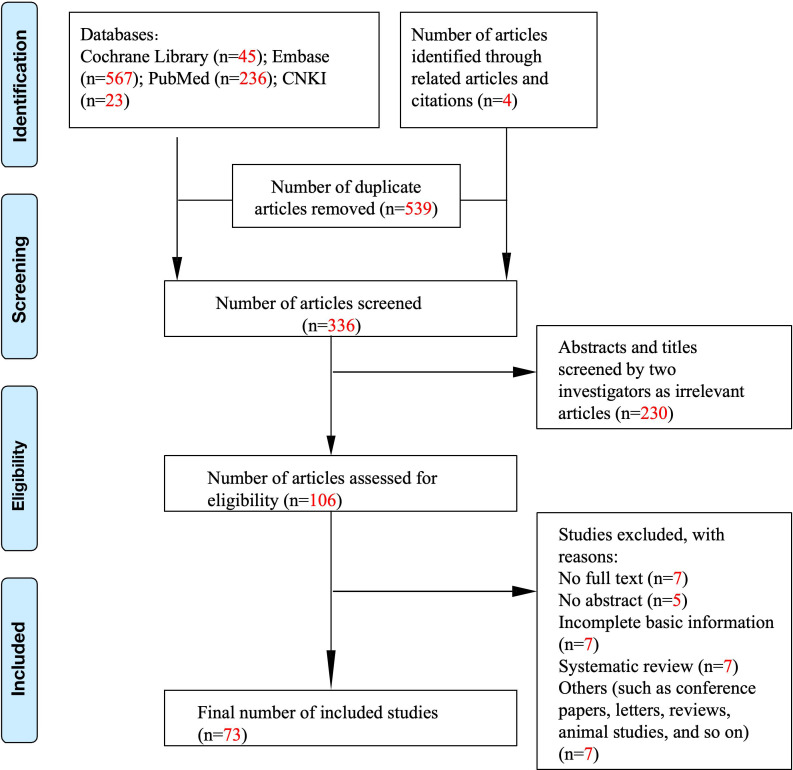
Four databases (PubMed, Embase, Cochrane, and China National Knowledge Internet) were searched for articles published between 1980 and December 2022. Keywords such as smoking, drinking, exercise, diet, and sleep were used.
Based on the search strategy, 875 relevant studies were retrieved, and 73 were included in this study, of which 41 studies with 8,542 patients with vitiligo were included in the meta-analysis. Vitamin C [mean difference (MD), -0.342; 95% confidence interval (CI), -1.090-0.407; p >0.05), folic acid (MD, -1.463; 95% CI, -7.133-4.208; p >0.05), and selenium (MD, 0.350; 95% CI, -0.687-1.387; p >0.05) levels did not differ between the groups. Vitamin E (MD, -1.408; 95% CI, -2.611--0.206; p <0.05), vitamin B12 (MD, -0.951; 95% CI, -1.672--0.275; p <0.05), copper (MD, -0.719; 95% CI, -1.185--0.252, p <0.005), and zinc (MD, -0.642; 95% CI, -0.731--0.554; p <0.001) levels were lower in the vitiligo group than in the control group. The serum iron level of the vitiligo group was significantly higher than that of the control group (MD, 1.181; 95% CI, 0.390-1.972; p <0.005). Finally, more participants in the vitiligo group smoked and drank alcohol than those in the control group.
Most studies are from Eastern countries; thus, extrapolating these results to Western populations is questionable. The significant heterogeneity may be attributed to the different stages, types, duration, center settings, population registries, etc., which seriously impair the validity of the results.
Patients with vitiligo should reduce smoking and alcohol consumption and take appropriate vitamin E, B12, copper, and zinc supplements. However, vitamin C, vitamin D, selenium, iron, and folic acid supplements are unnecessary. Moreover, they should consider sun protection and avoid permanent hair dye use. Patients with vitiligo may experience sleep disturbances and sexual dysfunction, and these patients should seek help from a specialist if necessary.
https://www.crd.york.ac.uk/prospero/#recordDetails, identifier CRD42023480757.
白癜风的治疗较为复杂,基于生活习惯提供指导是一个尚未得到总结或分析的不错选择。
阐明白癜风与生活方式因素之间的关系。
检索了四个数据库(PubMed、Embase、Cochrane和中国知网)中1980年至2022年12月发表的文章。使用了吸烟、饮酒、运动、饮食和睡眠等关键词。
根据检索策略,共检索到875项相关研究,本研究纳入73项,其中41项研究、8542例白癜风患者纳入荟萃分析。白癜风组与对照组相比,维生素C[平均差(MD),-0.342;95%置信区间(CI),-1.090至0.407;p>0.05]、叶酸(MD,-1.463;95%CI,-7.133至4.208;p>0.05)和硒(MD,0.350;95%CI,-0.687至1.387;p>0.05)水平无差异。白癜风组维生素E(MD,-1.408;95%CI,-2.611至-0.206;p<0.05)、维生素B12(MD,-0.951;95%CI,-1.672至-0.275;p<0.05)、铜(MD,-0.719;95%CI,-1.185至-0.252,p<0.005)和锌(MD,-0.642;95%CI,-0.731至-0.554;p<0.001)水平低于对照组。白癜风组血清铁水平显著高于对照组(MD,1.181;95%CI,0.390至1.972;p<0.005)。最后,白癜风组吸烟和饮酒的参与者比对照组更多。
大多数研究来自东方国家;因此,将这些结果外推至西方人群存在疑问。显著的异质性可能归因于不同的阶段、类型、病程、中心设置、人群登记等,这严重损害了结果的有效性。
白癜风患者应减少吸烟和饮酒,并适当补充维生素E、B12、铜和锌。然而,补充维生素C、维生素D、硒、铁和叶酸是不必要的。此外,他们应考虑防晒并避免使用永久性染发剂。白癜风患者可能会出现睡眠障碍和性功能障碍,必要时这些患者应寻求专科医生的帮助。
https://www.crd.york.ac.uk/prospero/#recordDetails,标识符CRD42023480757。