MacLeod Alexander I, Raval Parth K, Stockhorst Simon, Knopp Michael R, Frangedakis Eftychios, Gould Sven B
Institute for Molecular Evolution, Heinrich-Heine-Universität Düsseldorf, Düsseldorf, Germany.
Department of Plant Sciences, University of Cambridge, Cambridge, United Kingdom.
Front Plant Sci. 2022 Mar 14;13:863076. doi: 10.3389/fpls.2022.863076. eCollection 2022.
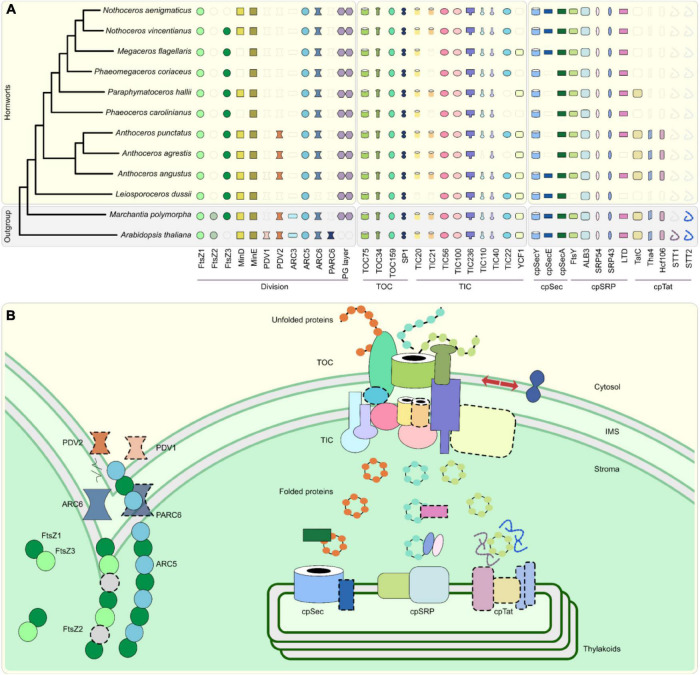
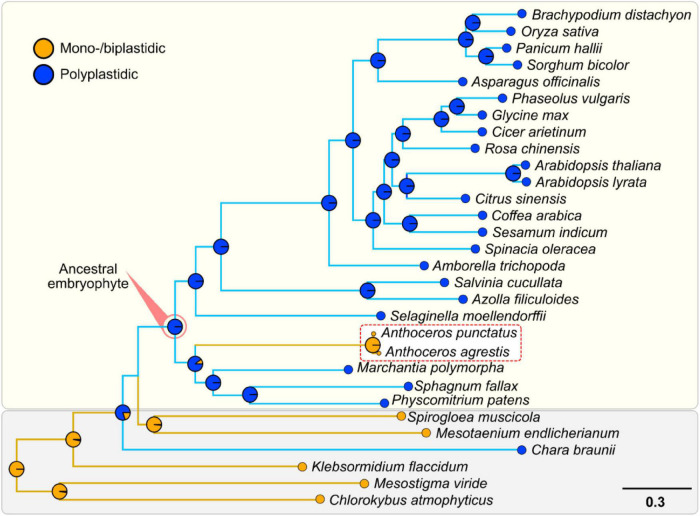
The first plastid evolved from an endosymbiotic cyanobacterium in the common ancestor of the Archaeplastida. The transformative steps from cyanobacterium to organelle included the transfer of control over developmental processes, a necessity for the host to orchestrate, for example, the fission of the organelle. The plastids of almost all embryophytes divide independently from nuclear division, leading to cells housing multiple plastids. Hornworts, however, are monoplastidic (or near-monoplastidic), and their photosynthetic organelles are a curious exception among embryophytes for reasons such as the occasional presence of pyrenoids. In this study, we screened genomic and transcriptomic data of eleven hornworts for components of plastid developmental pathways. We found intriguing differences among hornworts and specifically highlight that pathway components involved in regulating plastid development and biogenesis were differentially lost in this group of bryophytes. Our results also confirmed that hornworts underwent significant instances of gene loss, underpinning that the gene content of this group is significantly lower than other bryophytes and tracheophytes. In combination with ancestral state reconstruction, our data suggest that hornworts have reverted back to a monoplastidic phenotype due to the combined loss of two plastid division-associated genes, namely, ARC3 and FtsZ2.
第一个质体起源于古质体植物共同祖先中的一种内共生蓝细菌。从蓝细菌到细胞器的转变步骤包括对发育过程控制的转移,这是宿主协调(例如细胞器分裂)所必需的。几乎所有有胚植物的质体都独立于核分裂进行分裂,导致细胞中含有多个质体。然而,角苔是单核质体的(或接近单核质体),并且由于诸如偶尔存在蛋白核等原因,它们的光合细胞器在有胚植物中是一个奇特的例外。在这项研究中,我们筛选了11种角苔的基因组和转录组数据,以寻找质体发育途径的组成部分。我们在角苔之间发现了有趣的差异,并特别强调参与调节质体发育和生物发生的途径组成部分在这一组苔藓植物中存在差异丢失。我们的结果还证实,角苔经历了显著的基因丢失事件,这表明该组的基因含量明显低于其他苔藓植物和维管植物。结合祖先状态重建,我们的数据表明,由于两个与质体分裂相关的基因ARC3和FtsZ2的共同丢失,角苔已恢复到单核质体表型。