Zhang Jia-Jia, Sun Long-Long, Wang Ya-Nan, Xie Gui-Ying, An Shi-Heng, Chen Wen-Bo, Tang Qing-Bo, Zhao Xin-Cheng
Henan International Joint Laboratory of Green Pest Control, College of Plant Protection, Henan Agricultural University, Zhengzhou, China.
Front Neuroanat. 2022 Mar 10;16:844171. doi: 10.3389/fnana.2022.844171. eCollection 2022.
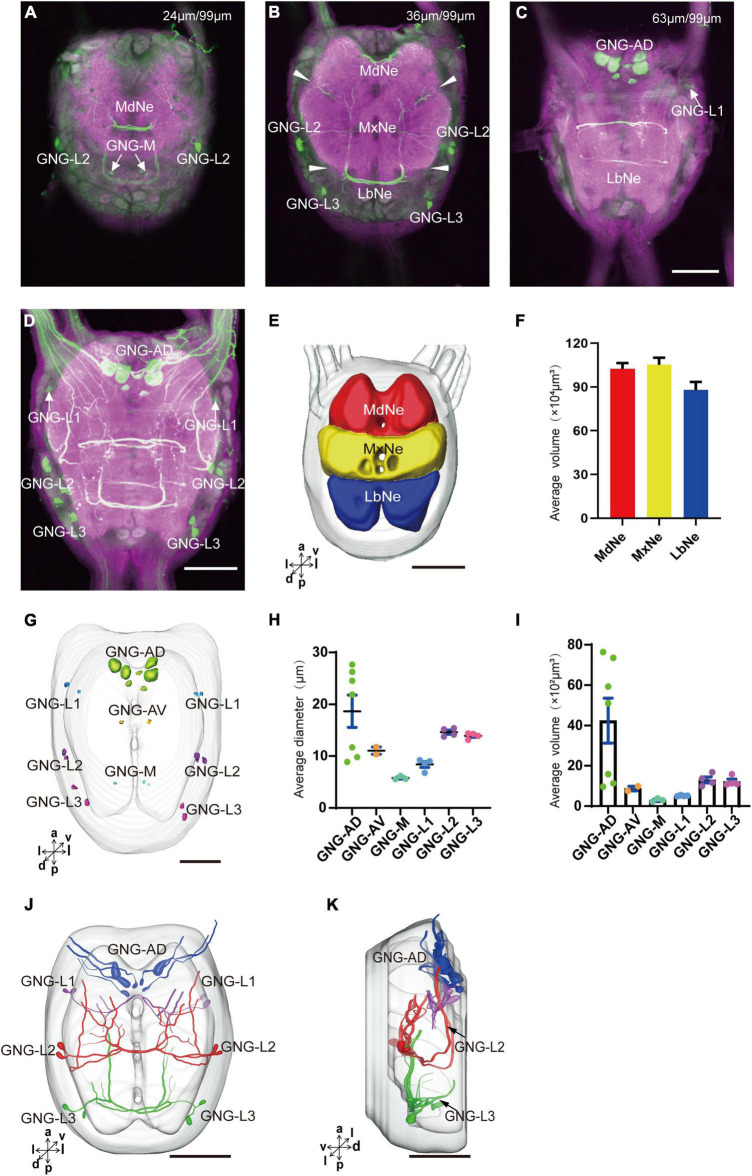
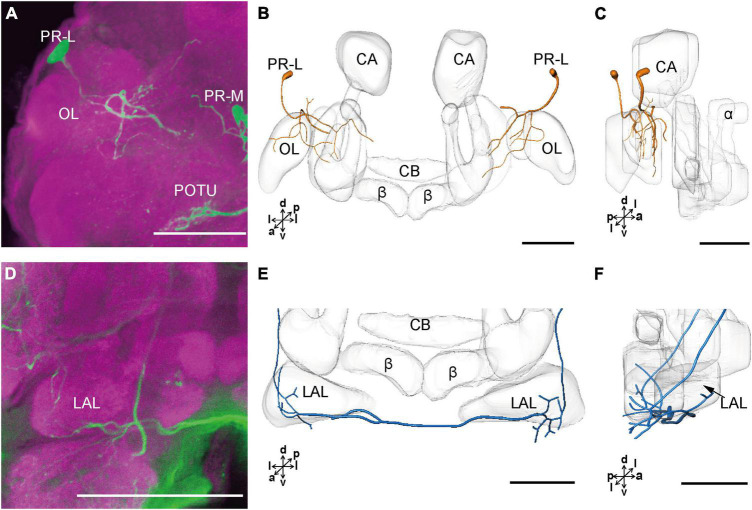
The fall armyworm () (Lepidoptera: Noctuidae) is a worldwide, disruptive, agricultural pest species. The larvae of feed on seedling, leave, and kernel of crops with chewing mouthparts, resulting in reduced crop yields. Serotonin is an important biogenic amine acting as a neural circuit modulator known to mediate lots of behaviors including feeding in insects. In order to explore the serotonergic neural network in the nervous system of larval , we performed immunohistochemical experiments to examine the neuropil structure of the brain and the gnathal ganglion with antisynapsin and to examine their serotonergic neurons with antiserotonin serum. Our data show that the brain of larval contains three neuromeres: the tritocerebrum, the deutocerebrum, and the protocerebrum. The gnathal ganglion also contains three neuromeres: the mandibular neuromere, the maxillary neuromere, and the labial neuromere. There are about 40 serotonergic neurons in the brain and about 24 serotonergic neurons in the gnathal ganglion. Most of these neurons are wide-field neurons giving off processes in several neuropils of the brain and the gnathal ganglion. Serotonergic neuron processes are mainly present in the protocerebrum. A pair of serotonergic neurons associated with the deutocerebrum has arborizations in the contralateral antennal lobe and bilateral superior lateral protocerebra. In the gnathal ganglion, the serotonergic neuron processes are also widespread throughout the neuropil and some process projections extend to the tritocerebrum. These findings on the serotonergic neuron network in larval allow us to explore the important roles of serotonin in feeding and find a potential approach to modulate the feeding behavior of the gluttonous pest and reduce its damage.
草地贪夜蛾(Spodoptera frugiperda)(鳞翅目:夜蛾科)是一种全球性的、具有破坏性的农业害虫。草地贪夜蛾的幼虫以作物的幼苗、叶片和籽粒为食,具有咀嚼式口器,会导致作物减产。血清素是一种重要的生物胺,作为一种神经回路调节剂,已知可介导包括昆虫进食在内的多种行为。为了探究草地贪夜蛾幼虫神经系统中的血清素能神经网络,我们进行了免疫组织化学实验,用抗突触素检测脑和颚神经节的神经纤维网结构,并用抗血清素血清检测它们的血清素能神经元。我们的数据表明,草地贪夜蛾幼虫的脑包含三个神经节段:后脑、中脑和前脑。颚神经节也包含三个神经节段:下颚神经节段、上颚神经节段和唇神经节段。脑中约有40个血清素能神经元,颚神经节中约有24个血清素能神经元。这些神经元大多是广域神经元,在脑和颚神经节的多个神经纤维网中发出突起。血清素能神经元的突起主要存在于前脑。一对与中脑相关的血清素能神经元在对侧触角叶和双侧前脑上外侧有分支。在颚神经节中,血清素能神经元的突起也广泛分布于神经纤维网中,一些突起延伸至后脑。这些关于草地贪夜蛾幼虫血清素能神经元网络的发现,使我们能够探究血清素在进食中的重要作用,并找到一种潜在的方法来调节这种暴食性害虫的进食行为,减少其危害。