Zhao Jinchuan, Gao Xin, Zhao Liangyou, Wang Yiqing, Zhang Jingbo, Liu Shumin
Heilongjiang University of Chinese Medicine, Harbin, China.
Drug Safety Evaluation Center, Heilongjiang University of Chinese Medicine, Harbin, China.
Evid Based Complement Alternat Med. 2022 Mar 22;2022:1525113. doi: 10.1155/2022/1525113. eCollection 2022.
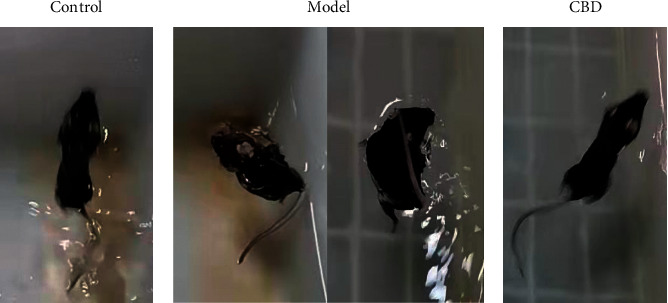
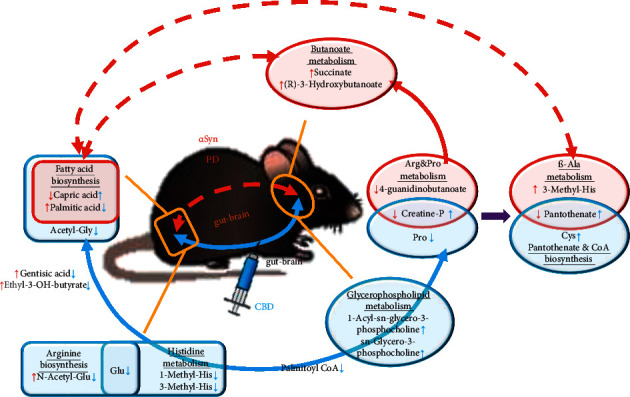
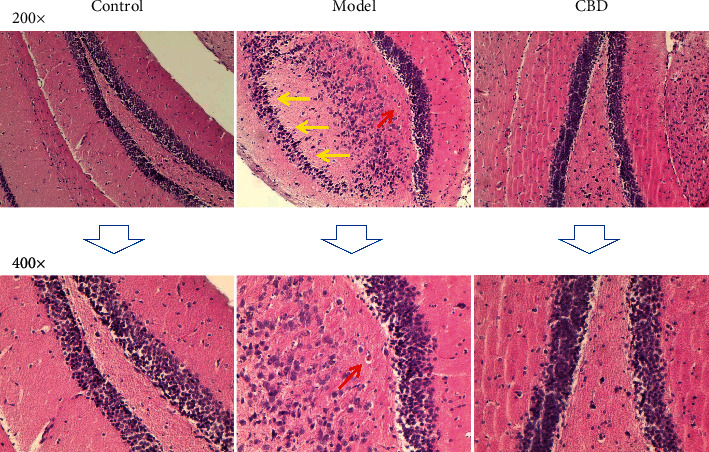
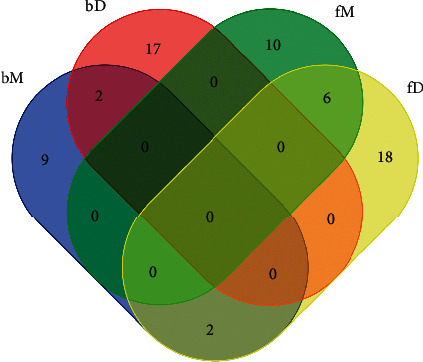
Parkinson's disease (PD) is a common neurodegenerative disease characterized by a disorder of the dopaminergic system in the midbrain, causing classical PD motor symptoms. The therapeutic effect of cannabidiol (CBD) on PD has been a research frontier in recent years. However, the pathogenesis of PD and the therapeutic mechanism of cannabinoid remain unclear. To further study the causes of PD and the effect of CBD on PD, we exposed the PD transgenic mouse model to CBD and then estimated the motorial and postural coordination through a modified swim test. Afterwards, the mechanism was investigated via the histopathology of substantia nigra and the gut-brain metabolic analysis in the approach of UHPLC-TOF-MS. The results showed that CBD significantly improved motor deficits of PD model and protected the substantia nigra area. The metabolic function of fatty acid biosynthesis, arginine biosynthesis/metabolism, butanoate (ketone body) metabolism, -alanine metabolism, and pantothenate/CoA biosynthesis was highlighted in the pathological and therapeutic process along the gut-brain axis. In conclusion, CBD could attenuate PD via the neuroprotective effect on the midbrain. The attenuation of the central nervous system in turn improved motor performance of PD, which might be partially induced by the metabolic interaction between the gut-brain. In view of gut-brain metabolomics, the mechanism of PD pathogenesis and the effect of CBD on PD are highly related to the biosynthesis and metabolism of energy and essential substance.
帕金森病(PD)是一种常见的神经退行性疾病,其特征是中脑多巴胺能系统紊乱,导致典型的PD运动症状。近年来,大麻二酚(CBD)对PD的治疗作用一直是研究前沿。然而,PD的发病机制和大麻素的治疗机制仍不清楚。为了进一步研究PD的病因以及CBD对PD的影响,我们将PD转基因小鼠模型暴露于CBD中,然后通过改良的游泳试验评估其运动和姿势协调性。之后,通过黑质组织病理学和UHPLC-TOF-MS方法进行肠-脑代谢分析来研究其机制。结果表明,CBD显著改善了PD模型的运动缺陷并保护了黑质区域。在沿肠-脑轴的病理和治疗过程中,脂肪酸生物合成、精氨酸生物合成/代谢、丁酸(酮体)代谢、β-丙氨酸代谢以及泛酸/辅酶A生物合成的代谢功能得到了突出体现。总之,CBD可通过对中脑的神经保护作用减轻PD。中枢神经系统的减轻进而改善了PD的运动表现,这可能部分是由肠-脑之间的代谢相互作用诱导的。从肠-脑代谢组学的角度来看,PD发病机制以及CBD对PD的影响机制与能量和必需物质的生物合成及代谢高度相关。