Dutta Sudhir K, Verma Sandeep, Jain Vardhmaan, Surapaneni Balarama K, Vinayek Rakesh, Phillips Laila, Nair Padmanabhan P
Sinai Hospital, Baltimore, MD, USA.
University of Maryland School of Medicine, Baltimore, MD, USA.
J Neurogastroenterol Motil. 2019 Jul 1;25(3):363-376. doi: 10.5056/jnm19044.
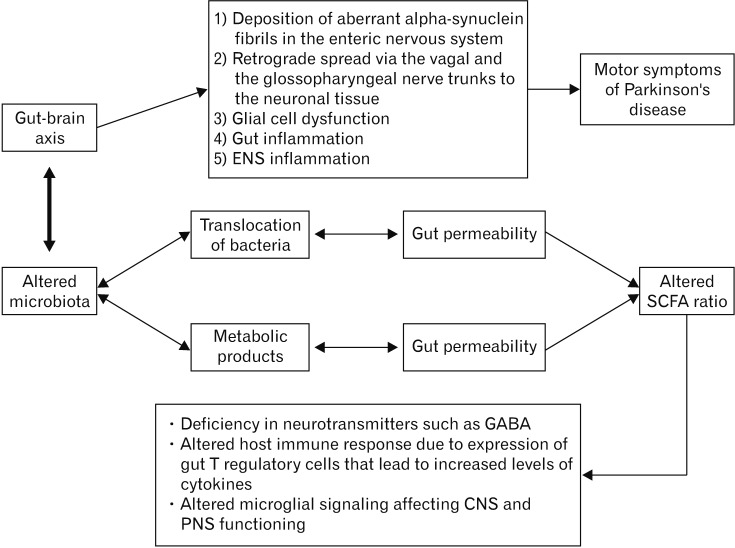
The role of the microbiome in health and human disease has emerged at the forefront of medicine in the 21st century. Over the last 2 decades evidence has emerged to suggest that inflammation-derived oxidative damage and cytokine induced toxicity may play a significant role in the neuronal damage associated with Parkinson's disease (PD). Presence of pro-inflammatory cytokines and T cell infiltration has been observed in the brain parenchyma of patients with PD. Furthermore, evidence for inflammatory changes has been reported in the enteric nervous system, the vagus nerve branches and glial cells. The presence of α-synuclein deposits in the post-mortem brain biopsy in patients with PD has further substantiated the role of inflammation in PD. It has been suggested that the α-synuclein misfolding might begin in the gut and spread "prion like" via the vagus nerve into lower brainstem and ultimately to the midbrain; this is known as the Braak hypothesis. It is noteworthy that the presence of gastrointestinal symptoms (constipation, dysphagia, and hypersalivation), altered gut microbiota and leaky gut have been observed in PD patients several years prior to the clinical onset of the disease. These clinical observations have been supported by in vitro studies in mice as well, demonstrating the role of genetic (α-synuclein overexpression) and environmental (gut dysbiosis) factors in the pathogenesis of PD. The restoration of the gut microbiome in patients with PD may alter the clinical progression of PD and this alteration can be accomplished by carefully designed studies using customized probiotics and fecal microbiota transplantation.
微生物群落在健康和人类疾病中的作用已成为21世纪医学的前沿领域。在过去20年里,有证据表明炎症衍生的氧化损伤和细胞因子诱导的毒性可能在与帕金森病(PD)相关的神经元损伤中起重要作用。在PD患者的脑实质中观察到促炎细胞因子的存在和T细胞浸润。此外,在肠神经系统、迷走神经分支和神经胶质细胞中也有炎症变化的报道。PD患者死后脑活检中α-突触核蛋白沉积物的存在进一步证实了炎症在PD中的作用。有人提出,α-突触核蛋白错误折叠可能始于肠道,并通过迷走神经“朊病毒样”扩散到脑干下部,最终到达中脑;这就是布拉克假说。值得注意的是,在PD患者临床发病前数年就观察到了胃肠道症状(便秘、吞咽困难和流涎过多)、肠道微生物群改变和肠道通透性增加。这些临床观察结果也得到了小鼠体外研究的支持,证明了遗传(α-突触核蛋白过表达)和环境(肠道菌群失调)因素在PD发病机制中的作用。恢复PD患者的肠道微生物群可能会改变PD的临床进程,这种改变可以通过使用定制益生菌和粪便微生物群移植的精心设计的研究来实现。