Center of Oral Implantology, Stomatological Hospital, Southern Medical University, Guangzhou, China.
Center for Dentistry and Oral Hygiene, University Medical Center Groningen (UMCG), University of Groningen, Groningen, The Netherlands.
J Periodontol. 2022 Sep;93(9):1302-1313. doi: 10.1002/JPER.21-0620. Epub 2022 May 5.
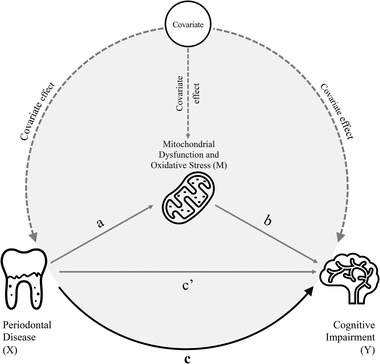
Increased attention has been focused on the associations of periodontal disease with the onset and progression of cognitive impairment. Although the associations are likely to be multifactorial, few studies have explored the role of mitochondrial dysfunction in the periodontitis-dementia link.
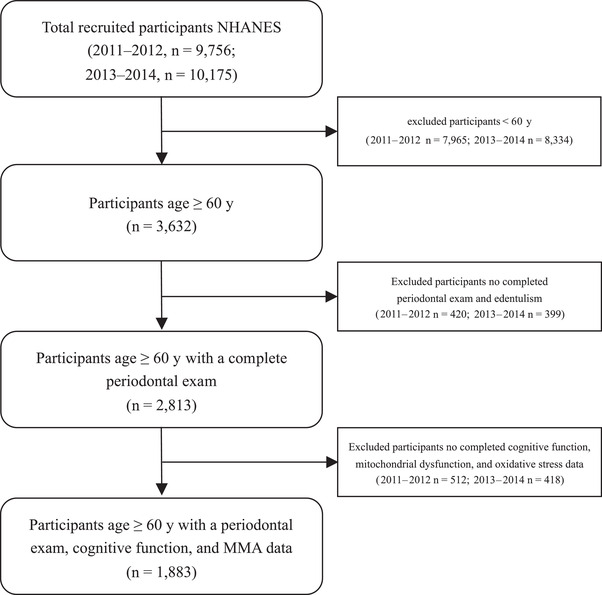
Cross-sectional data of 1,883 participants aged ≥60 years in the National Health and Nutrition Examination Survey 2011-2014 were analyzed. The following data were collected: 1) general information on sociodemographic, behavioral, and health-related factors; 2) periodontal status (mean attachment loss [AL] and mean probing depth [PD]); 3) mitochondrion-derived biomarker of mitochondrial dysfunction (blood sample concentration of methylmalonic acid [MMA]); 4) cognitive function (Consortium to Establish a Registry for Alzheimer's disease immediate recall [CERAD-IR] and delay recall [CERAD-DR], animal fluency test, and digit symbol substitution test [DSST]). Mediation analysis weighted for complex survey design was used to assess the effect of MMA on the association of periodontal status with cognitive function after adjusting for potential confounders.
Participants with Stage III and IV periodontitis had lower scores on cognitive performance and higher MMA levels than those with Stages I/II periodontitis. Circulating MMA was significantly associated with CERAD-DR (weighted β [SE] = -0.076 [0.011]) and DSST (weighted β [SE] = -0.039 [0.009]), which mediated 9.9% and 6.0% of the total association of mean PD with cognitive function. Moreover, MMA mediated 11.7% and 5.8% of the association of mean AL with CERAD-DR and DSST, respectively.
The findings suggest that MMA, a biomarker of mitochondrial dysfunction, plays a mediating role in the link between periodontitis and cognitive impairment in older adults aged ≥60 years.
人们越来越关注牙周病与认知障碍的发生和进展之间的关联。尽管这些关联可能是多因素的,但很少有研究探讨线粒体功能障碍在牙周炎与痴呆症关联中的作用。
分析了 2011-2014 年国家健康和营养调查(NHANES)中 1883 名年龄≥60 岁的参与者的横断面数据。收集了以下数据:1)社会人口统计学、行为和健康相关因素的一般信息;2)牙周状况(平均附着丧失[AL]和平均探诊深度[PD]);3)线粒体功能障碍的线粒体衍生生物标志物(血液样本中甲基丙二酸[MMA]的浓度);4)认知功能(阿尔茨海默病协会建立的登记处即时回忆[CERAD-IR]和延迟回忆[CERAD-DR]、动物流畅性测试和数字符号替换测试[DSST])。采用加权复杂调查设计的中介分析来评估 MMA 对牙周状况与认知功能之间关联的影响,同时调整了潜在的混杂因素。
与 I/II 期牙周炎相比,III/IV 期牙周炎患者的认知功能评分较低,MMA 水平较高。循环 MMA 与 CERAD-DR(加权β[SE] = -0.076[0.011])和 DSST(加权β[SE] = -0.039[0.009])显著相关,这两种标志物分别解释了 PD 与认知功能之间总关联的 9.9%和 6.0%。此外,MMA 分别解释了 AL 与 CERAD-DR 和 DSST 之间总关联的 11.7%和 5.8%。
研究结果表明,线粒体功能障碍的生物标志物 MMA 在 60 岁及以上老年人中牙周炎与认知障碍之间的关联中起中介作用。