Osmancevic Selvedina, Großschädl Franziska, Stijic Marko, Lohrmann Christa
Institute of Nursing Science, Medical University of Graz, Universitätsplatz 4, 8010, Graz, Austria.
Institute for Medical Informatics, Statistics and Documentation, Medical University of Graz, Auenbruggerplatz 2/5, 8036, Graz, Austria.
BMC Nurs. 2022 Apr 1;21(1):77. doi: 10.1186/s12912-022-00854-w.
Adapting practices to respond sensitively to increasingly culturally diverse patients can be challenging. Therefore, cultural competence among nurses needs to be assessed to evaluate their current cultural competence and the need for interventions to improve daily nursing practice. Little is known about cultural competence of nurses in German-speaking countries, including Austria, as there is currently no validated tool in German to assess cultural competence in nurses. The aims of this study were to translate and cross-culturally adapt the Cultural Competence Assessment scale in German and to evaluate its psychometric properties.
This is a methodology study with a cross-sectional design. Conducting a convenience sampling, Austrian nurses working in the direct care of patients in acute care settings were invited to participate in this study. Data collection was conducted in March 2021. The translation and cross-cultural adaptation were conducted by following the guidelines of Sousa et al. (J Eval Clin Pract 17:268-74, 2011) and Beaton et al. (Spine 25:3186-91, 2000). The face and content validity, structural validity, and internal consistency reliability of the Cultural Competence Assessment scale, which consists of 25 items, was evaluated. Data were analysed using content validity index, confirmatory factor analyses as well as McDonald's Omega. Descriptive statistics were computed with the statistical software IBM SPSS Statistics 26, while the confirmatory factor analysis was conducted with the R package Lavaan.
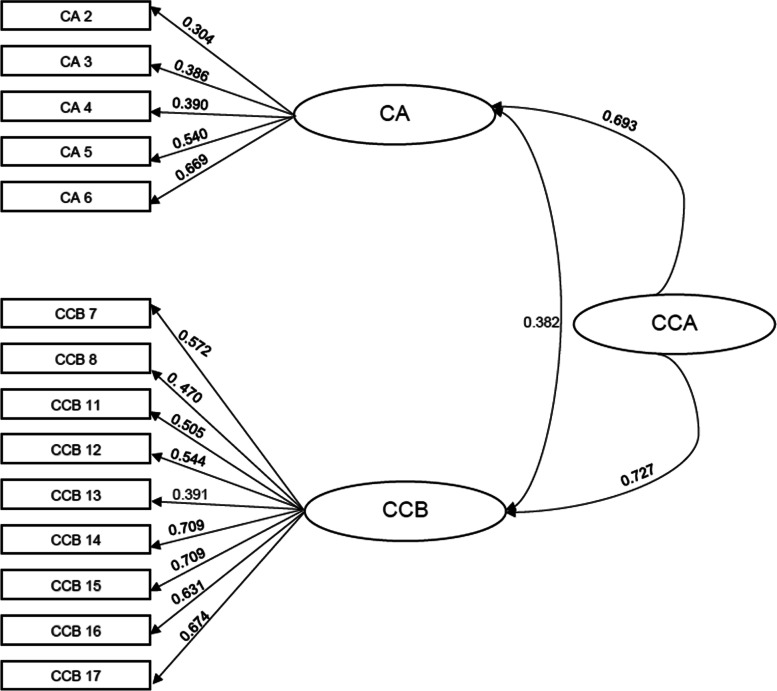
Overall, 915 nurses completed the questionnaire. Twenty items had an acceptable item content validity index. Using confirmatory factor analyses, a two-factor model with 14 items yielded a good fit (x/df = 3.16; CFI = .923; TLI = .908; RMSEA = .055 (.049-.062) and SRMR = .039). Internal consistency reliability was found to be acceptable, as indicated by a Omega of .87.
The German version of the Cultural Competence Assessment scale (CCA-G) can be recommended for measuring cultural competence behaviour of nurses in acute care settings. The 14-item scale showed strong construct validity and acceptable internal consistency. Further research using repeated measures could determine the cultural sensitivity and indicate if the tool is applicable in other healthcare settings and for other healthcare professionals.
使护理实践能够敏感地应对文化日益多样化的患者具有挑战性。因此,需要评估护士的文化能力,以评估他们目前的文化能力以及改进日常护理实践所需的干预措施。对于包括奥地利在内的德语国家护士的文化能力了解甚少,因为目前尚无经过验证的德语工具来评估护士的文化能力。本研究的目的是将文化能力评估量表翻译成德语并进行跨文化调适,并评估其心理测量特性。
这是一项采用横断面设计的方法学研究。采用便利抽样法,邀请在急性护理环境中直接护理患者的奥地利护士参与本研究。数据收集于2021年3月进行。翻译和跨文化调适按照苏萨等人(《临床实践评价杂志》17:268 - 274,2011年)和比顿等人(《脊柱》25:3186 - 3191,2000年)的指南进行。对由25个项目组成的文化能力评估量表的表面效度和内容效度、结构效度以及内部一致性信度进行了评估。使用内容效度指数、验证性因子分析以及麦克唐纳欧米茄系数对数据进行分析。使用统计软件IBM SPSS Statistics 26计算描述性统计量,而验证性因子分析则使用R包Lavaan进行。
总体而言,915名护士完成了问卷。20个项目具有可接受的项目内容效度指数。通过验证性因子分析,一个包含14个项目的双因素模型拟合良好(χ/df = 3.16;CFI = 0.923;TLI = 0.908;RMSEA = 0.055(0.049 - 0.062);SRMR = 0.039)。内部一致性信度可接受,欧米茄系数为0.87。
文化能力评估量表德语版(CCA - G)可推荐用于测量急性护理环境中护士的文化能力行为。这个包含14个项目的量表显示出较强的结构效度和可接受的内部一致性。使用重复测量的进一步研究可以确定文化敏感性,并表明该工具是否适用于其他医疗环境和其他医疗专业人员。