Rehabilitation Engineering Laboratory, ETH Zürich, Zürich, Switzerland.
CYBATHLON, ETH Zürich, Zürich, Switzerland.
J Neuroeng Rehabil. 2022 Apr 2;19(1):38. doi: 10.1186/s12984-022-01015-5.
Advanced assistive technologies (AAT) aim to exploit the vast potential of technological developments made in the past decades to improve the quality of life of people with disabilities. Combining complex robotic technologies with the unique needs of people with disabilities requires a strong focus on user-centered design to ensure that the AAT appropriately addresses the daily life struggles of target users. The CYBATHLON aims to promote this mindset by empowering the AAT target users ("pilots") to compete on race tracks that represent approximations of daily life obstacles. The objective of this work was to investigate the AAT technology development, usability, and user involvement (i.e., application of user-centered design) in the context of the CYBATHLON.
With an online survey targeting the pilots and technical leads of teams preparing for the CYBATHLON 2020 Global Edition, we investigated to what extent the pilots were involved in device development and how this influences the perceived usability of the showcased AAT. Furthermore, the effects of user-centered design variables on the individual race performances were analyzed.
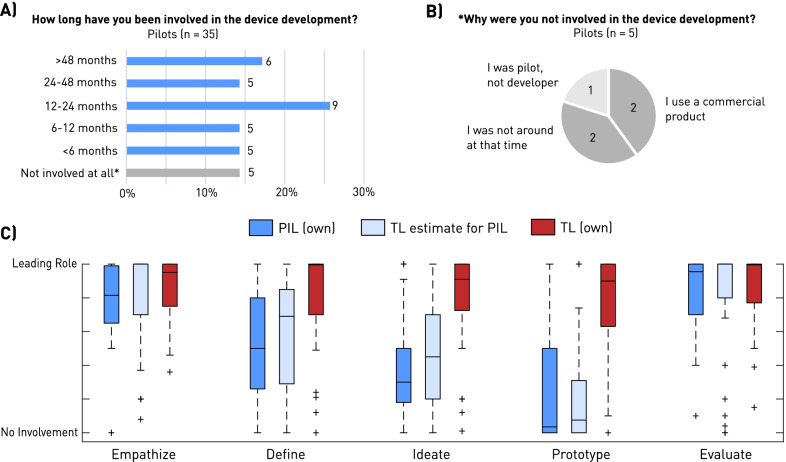
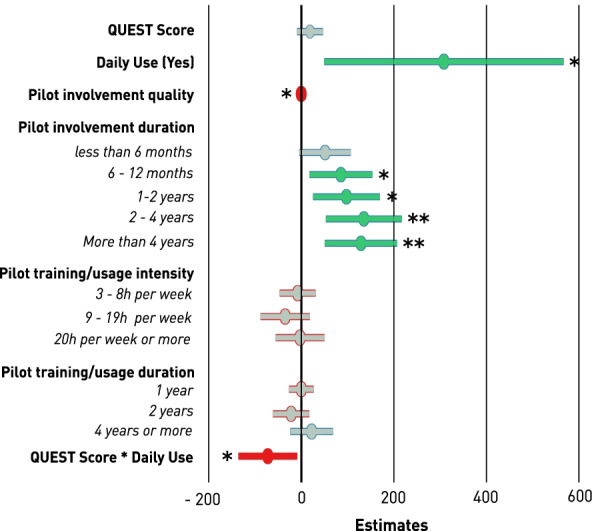
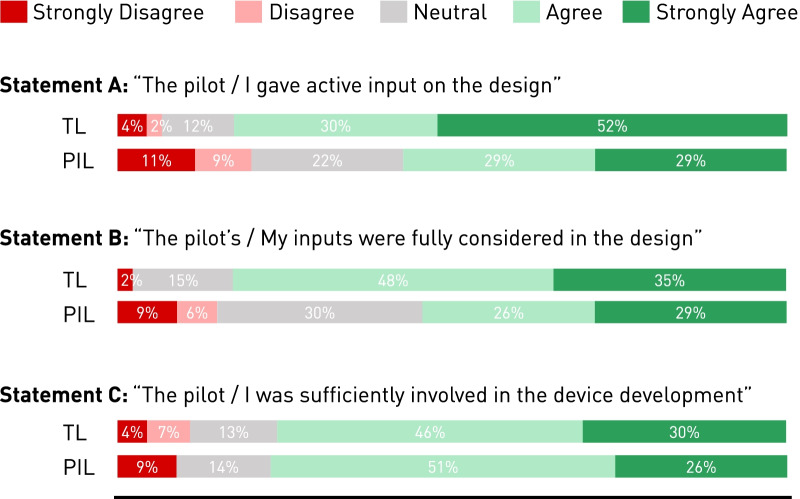
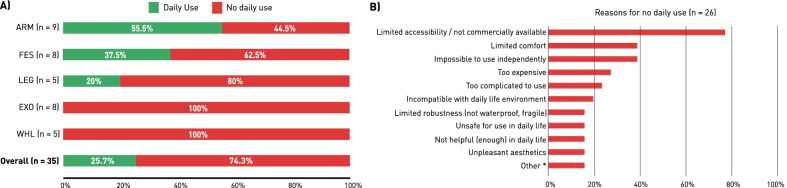
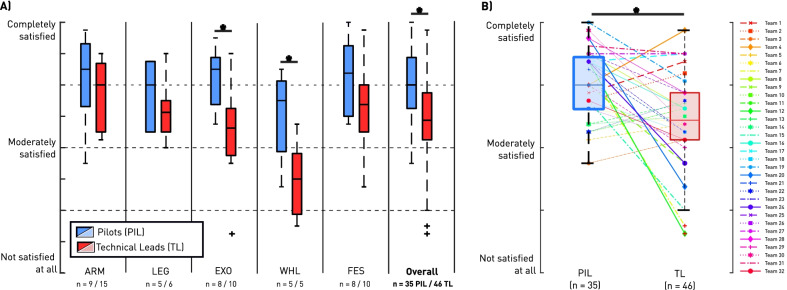
A total of 81 responses from 35 pilots and 46 technical leads were collected in the two weeks prior to the event. Of all teams partaking in the included disciplines of the CYBATHLON 2020 Global Edition, 81.8% (36 of 44) were included in the study. User-centered design appeared to be a prevalent practice among the teams, as 85.7% of all pilots reported a certain level of involvement. However, only 25.5% of the pilots reported daily life usage, despite QUEST usability scores of both respondent groups showing moderate to high satisfaction with the respected AAT across all investigated disciplines. An explorative linear mixed model indicated that daily life usage (p < 0.05) and prolonged user involvement (e.g., more than 2 years, p < 0.001) have a significant positive effect on the race performance at the competition.
We conclude that the CYBATHLON positively fulfills its conceptual goals of promoting active participation and inclusion of people with disabilities in the design and evaluation of AAT, thereby stimulating the development of promising novel technological solutions. Also, our data could underline the value of the competition as a benchmark, highlighting remaining usability limitations or technology adoption hurdles.
先进的辅助技术(AAT)旨在利用过去几十年中在技术发展方面取得的巨大潜力,提高残疾人士的生活质量。将复杂的机器人技术与残疾人士的独特需求相结合,需要高度关注以用户为中心的设计,以确保 AAT 能够妥善解决目标用户的日常生活挑战。CYBATHLON 通过授权 AAT 的目标用户(“飞行员”)在代表日常生活障碍的赛道上进行比赛,从而推动这种思维模式。本研究的目的是调查 CYBATHLON 背景下 AAT 技术的开发、可用性和用户参与度(即应用以用户为中心的设计)。
我们通过针对参加 2020 年全球版 CYBATHLON 的飞行员和技术团队负责人的在线调查,调查了飞行员在设备开发中的参与程度以及这对展示的 AAT 的感知可用性的影响。此外,还分析了以用户为中心的设计变量对个人比赛成绩的影响。
在活动前两周内,共收集了 81 名飞行员和 46 名技术团队负责人的 81 份回复。在参加 2020 年全球版 CYBATHLON 所包含学科的所有团队中,有 81.8%(36 个)被纳入研究。以用户为中心的设计似乎是团队中普遍采用的做法,因为 85.7%的飞行员报告了某种程度的参与。然而,只有 25.5%的飞行员报告了日常生活的使用情况,尽管 QUEST 可用性评分显示,在所有调查学科中,飞行员对所尊重的 AAT 的满意度均为中等至高度。探索性线性混合模型表明,日常生活的使用(p<0.05)和长期用户参与(例如,超过 2 年,p<0.001)对比赛成绩有显著的积极影响。
我们得出结论,CYBATHLON 积极实现了其促进残疾人士积极参与和融入 AAT 的设计和评估的概念性目标,从而刺激了有前途的新型技术解决方案的发展。此外,我们的数据还可以强调该竞赛作为基准的价值,突出可用性限制或技术采用障碍。