Şenkesen Öznur, Tezcanlı Evrim, Abacıoğlu Mehmet Ufuk, Özen Zeynep, Çöne Derya, Küçücük Halil, Göksel Evren Ozan, Arifoğlu Alptekin, Şengöz Meriç
Department of Radiation Oncology, Acıbadem Mehmet Ali Aydınlar University, Istanbul, Turkey.
Department of Radiation Oncology, Acıbadem Altunizade Hospital, Istanbul, Turkey.
Radiat Oncol J. 2022 Mar;40(1):9-19. doi: 10.3857/roj.2021.00542. Epub 2022 Mar 28.
This study aimed to investigate the tumor volume changes occurring during limited-field radiotherapy (RT) for glioblastoma patients and whether a volume-adapted boost planning approach provided any benefit on tumor coverage and normal tissue sparing.
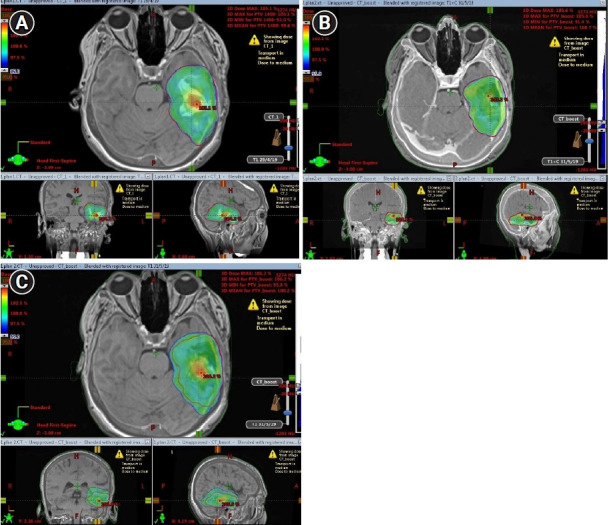
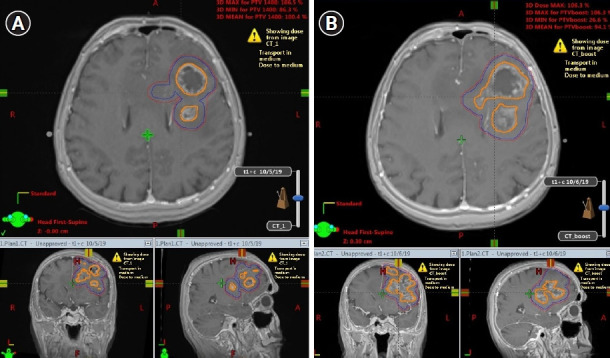
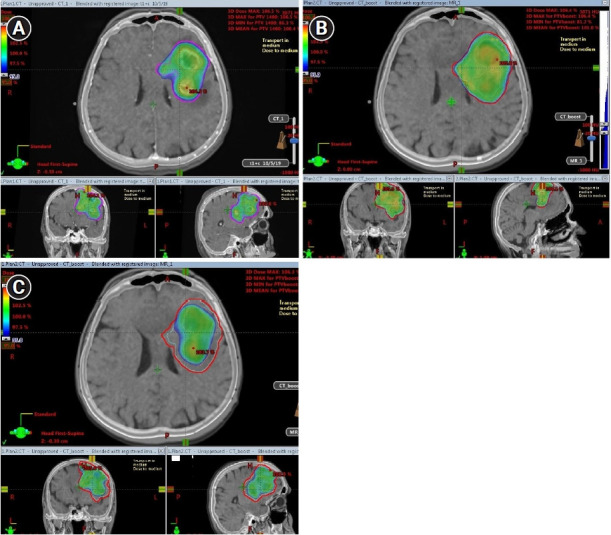
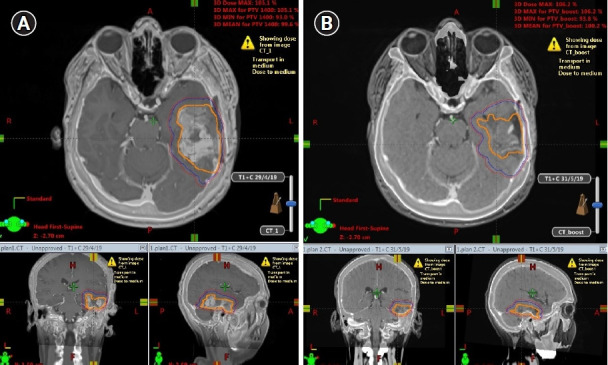
Twenty-four patients underwent simulation with magnetic resonance (MR) and computed tomography (CT) scans prior to RT (MR_initial, CT_initial) and boost treatment (MR_adapt, CT_adapt). For the boost phase, MR_initial and MR_adapt images were used to delineate GTV2 and GTV2_adapt, respectively. An initial boost plan (Plan_initial) created on CT_initial for PTV2 was then reoptimized on CT_adapt by keeping the same optimization and normalization values. Plan_adapt was generated on CT_adapt for PTV2_adapt volume. Dose volume histogram parameters for target volumes and organs-at-risk were compared using these boost plans generated on CT_adapt. Plan_initial and Plan_adaptive boost plans were summed with the first phase plan and the effect on the total dose was investigated.
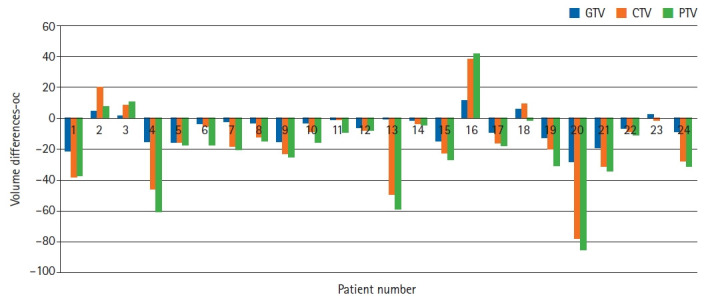
Target volume expansion was noted in 21% of patients while 79% had shrinkage. The average difference for the initial and adaptive gross tumor volume (GTV), clinical target volume (CTV), and planning target volume (PTV) volumes were statistically significant. Maximum dose differences for brainstem and optic chiasm were significant. Healthy brain tissue V10 and ipsilateral optic nerve maximum doses were found to decrease significantly in Plan_adaptive.
Results of this study confirm occurrence of target volume changes during RT for glioblastoma patients. An adaptive plan can provide better normal tissue sparing for patients with lesion shrinkage and avoid undercoverage of treatment volumes in case of target volume expansion especially when limited-fields are used.
本研究旨在调查胶质母细胞瘤患者在适形调强放疗(RT)期间肿瘤体积的变化,以及体积适应性调强计划方法是否对肿瘤覆盖和正常组织保护有益。
24例患者在放疗前(MR初始、CT初始)以及调强治疗前(MR适应性、CT适应性)接受了磁共振(MR)和计算机断层扫描(CT)模拟。对于调强阶段,分别使用MR初始图像和MR适应性图像勾画GTV2和GTV2适应性。然后,在CT初始图像上为PTV2创建的初始调强计划(计划初始)在CT适应性图像上通过保持相同的优化和归一化值进行重新优化。在CT适应性图像上为PTV2适应性体积生成计划适应性。使用在CT适应性图像上生成的这些调强计划比较靶区体积和危及器官的剂量体积直方图参数。将计划初始和计划适应性调强计划与第一阶段计划相加,并研究对总剂量的影响。
21%的患者出现靶区体积增大,而79%的患者出现缩小。初始和适应性大体肿瘤体积(GTV)、临床靶区体积(CTV)和计划靶区体积(PTV)体积的平均差异具有统计学意义。脑干和视交叉的最大剂量差异显著。在计划适应性中发现健康脑组织V10和同侧视神经最大剂量显著降低。
本研究结果证实胶质母细胞瘤患者在放疗期间会出现靶区体积变化。适应性计划可以为病变缩小的患者更好地保护正常组织,并在靶区体积增大的情况下避免治疗体积覆盖不足,尤其是在使用适形野时。