Zhang Ping, Han Ting, Xia Hui, Dong Lijie, Chen Liuqing, Lei Li
Department of Dermatology, Wuhan No. 1 Hospital, Tongji Medical College, Huazhong University of Science and Technology, Wuhan, China.
School of Materials Science and Engineering, Wuhan University of Technology, Wuhan, China.
Front Oncol. 2022 Mar 16;12:836397. doi: 10.3389/fonc.2022.836397. eCollection 2022.
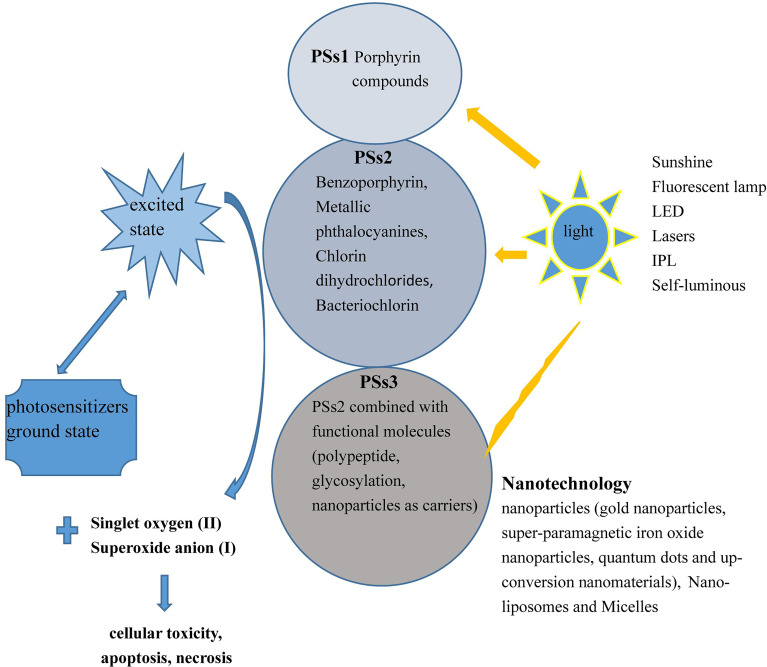
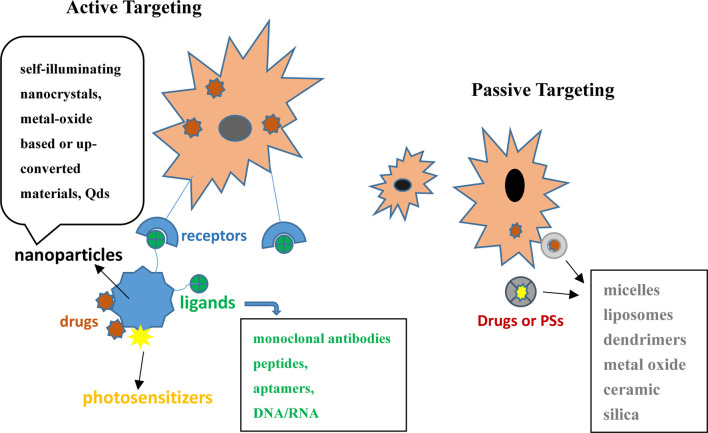
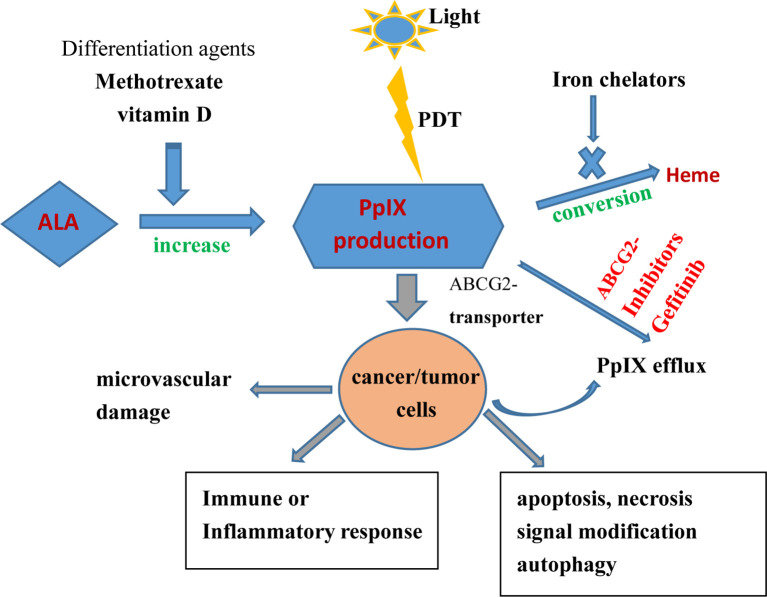
Comprehensive cancer treatments have been widely studied. Traditional treatment methods (e.g., radiotherapy, chemotherapy), despite ablating tumors, inevitably damage normal cells and cause serious complications. Photodynamic therapy (PDT), with its low rate of trauma, accurate targeting, synergism, repeatability, has displayed great advantages in the treatment of tumors. In recent years, nanotech-based PDT has provided a new modality for cancer treatment. Direct modification of PSs by nanotechnology or the delivery of PSs by nanocarriers can improve their targeting, specificity, and PDT efficacy for tumors. In this review, we strive to provide the reader with a comprehensive overview, on various aspects of the types, characteristics, and research progress of photosensitizers and nanomaterials used in PDT. And the application progress and relative limitations of nanotech-PDT in non-melanoma skin cancer and melanoma are also summarized.
综合癌症治疗方法已得到广泛研究。传统治疗方法(如放疗、化疗)尽管能消融肿瘤,但不可避免地会损伤正常细胞并引发严重并发症。光动力疗法(PDT)因其创伤率低、靶向精准、具有协同作用且可重复性强,在肿瘤治疗中显示出巨大优势。近年来,基于纳米技术的光动力疗法为癌症治疗提供了一种新方式。通过纳米技术直接修饰光敏剂或利用纳米载体递送光敏剂,可提高其对肿瘤的靶向性、特异性及光动力疗法疗效。在本综述中,我们力图为读者全面概述光动力疗法中所用光敏剂和纳米材料的类型、特性及研究进展等各个方面。同时还总结了纳米技术光动力疗法在非黑素瘤皮肤癌和黑素瘤中的应用进展及相关局限性。