Cohen R, Holland J P, Yokoi T, Holland M J
Mol Cell Biol. 1986 Jul;6(7):2287-97. doi: 10.1128/mcb.6.7.2287-2297.1986.
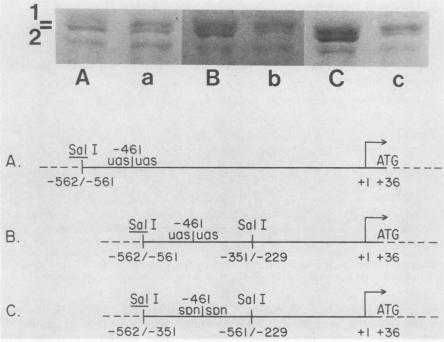
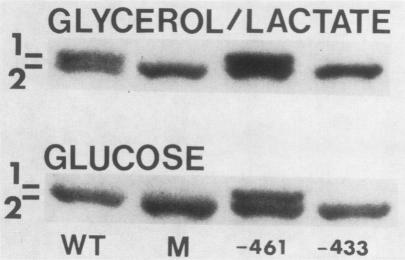
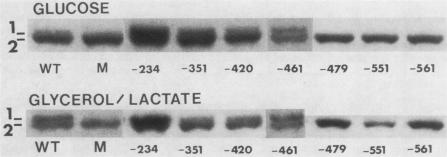
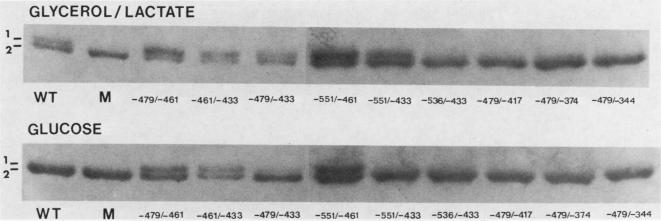
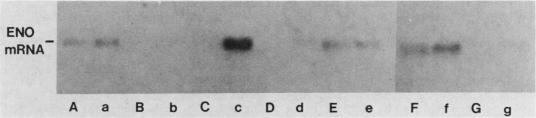
There are two yeast enolase genes, designated ENO1 and ENO2, which are expressed differentially in vegetative cells grown on glucose and in cells grown on gluconeogenic carbon sources. ENO2 is induced more than 20-fold in cells grown on glucose, whereas ENO1 expression is similar in cells grown on glucose and in cells grown on gluconeogenic carbon sources. Sequences within the 5' flanking region of ENO2 which are required for glucose-dependent induction were identified by deletion mapping analysis. These studies were carried out by using a fused gene containing the ENO2 5' flanking sequences and the ENO1 coding sequences. This fused gene undergoes glucose-dependent induction and is expressed at the same level as the resident ENO2 gene in cells grown on glucose or gluconeogenic carbon sources. Expression of fused genes containing deletion mutations within the ENO2 5' flanking region was monitored after integration at the ENO1 locus of a strain carrying a deletion of the resident ENO1 coding sequences. This analysis showed that there are two upstream activation sites located immediately upstream and downstream from a position 461 base pairs upstream from the transcriptional initiation site. Either one of these upstream activation sites is sufficient for glucose-dependent induction and normal gene expression in the presence of gluconeogenic carbon sources. Deletion of both regulatory regions results in a complete loss of gene expression. The regulatory regions function normally in both orientations relative to the coding sequences. Mutant fused genes containing small deletions within the regulatory regions were constructed; these genes were expressed normally in gluconeogenic carbon sources but were not induced in the presence of glucose. Based on this analysis, ENO2 contains a cis-acting regulatory region which is required for gene expression and mediates glucose-dependent induction of gene expression.
有两个酵母烯醇化酶基因,分别命名为ENO1和ENO2,它们在以葡萄糖为碳源生长的营养细胞以及以糖异生碳源生长的细胞中差异表达。在以葡萄糖为碳源生长的细胞中,ENO2的诱导倍数超过20倍,而ENO1在以葡萄糖为碳源生长的细胞和以糖异生碳源生长的细胞中的表达相似。通过缺失定位分析确定了ENO2 5'侧翼区域内葡萄糖依赖性诱导所需的序列。这些研究是通过使用一个包含ENO2 5'侧翼序列和ENO1编码序列的融合基因进行的。这个融合基因经历葡萄糖依赖性诱导,并且在以葡萄糖或糖异生碳源生长的细胞中与内源性ENO2基因以相同水平表达。在携带内源性ENO1编码序列缺失的菌株的ENO1位点整合后,监测了在ENO2 5'侧翼区域内含有缺失突变的融合基因的表达。该分析表明,在转录起始位点上游461个碱基对的位置的上游和下游紧邻处有两个上游激活位点。这些上游激活位点中的任何一个对于葡萄糖依赖性诱导和在存在糖异生碳源时的正常基因表达都是足够的。两个调控区域的缺失导致基因表达完全丧失。调控区域相对于编码序列在两个方向上都正常发挥作用。构建了在调控区域内含有小缺失的突变融合基因;这些基因在糖异生碳源中正常表达,但在葡萄糖存在时不被诱导。基于此分析,ENO2包含一个顺式作用调控区域,该区域是基因表达所必需的,并介导基因表达的葡萄糖依赖性诱导。