Department of Surgery, Radboud University Medical Center, Nijmegen, Netherlands.
Department of Design, Production, and Management, Faculty of Engineering Technology, University of Twente, Enschede, Netherlands.
J Med Internet Res. 2022 Apr 4;24(4):e33787. doi: 10.2196/33787.
Digital health refers to the proper use of technology for improving the health and well-being of people and enhancing the care of patients through the intelligent processing of clinical and genetic data. Despite increasing interest in well-being in both health care and technology, there is no clear understanding of what constitutes well-being, which leads to uncertainty in how to create well-being through digital health. In an effort to clarify this uncertainty, Brey developed a framework to define problems in technology for well-being using the following four categories: epistemological problem, scope problem, specification problem, and aggregation problem.
This systematic scoping review aims to gain insights into how to define and address well-being in digital health.
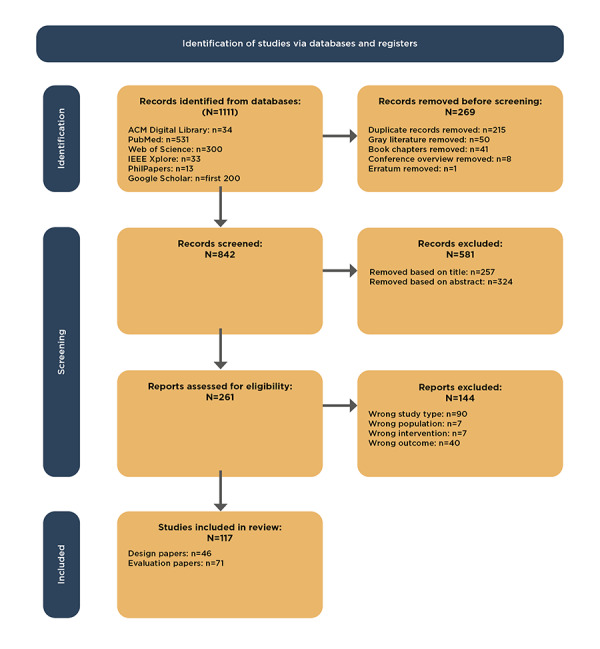
We followed the PRISMA-ScR (Preferred Reporting Items for Systematic Reviews and Meta-Analyses extension for Scoping Reviews) checklist. Papers were identified from 6 databases and included if they addressed the design or evaluation of digital health and reported the enhancement of patient well-being as their purpose. These papers were divided into design and evaluation papers. We studied how the 4 problems in technology for well-being are considered per paper.
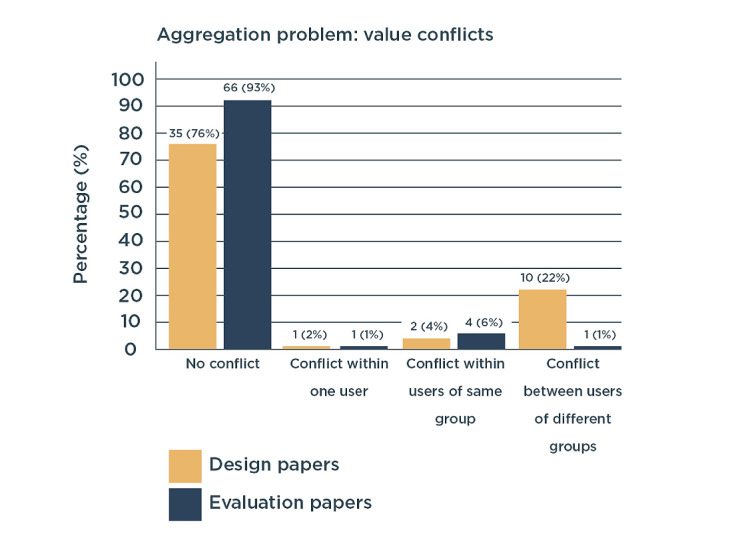
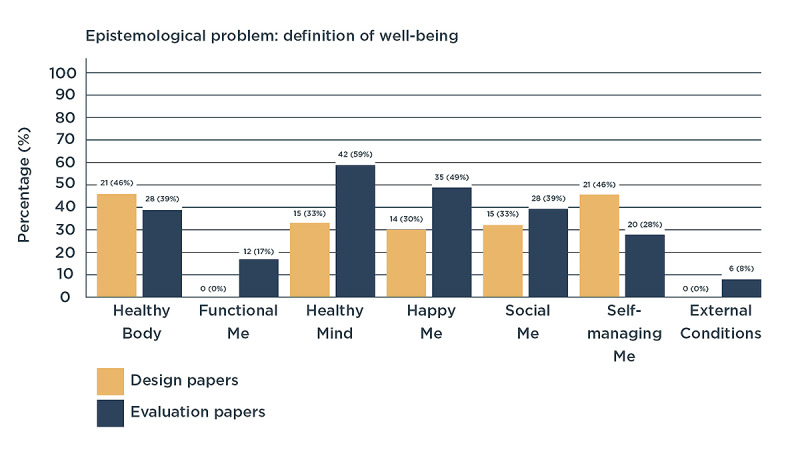
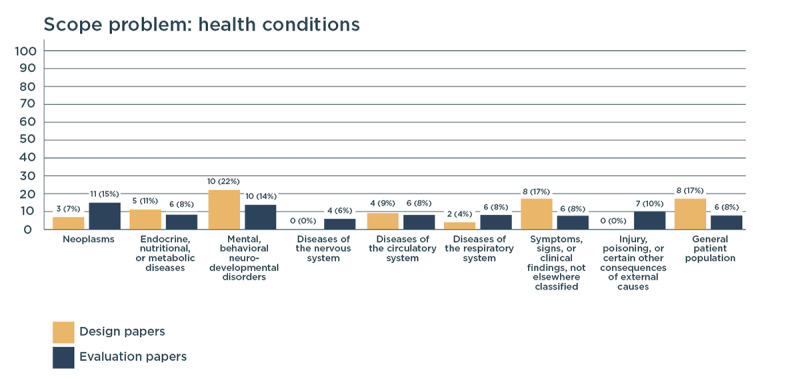
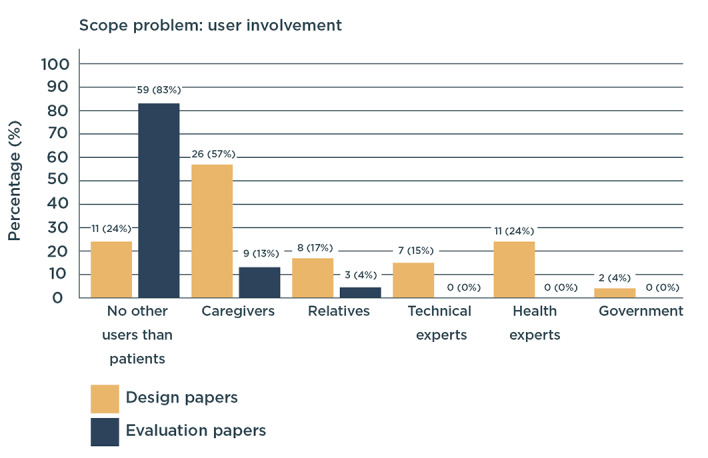
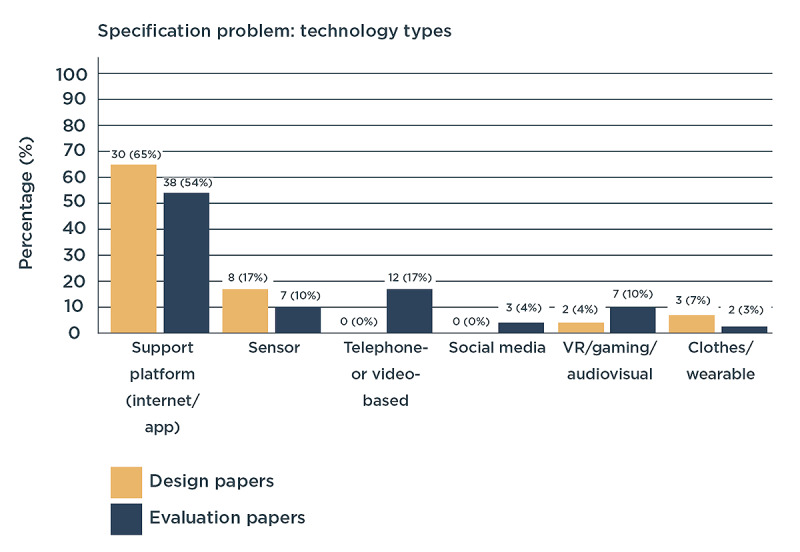
A total of 117 studies were eligible for analysis (n=46, 39.3% design papers and n=71, 60.7% evaluation papers). For the epistemological problem, the thematic analysis resulted in various definitions of well-being, which were grouped into the following seven values: healthy body, functional me, healthy mind, happy me, social me, self-managing me, and external conditions. Design papers mostly considered well-being as healthy body and self-managing me, whereas evaluation papers considered the values of healthy mind and happy me. Users were rarely involved in defining well-being. For the scope problem, patients with chronic care needs were commonly considered as the main users. Design papers also regularly involved other users, such as caregivers and relatives. These users were often not involved in evaluation papers. For the specification problem, most design and evaluation papers focused on the provision of care support through a digital platform. Design papers used numerous design methods, whereas evaluation papers mostly considered pre-post measurements and randomized controlled trials. For the aggregation problem, value conflicts were rarely described.
Current practice has found pragmatic ways of circumventing or dealing with the problems of digital health for well-being. Major differences exist between the design and evaluation of digital health, particularly regarding their conceptualization of well-being and the types of users studied. In addition, we found that current methodologies for designing and evaluating digital health can be improved. For optimal digital health for well-being, multidisciplinary collaborations that move beyond the common dichotomy of design and evaluation are needed.
数字健康是指通过临床和遗传数据的智能处理,正确使用技术来改善人们的健康和幸福感,并增强患者的护理。尽管人们对医疗保健和技术领域的幸福感越来越感兴趣,但对于幸福感的构成并没有明确的认识,这导致了如何通过数字健康创造幸福感的不确定性。为了澄清这种不确定性,Brey 开发了一个框架,使用以下四个类别来定义技术中的幸福感问题:认识论问题、范围问题、规范问题和聚合问题。
本系统范围综述旨在深入了解如何定义和解决数字健康中的幸福感问题。
我们遵循 PRISMA-ScR(系统评价和荟萃分析扩展的首选报告项目用于范围综述)检查表。从 6 个数据库中确定了论文,如果它们涉及数字健康的设计或评估,并报告将患者幸福感的提高作为其目的,则将这些论文包括在内。这些论文分为设计和评估论文。我们研究了每篇论文如何考虑技术中的 4 个幸福感问题。
共有 117 项研究符合分析条件(n=46,39.3%的设计论文和 n=71,60.7%的评估论文)。对于认识论问题,主题分析导致了幸福感的各种定义,这些定义被分为以下七个价值观:健康的身体、功能我、健康的心理、快乐的我、社会的我、自我管理的我和外部条件。设计论文主要将幸福感视为健康的身体和自我管理的我,而评估论文则考虑了健康心理和快乐的我的价值观。很少有用户参与幸福感的定义。对于范围问题,患有慢性护理需求的患者通常被认为是主要用户。设计论文还经常涉及其他用户,如护理人员和亲属。这些用户通常不参与评估论文。对于规范问题,大多数设计和评估论文都侧重于通过数字平台提供护理支持。设计论文使用了许多设计方法,而评估论文主要考虑前后测量和随机对照试验。对于聚合问题,很少描述价值冲突。
目前的实践已经找到了规避或解决数字健康幸福感问题的务实方法。数字健康的设计和评估之间存在重大差异,特别是在幸福感的概念化和研究的用户类型方面。此外,我们发现数字健康的设计和评估方法可以得到改进。为了实现最佳的数字健康幸福感,需要超越设计和评估的常见二分法,进行多学科合作。