Integrated Mathematical Oncology Department, H. Lee Moffitt Cancer Center & Research Institute, 12902 Magnolia Drive, SRB 4, Tampa, FL, 336122, USA.
Evolution and Cancer Laboratory, Centre for Genomics and Computational Biology, Barts Cancer Institute, Queen Mary University of London, London, EC1M 6BQ, UK.
Nat Commun. 2022 Apr 4;13(1):1798. doi: 10.1038/s41467-022-29027-8.
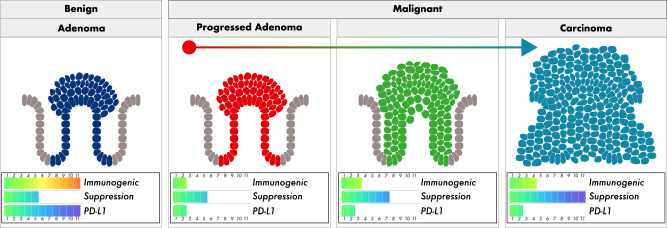
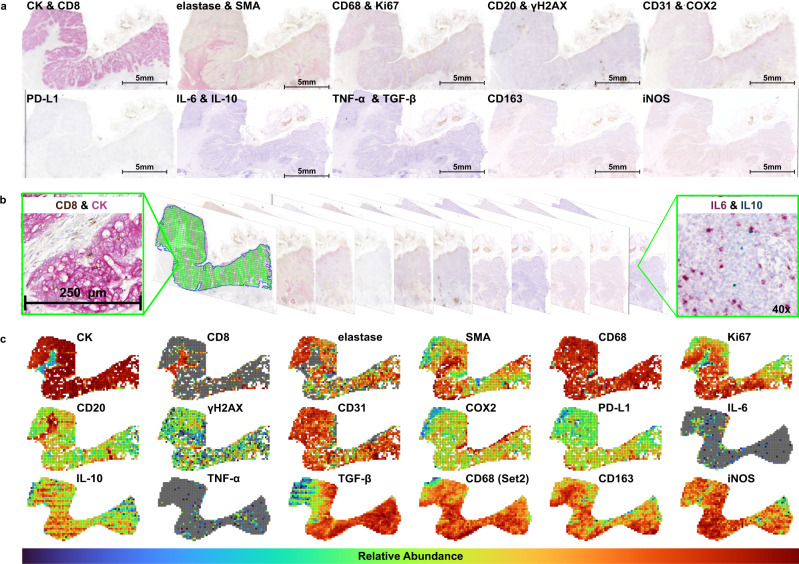
The evolutionary dynamics of tumor initiation remain undetermined, and the interplay between neoplastic cells and the immune system is hypothesized to be critical in transformation. Colorectal cancer (CRC) presents a unique opportunity to study the transition to malignancy as pre-cancers (adenomas) and early-stage cancers are frequently resected. Here, we examine tumor-immune eco-evolutionary dynamics from pre-cancer to carcinoma using a computational model, ecological analysis of digital pathology data, and neoantigen prediction in 62 patient samples. Modeling predicted recruitment of immunosuppressive cells would be the most common driver of transformation. As predicted, ecological analysis reveals that progressed adenomas co-localized with immunosuppressive cells and cytokines, while benign adenomas co-localized with a mixed immune response. Carcinomas converge to a common immune "cold" ecology, relaxing selection against immunogenicity and high neoantigen burdens, with little evidence for PD-L1 overexpression driving tumor initiation. These findings suggest re-engineering the immunosuppressive niche may prove an effective immunotherapy in CRC.
肿瘤起始的进化动态仍未确定,并且肿瘤细胞与免疫系统之间的相互作用被假设在转化中至关重要。结直肠癌(CRC)为研究向恶性肿瘤的转变提供了独特的机会,因为经常切除癌前病变(腺瘤)和早期癌症。在这里,我们使用计算模型、数字病理学数据的生态分析和 62 个患者样本中的新抗原预测,研究从癌前病变到癌的肿瘤免疫生态进化动态。模型预测,免疫抑制细胞的招募将是转化的最常见驱动因素。正如预测的那样,生态分析表明进展性腺瘤与免疫抑制细胞和细胞因子共定位,而良性腺瘤与混合免疫反应共定位。癌集中到一个共同的免疫“冷”生态,对免疫原性和高新抗原负担的选择放松,几乎没有证据表明 PD-L1 过表达驱动肿瘤起始。这些发现表明,重新设计免疫抑制生态位可能被证明是 CRC 有效的免疫疗法。