Institute of Pathology, Charité Universitätsmedizin Berlin, Berlin, Germany.
German Cancer Consortium (DKTK), Heidelberg, Germany.
BMC Biol. 2020 Sep 7;18(1):116. doi: 10.1186/s12915-020-00844-x.
Colorectal cancer (CRC) development is generally accepted as a sequential process, with genetic mutations determining phenotypic tumor progression. However, matching genetic profiles with histological transition requires the analyses of temporal samples from the same patient at key stages of progression.
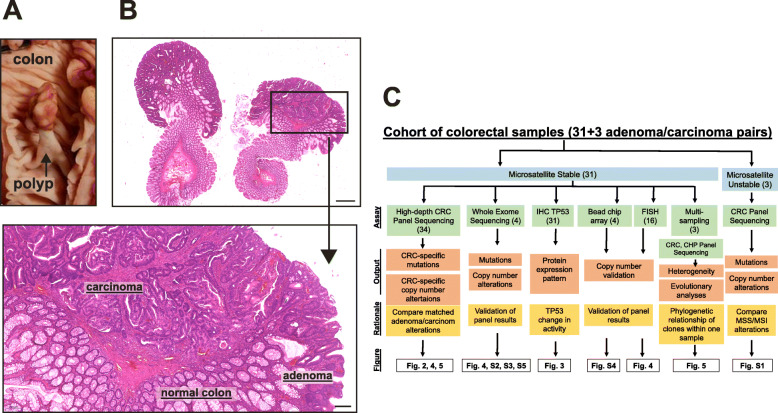
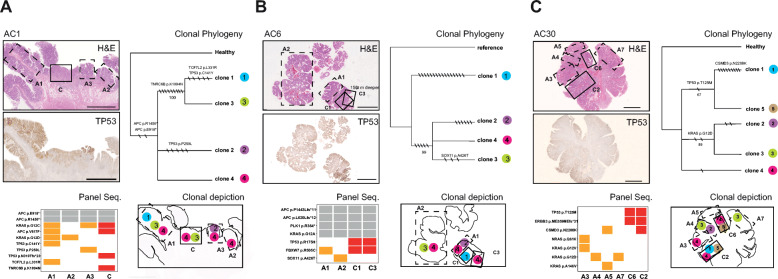
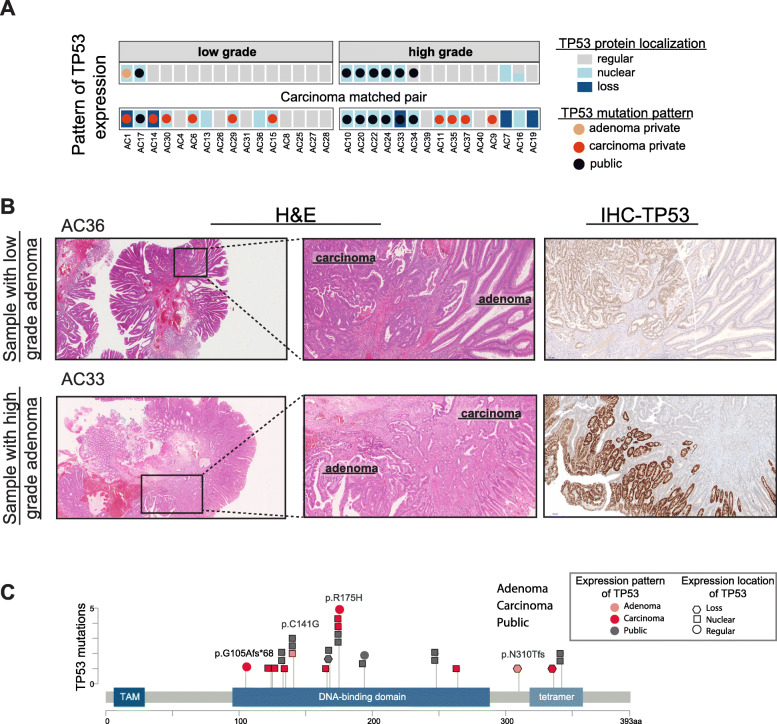
Here, we compared the genetic profiles of 34 early carcinomas with their respective adenomatous precursors to assess timing and heterogeneity of driver alterations accompanying the switch from benign adenoma to malignant carcinoma. In almost half of the cases, driver mutations specific to the carcinoma stage were not observed. In samples where carcinoma-specific alterations were present, TP53 mutations and chromosome 20 copy gains commonly accompanied the switch from adenomatous tissue to carcinoma. Remarkably, 40% and 50% of high-grade adenomas shared TP53 mutations and chromosome 20 gains, respectively, with their matched carcinomas. In addition, multi-regional analyses revealed greater heterogeneity of driver mutations in adenomas compared to their matched carcinomas.
Genetic alterations in TP53 and chromosome 20 occur at the earliest histological stage in colorectal carcinomas (pTis and pT1). However, high-grade adenomas can share these alterations despite their histological distinction. Based on the well-defined sequence of CRC development, we suggest that the timing of genetic changes during neoplastic progression is frequently uncoupled from histological progression.
结直肠癌(CRC)的发展通常被认为是一个连续的过程,遗传突变决定了肿瘤表型的进展。然而,要将遗传特征与组织学转变相匹配,需要对同一患者在进展的关键阶段的时间样本进行分析。
在这里,我们比较了 34 例早期癌与其各自的腺瘤前体的遗传特征,以评估从良性腺瘤向恶性癌转变过程中伴随的驱动改变的时间和异质性。在近一半的病例中,没有观察到特定于癌阶段的驱动突变。在存在癌特异性改变的样本中,TP53 突变和 20 号染色体拷贝数增加通常伴随着从腺瘤组织到癌的转变。值得注意的是,40%和 50%的高级别腺瘤分别与其匹配的癌共享 TP53 突变和 20 号染色体获得。此外,多区域分析显示,腺瘤中的驱动突变异质性大于其匹配的癌。
TP53 和 20 号染色体上的遗传改变最早发生在结直肠癌的组织学阶段(Tis 和 T1)。然而,尽管高级别腺瘤在组织学上有所不同,但它们可以共享这些改变。基于结直肠癌发展的明确序列,我们认为在肿瘤进展过程中遗传变化的时间通常与组织学进展不同步。