Gavin Herbert Eye Institute, Center for Translational Vision Research, Department of Ophthalmology, University of California-Irvine, Irvine, CA, United States of America.
Institute for Clinical and Translational Sciences, University of California-Irvine, Irvine, CA, United States of America.
PLoS One. 2022 Apr 6;17(4):e0265185. doi: 10.1371/journal.pone.0265185. eCollection 2022.
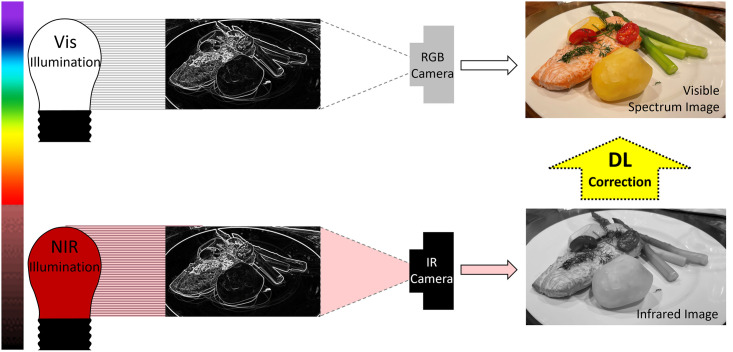
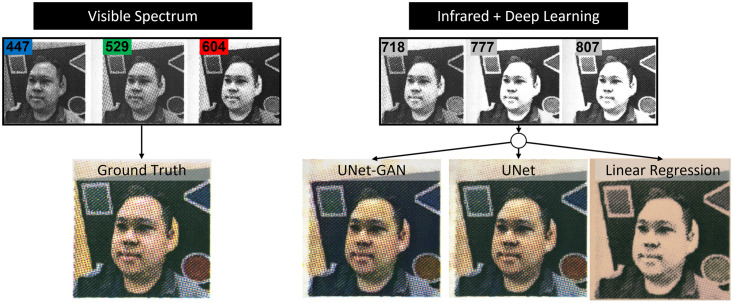
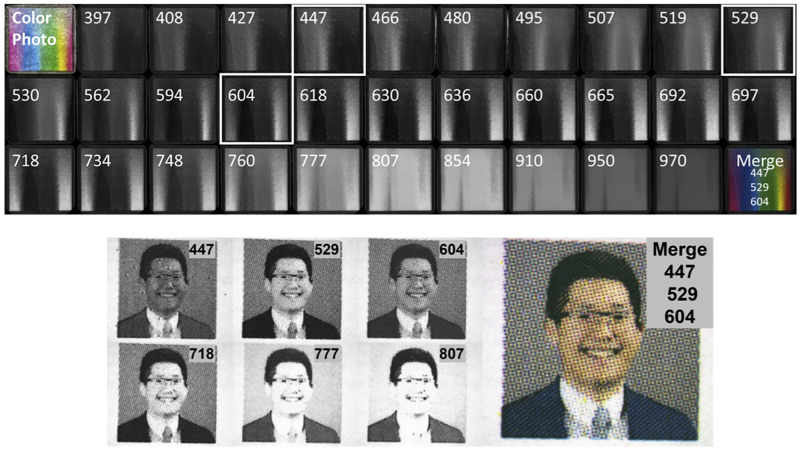
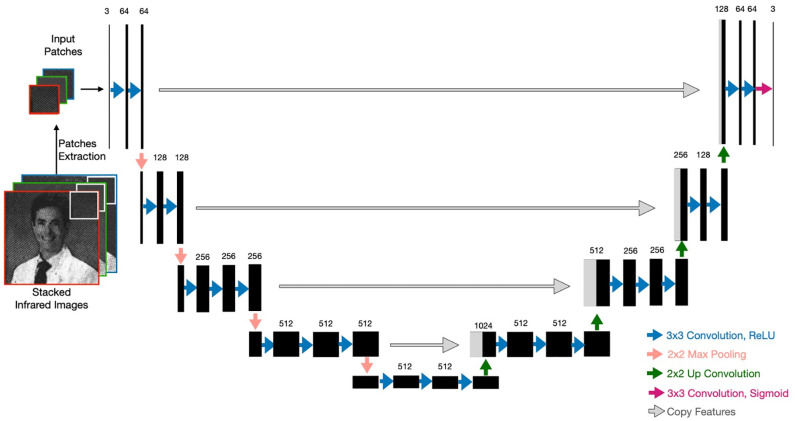
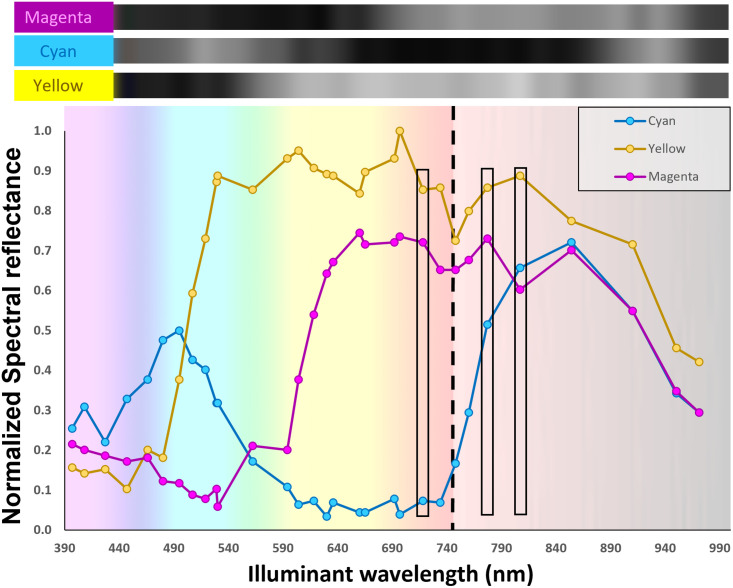
Humans perceive light in the visible spectrum (400-700 nm). Some night vision systems use infrared light that is not perceptible to humans and the images rendered are transposed to a digital display presenting a monochromatic image in the visible spectrum. We sought to develop an imaging algorithm powered by optimized deep learning architectures whereby infrared spectral illumination of a scene could be used to predict a visible spectrum rendering of the scene as if it were perceived by a human with visible spectrum light. This would make it possible to digitally render a visible spectrum scene to humans when they are otherwise in complete "darkness" and only illuminated with infrared light. To achieve this goal, we used a monochromatic camera sensitive to visible and near infrared light to acquire an image dataset of printed images of faces under multispectral illumination spanning standard visible red (604 nm), green (529 nm) and blue (447 nm) as well as infrared wavelengths (718, 777, and 807 nm). We then optimized a convolutional neural network with a U-Net-like architecture to predict visible spectrum images from only near-infrared images. This study serves as a first step towards predicting human visible spectrum scenes from imperceptible near-infrared illumination. Further work can profoundly contribute to a variety of applications including night vision and studies of biological samples sensitive to visible light.
人类只能感知可见光光谱(400-700nm)。一些夜视系统使用人眼不可见的红外光,生成的图像被转换为数字显示器,呈现出可见光光谱中的单色图像。我们旨在开发一种由优化的深度学习架构提供动力的成像算法,通过该算法,场景的红外光谱照明可以被用来预测场景的可见光谱渲染,就好像人用可见光谱光感知一样。这将使得当人处于完全“黑暗”状态,只能被红外光照明时,能够以数字方式呈现可见光谱场景。为了实现这一目标,我们使用了对可见光和近红外光敏感的单色相机,在多光谱照明下获取人脸的打印图像数据集,包括标准可见红光(604nm)、绿光(529nm)、蓝光(447nm)以及红外光波长(718nm、777nm 和 807nm)。然后,我们使用类似于 U-Net 的卷积神经网络对其进行优化,以便仅从近红外图像预测可见光谱图像。本研究是从不可见的近红外照明预测人眼可见光谱场景的第一步。进一步的工作可以为多种应用做出重要贡献,包括夜视和对可见光敏感的生物样本研究。