Wang Zhule, Nogueira Liebert Parreiras, Haugen Håvard Jostein, Van Der Geest Ingrid Cm, de Almeida Rodrigues Patricia Caetano, Janssen Dennis, Bitter Thom, van den Beucken Jeroen J J P, Leeuwenburgh Sander Cg
Radboud University Medical Center, Department of Dentistry - Regenerative Biomaterials, Radboud Institute for Molecular Life Sciences, Nijmegen, the Netherlands.
University of Oslo, Department of Biomaterials, Institute of Clinical Dentistry, Faculty of Dentistry, Oslo, Norway.
Bioact Mater. 2021 Dec 29;15:120-130. doi: 10.1016/j.bioactmat.2021.12.023. eCollection 2022 Sep.
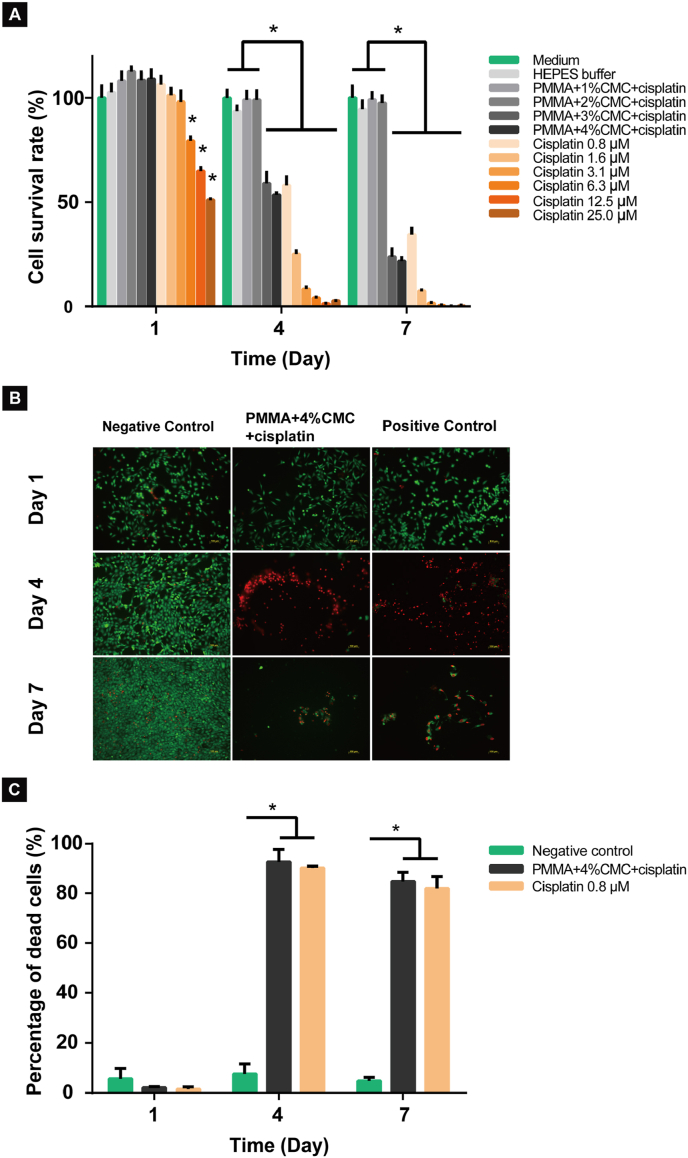
Malignant bone tumors are usually treated by resection of tumor tissue followed by filling of the bone defect with bone graft substitutes. Polymethylmethacrylate (PMMA) cement is the most commonly used bone substitute in clinical orthopedics in view of its reliability. However, the dense nature of PMMA renders this biomaterial unsuitable for local delivery of chemotherapeutic drugs to limit the recurrence of bone tumors. Here, we introduce porosity into PMMA cement by adding carboxymethylcellulose (CMC) to facilitate such local delivery of chemotherapeutic drugs, while retaining sufficient mechanical properties for bone reconstruction in load-bearing sites. Our results show that the mechanical strength of PMMA-based cements gradually decreases with increasing CMC content. Upon incorporation of ≥3% CMC, the PMMA-based cements released up to 18% of the loaded cisplatin, in contrast to cements containing lower amounts of CMC which only released less than 2% of the cisplatin over 28 days. This release of cisplatin efficiently killed osteosarcoma cells and the fraction of dead cells increased to 91.3% at day 7, which confirms the retained chemotherapeutic activity of released cisplatin from these PMMA-based cements. Additionally, tibias filled with PMMA-based cements containing up to 3% of CMC exhibit comparable compressive strengths as compared to intact tibias. In conclusion, we demonstrate that PMMA cements can be rendered therapeutically active by introducing porosity using CMC to allow for release of cisplatin without compromising mechanical properties beyond critical levels. As such, these data suggest that our dual-functional PMMA-based cements represent a viable treatment option for filling bone defects after bone tumor resection in load-bearing sites.
恶性骨肿瘤通常通过切除肿瘤组织,随后用骨移植替代物填充骨缺损来进行治疗。鉴于其可靠性,聚甲基丙烯酸甲酯(PMMA)骨水泥是临床骨科中最常用的骨替代物。然而,PMMA的致密性质使得这种生物材料不适用于局部递送化疗药物以限制骨肿瘤的复发。在此,我们通过添加羧甲基纤维素(CMC)在PMMA骨水泥中引入孔隙,以促进化疗药物的这种局部递送,同时保留足够的机械性能用于承重部位的骨重建。我们的结果表明,基于PMMA的骨水泥的机械强度随着CMC含量的增加而逐渐降低。当加入≥3%的CMC时,基于PMMA的骨水泥释放了高达18%负载的顺铂,相比之下,含有较低量CMC的骨水泥在28天内仅释放了不到2%的顺铂。顺铂的这种释放有效地杀死了骨肉瘤细胞,并且在第7天死亡细胞的比例增加到91.3%,这证实了从这些基于PMMA的骨水泥中释放的顺铂保留了化疗活性。此外,填充有含有高达3% CMC的基于PMMA的骨水泥的胫骨与完整胫骨相比表现出相当的抗压强度。总之,我们证明通过使用CMC引入孔隙可以使PMMA骨水泥具有治疗活性,以允许顺铂的释放而不会在超过临界水平的情况下损害机械性能。因此,这些数据表明我们的双功能基于PMMA的骨水泥是承重部位骨肿瘤切除后填充骨缺损的一种可行治疗选择。