Chan Kam Wa, Yu Kam Yan, Yiu Wai Han, Xue Rui, Lok Sarah Wing-Yan, Li Hongyu, Zou Yixin, Ma Jinyuan, Lai Kar Neng, Tang Sydney Chi-Wai
Department of Medicine, The University of Hong Kong, Hong Kong SAR, China.
Front Pharmacol. 2022 Mar 21;13:794139. doi: 10.3389/fphar.2022.794139. eCollection 2022.
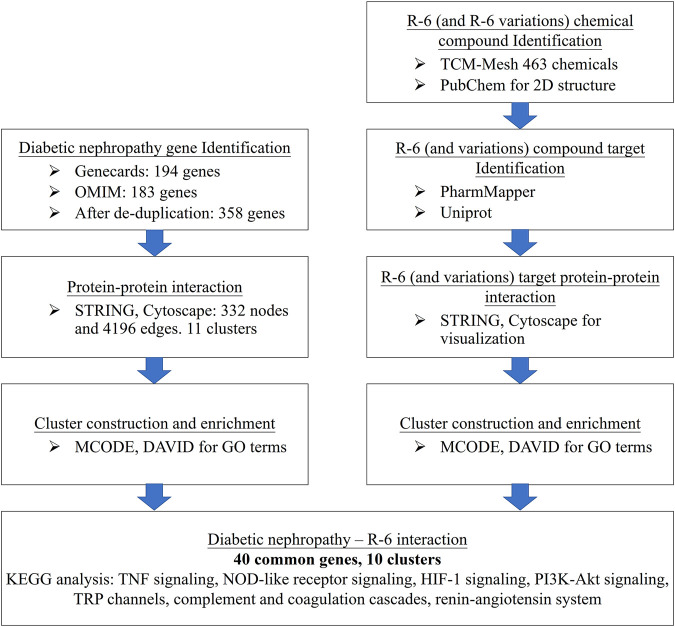
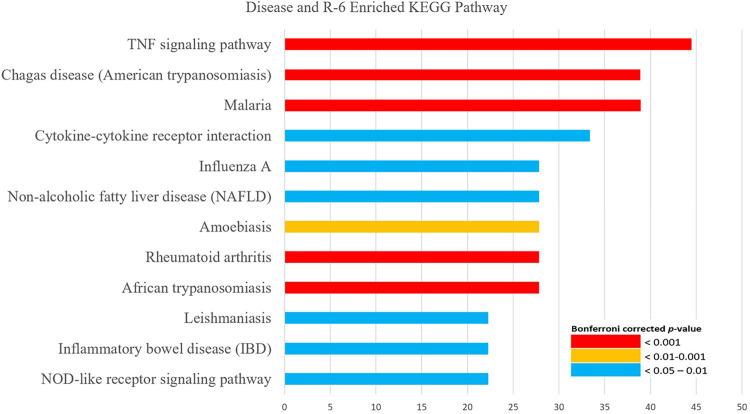
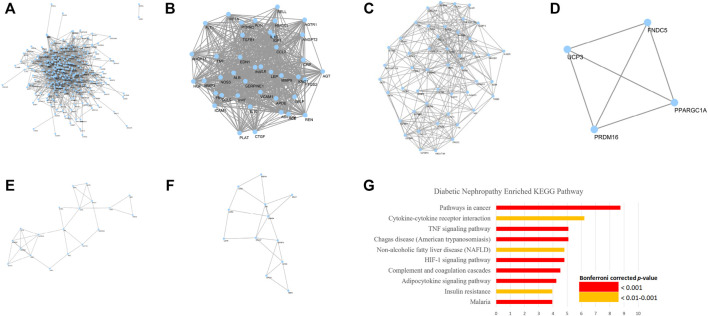
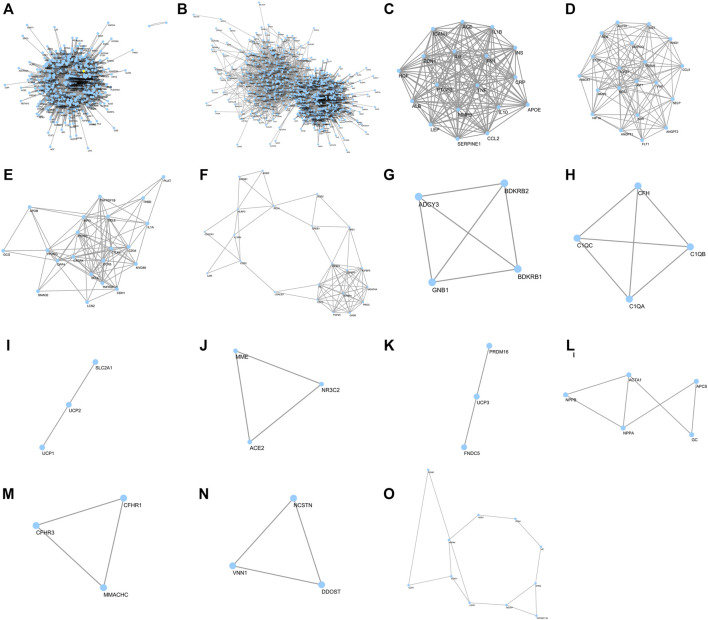
Previous retrospective cohorts showed that Rehmannia-6 (R-6, Liu-wei-di-huang-wan) formulations were associated with significant kidney function preservation and mortality reduction among chronic kidney disease patients with diabetes. This study aimed to investigate the potential mechanism of action of common R-6 variations in a clinical protocol for diabetic nephropathy (DN) from a system pharmacology approach. Disease-related genes were retrieved from GeneCards and OMIM by searching "Diabetic Nephropathy" and "Macroalbuminuria". Variations of R-6 were identified from a published existing clinical practice guideline developed from expert consensus and pilot clinical service program. The chemical compound IDs of each herb were retrieved from TCM-Mesh and PubChem. Drug targets were subsequently revealed via PharmaMapper and UniProtKB. The disease gene interactions were assessed through STRING, and disease-drug protein-protein interaction network was integrated and visualized by Cytoscape. Clusters of disease-drug protein-protein interaction were constructed by Molecular Complex Detection (MCODE) extension. Functional annotation of clusters was analyzed by DAVID and KEGG pathway enrichment. Differences among variations of R-6 were compared. Binding was verified by molecular docking with AutoDock. Three hundred fifty-eight genes related to DN were identified, forming 11 clusters which corresponded to complement and coagulation cascades and signaling pathways of adipocytokine, TNF, HIF-1, and AMPK. Five variations of R-6 were analyzed. Common putative targets of the R-6 variations on DN included ACE, APOE, CCL2, CRP, EDN1, FN1, HGF, ICAM1, IL10, IL1B, IL6, INS, LEP, MMP9, PTGS2, SERPINE1, and TNF, which are related to regulation of nitric oxide biosynthesis, lipid storage, cellular response to lipopolysaccharide, inflammatory response, NF-kappa B transcription factor activity, smooth muscle cell proliferation, blood pressure, cellular response to interleukin-1, angiogenesis, cell proliferation, peptidyl-tyrosine phosphorylation, and protein kinase B signaling. TNF was identified as the seed for the most significant cluster of all R-6 variations. Targets specific to each formulation were identified. The key chemical compounds of R-6 have good binding ability to the putative protein targets. The mechanism of action of R-6 on DN is mostly related to the TNF signaling pathway as a core mechanism, involving amelioration of angiogenesis, fibrosis, inflammation, disease susceptibility, and oxidative stress. The putative targets identified could be validated through clinical trials.
既往回顾性队列研究表明,六味地黄丸制剂与糖尿病慢性肾病患者显著的肾功能保护及死亡率降低相关。本研究旨在从系统药理学方法探讨常见六味地黄丸变体在糖尿病肾病(DN)临床方案中的潜在作用机制。通过搜索“糖尿病肾病”和“大量蛋白尿”,从GeneCards和OMIM中检索疾病相关基因。六味地黄丸变体从已发表的由专家共识和试点临床服务项目制定的现有临床实践指南中确定。每种草药的化合物ID从TCM-Mesh和PubChem中检索。随后通过PharmaMapper和UniProtKB揭示药物靶点。通过STRING评估疾病基因相互作用,并通过Cytoscape整合和可视化疾病-药物蛋白质-蛋白质相互作用网络。通过分子复合物检测(MCODE)扩展构建疾病-药物蛋白质-蛋白质相互作用簇。通过DAVID和KEGG通路富集分析簇的功能注释。比较六味地黄丸变体之间的差异。通过AutoDock分子对接验证结合。鉴定出358个与糖尿病肾病相关的基因,形成11个簇,分别对应补体和凝血级联以及脂肪细胞因子、TNF、HIF-1和AMPK的信号通路。分析了六味地黄丸的5种变体。六味地黄丸变体对糖尿病肾病的常见假定靶点包括ACE、APOE、CCL2、CRP、EDN1、FN1、HGF、ICAM1、IL10、IL1B、IL6、INS、LEP、MMP9、PTGS2、SERPINE1和TNF,这些靶点与一氧化氮生物合成调节、脂质储存、细胞对脂多糖的反应、炎症反应、NF-κB转录因子活性、平滑肌细胞增殖、血压、细胞对白介素-1的反应、血管生成、细胞增殖、肽基酪氨酸磷酸化和蛋白激酶B信号传导有关。TNF被确定为所有六味地黄丸变体中最显著簇的种子。确定了每种制剂特有的靶点。六味地黄丸的关键化合物对假定的蛋白质靶点具有良好的结合能力。六味地黄丸对糖尿病肾病的作用机制主要与TNF信号通路作为核心机制有关,涉及改善血管生成、纤维化、炎症、疾病易感性和氧化应激。所确定的假定靶点可通过临床试验进行验证。