Firoz Tabassum, Trigo Romero Carla Lionela, Leung Clarus, Souza João Paulo, Tunçalp Özge
Yale New Haven Health, Bridgeport Hospital, Bridgeport, Connecticut, USA
Department of Social Medicine, University of Sao Paulo Faculty of Medicine of Ribeirao Preto, Ribeirao Preto, Brazil.
BMJ Glob Health. 2022 Apr;7(4). doi: 10.1136/bmjgh-2021-007077.
Maternal near miss (MNM) is a useful means to examine quality of obstetric care. Since the introduction of the WHO MNM criteria in 2011, it has been tested and validated, and is being used globally. We sought to systematically review all available studies using the WHO MNM criteria to develop global and regional estimates of MNM frequency and examine its application across settings.
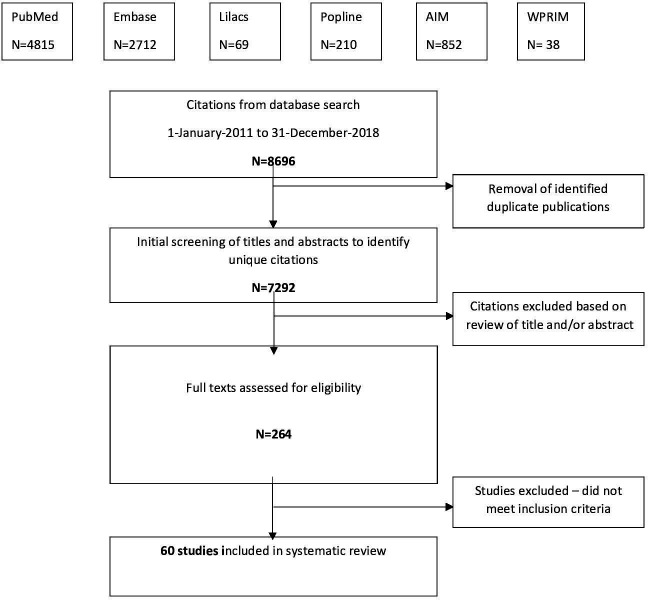
We conducted a systematic review by implementing a comprehensive literature search from 2011 to 2018 in six databases with no language restrictions. The predefined data collection tool included sections on study characteristics, frequency of near-miss cases and study quality. Meta-analysis was performed by regional groupings. Reported adaptations, modifications and remarks about application were extracted.
7292 articles were screened by title and abstract, and 264 articles were retrieved for full text review for the meta-analysis. An additional 230 articles were screened for experiences with application of the WHO MNM criteria. Sixty studies with near-miss data from 56 countries were included in the meta-analysis. The pooled global near-miss estimate was 1.4% (95% CI 0.4% to 2.5%) with regional variation in MNM frequency. Of the 20 studies that made adaptations to the criteria, 19 were from low-resource settings where lab-based criteria were adapted due to resource limitations.
The WHO MNM criteria have enabled the comparison of global and sub-national estimates of MNM frequency. There has been good uptake in low-resource countries but contextual adaptations are necessary.
孕产妇险些死亡(MNM)是评估产科护理质量的一种有效手段。自2011年世界卫生组织(WHO)的MNM标准推出以来,该标准已经过测试和验证,并在全球范围内得到应用。我们旨在系统回顾所有使用WHO的MNM标准的现有研究,以得出全球和区域MNM发生率的估计值,并研究其在不同环境中的应用情况。
我们通过在六个无语言限制的数据库中进行全面的文献检索,从2011年至2018年开展了一项系统回顾。预定义的数据收集工具包括研究特征、险些死亡病例发生率和研究质量等部分。按区域分组进行荟萃分析。提取了有关应用的报告改编、修改和说明。
通过标题和摘要筛选了7292篇文章,检索到264篇文章进行全文审查以进行荟萃分析。另外筛选了230篇文章以了解WHO的MNM标准的应用经验。荟萃分析纳入了来自56个国家的60项有险些死亡数据的研究。全球汇总的险些死亡估计值为1.4%(95%置信区间0.4%至2.5%),MNM发生率存在区域差异。在对标准进行改编的20项研究中,19项来自资源匮乏地区,由于资源限制对基于实验室的标准进行了改编。
WHO的MNM标准使得能够对全球和国家以下层面的MNM发生率估计值进行比较。资源匮乏国家对该标准的接受度良好,但有必要根据具体情况进行调整。