Corbin Denis, Lesage Frédéric
Laboratoire d'Imagerie optique et Moléculaire, Polytechnique Montréal, 2500 Chemin de Polytechnique Montréal, Montreal, QC, H3T 1J4, Canada.
Institut de Cardiologie de Montréal, 5000 Rue Bélanger, Montreal, QC, H1T 1C8, Canada.
Sci Rep. 2022 Apr 6;12(1):5767. doi: 10.1038/s41598-022-09719-3.
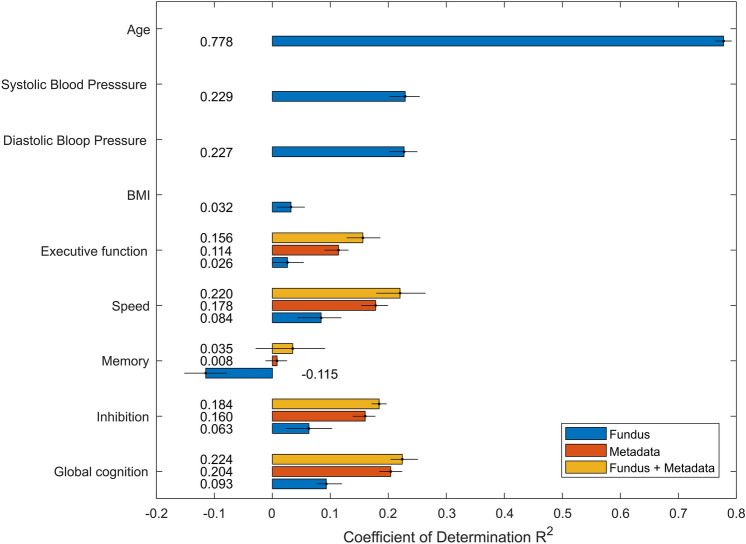
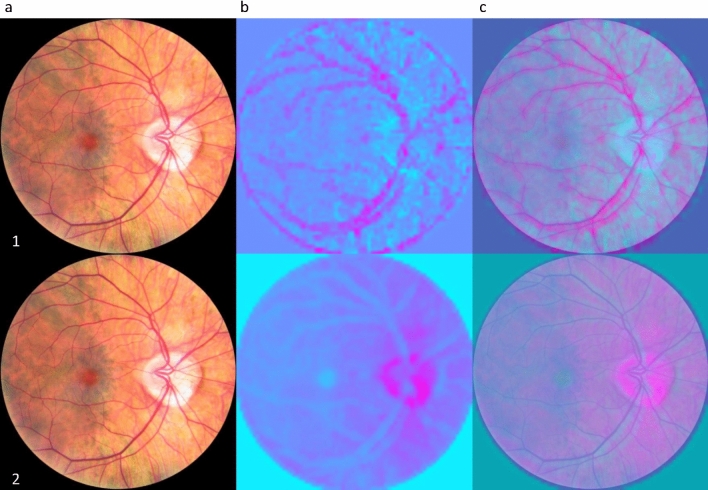
Accumulation of beta-amyloid in the brain and cognitive decline are considered hallmarks of Alzheimer's disease. Knowing from previous studies that these two factors can manifest in the retina, the aim was to investigate whether a deep learning method was able to predict the cognition of an individual from a RGB image of his retina and metadata. A deep learning model, EfficientNet, was used to predict cognitive scores from the Canadian Longitudinal Study on Aging (CLSA) database. The proposed model explained 22.4% of the variance in cognitive scores on the test dataset using fundus images and metadata. Metadata alone proved to be more effective in explaining the variance in the sample (20.4%) versus fundus images (9.3%) alone. Attention maps highlighted the optic nerve head as the most influential feature in predicting cognitive scores. The results demonstrate that RGB fundus images are limited in predicting cognition.
大脑中β-淀粉样蛋白的积累和认知能力下降被认为是阿尔茨海默病的标志。从先前的研究中了解到这两个因素会在视网膜中显现,目的是研究深度学习方法是否能够根据个体视网膜的RGB图像和元数据预测其认知能力。使用深度学习模型EfficientNet从加拿大老龄化纵向研究(CLSA)数据库中预测认知分数。所提出的模型使用眼底图像和元数据解释了测试数据集中认知分数方差的22.4%。单独的元数据在解释样本方差(20.4%)方面比单独的眼底图像(9.3%)更有效。注意力图突出显示视神经乳头是预测认知分数时最具影响力的特征。结果表明,RGB眼底图像在预测认知方面存在局限性。