Department of Biostatistics, Institute of Psychiatry, Psychology & Neuroscience, King's College London, London, UK.
Department of Pediatrics, Gynaecology and Obstetrics, Faculty of Medicine, University of Geneva, Geneva, Switzerland.
Eur Eat Disord Rev. 2022 Sep;30(5):604-615. doi: 10.1002/erv.2902. Epub 2022 Apr 6.
Previous literature shows an increased risk for eating disorders in autistic individuals. This study tested whether fussy eating contributes to the association between childhood autistic traits and adolescent eating disorder behaviours.
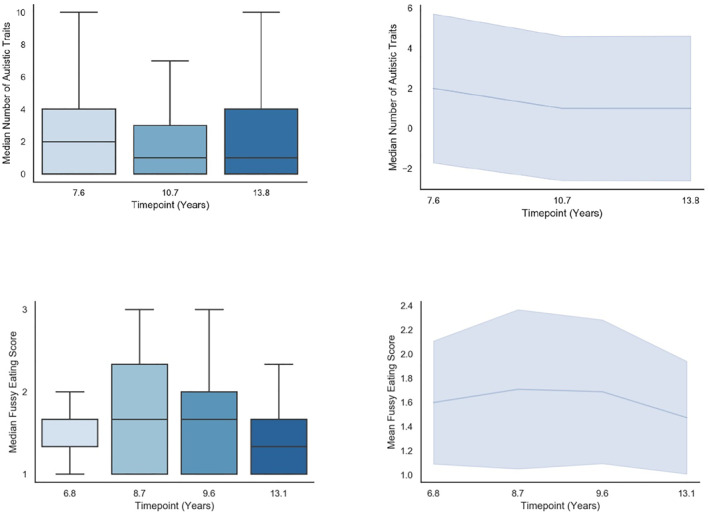
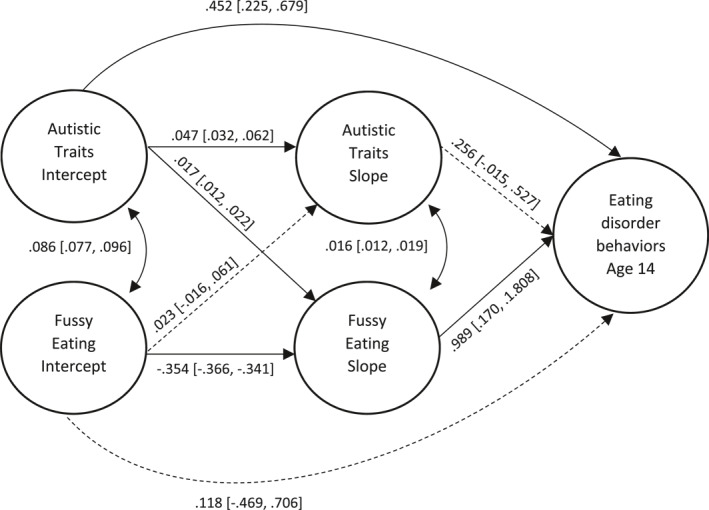
Using data from the Avon Longitudinal Study of Parents and Children, we estimated the intercept and slope of parent-rated autistic traits and fussy eating between 7 and 14 years (N = 8982) and their association with self-reported eating disorder behaviours at age 14 years, including the indirect path from autistic traits to eating disorder behaviours via fussy eating. Analyses were adjusted for child sex, maternal age at delivery, maternal body mass index and maternal education.
Analyses found a small indirect pathway from autistic traits intercept to eating disorder behaviours via fussy eating slope (b = 0.017, 95% CI = 0.002-0.032, p = 0.026), with higher levels of autistic traits at age 7 years being associated with a shallower decline in fussy eating, which in turn was associated with greater eating disorder behaviours.
Findings point towards fussy eating as a potential link between childhood autistic traits and later disordered eating. Addressing fussy eating patterns before they become entrenched may decrease risk for eating disorders later in development.
既往文献表明自闭症个体发生饮食障碍的风险增加。本研究旨在检验挑剔饮食是否是儿童期自闭症特质与青少年饮食障碍行为之间关联的促成因素。
本研究使用了来自阿冯纵向研究父母与子女的数据,估计了 7 至 14 岁(N=8982)期间父母评定的自闭症特质和挑剔饮食的截距和斜率,以及它们与 14 岁时自我报告的饮食障碍行为之间的关联,包括通过挑剔饮食从自闭症特质到饮食障碍行为的间接路径。分析调整了儿童性别、分娩时母亲年龄、母亲体重指数和母亲教育。
分析发现,自闭症特质截距到饮食障碍行为的间接路径较小,通过挑剔饮食斜率(b=0.017,95%CI=0.002-0.032,p=0.026),7 岁时自闭症特质水平较高与挑剔饮食的下降幅度较浅相关,而挑剔饮食的下降幅度较浅与饮食障碍行为的增加相关。
研究结果表明,挑剔饮食是儿童期自闭症特质与后期饮食障碍之间的潜在联系。在挑剔饮食模式变得根深蒂固之前加以解决,可能会降低日后发展为饮食障碍的风险。