Laboratory of Infectious Agents and Vectors, Center of Biological Sciences and Health, Federal University of Western Bahia, Barreiras, Bahia, Brazil.
Department of Biological Sciences, State University of Santa Cruz, Ilhéus, Bahia, Brazil.
J Virol. 2022 Apr 27;96(8):e0017722. doi: 10.1128/jvi.00177-22. Epub 2022 Apr 7.
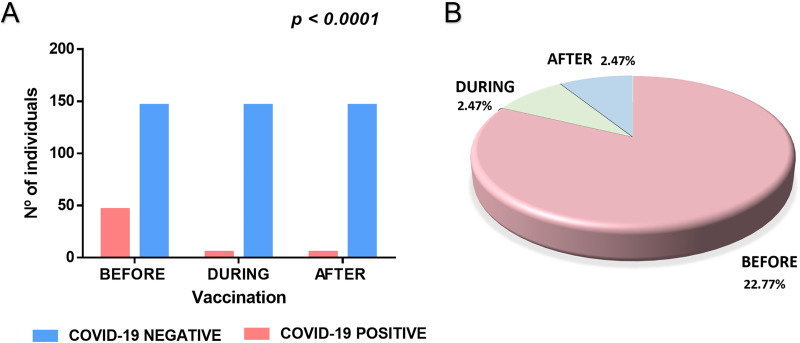
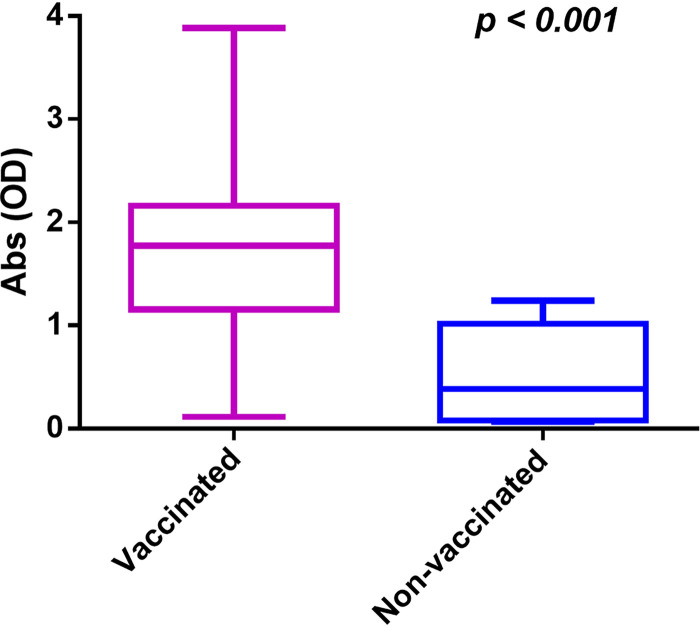
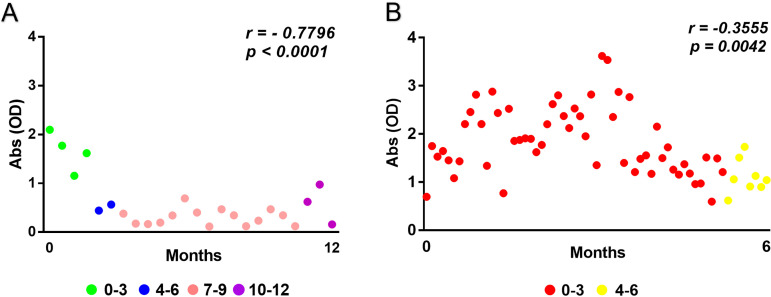
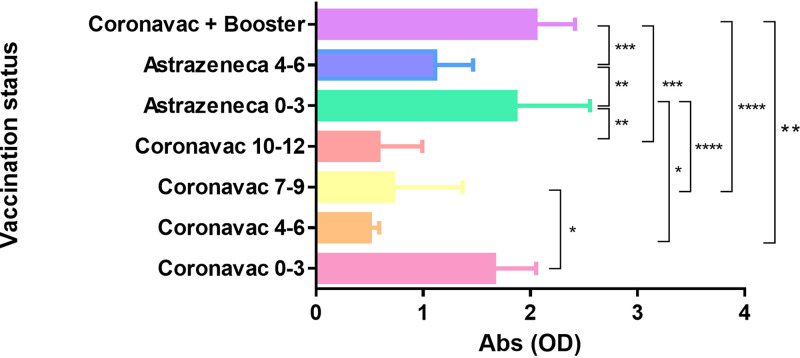
A third vaccine dose against COVID-19 is already a reality in some countries around the world. In this study, we aimed to evaluate the effectiveness of the Brazilian immunization policy for COVID-19, which involves a booster shot. Participants ( = 210) provided serum samples, which were subjected to enzyme-linked immunosorbent assay (ELISA). Immunological profiles were defined as individuals with or without previous SARS-CoV-2 infection who received at least one vaccine dose in the immunization regimens of AstraZeneca, CoronaVac, or CoronaVac plus a booster shot with Pfizer. In addition, nonvaccinated/infected individuals were also included. As main results, we observed that the numbers of infected individuals were significantly reduced among those who were vaccinated, even with one dose. This result indicates that vaccines are highly protective against COVID-19. However, we observed a significant tendency of serum level decreases of specific antibodies over the time after the second dose. In contrast, the booster shot with the Pfizer vaccine after a CoronaVac immunization regimen showed a significant increase in the specific SARS-CoV-2 IgG serum levels. Moreover, we found that vaccination induced a significantly higher humoral immunological status than only the natural infection with SARS-CoV-2. Collectively, results presented here indicate that vaccines are necessary to induce a robust immunological status, which is maintained, restored, or even improved by booster shots. COVID-19 continues to spread around the world despite significant progress in vaccine distribution and population immunity. The dynamics of the antiviral antibody response postvaccination is critical to evaluate vaccine effectiveness across different vaccine platforms and over time. In this study, we evaluate the serum levels of antiviral antibodies in patients from Brazil that received either the CoronaVac or the AstraZeneca vaccine. We found that antibody levels wane over time, vaccines induce protective immunity, and humoral immunity is enhanced with a third vaccine dose. This study reveals that the COVID-19 humoral immunological status induced by vaccines significantly benefits from a booster shot.
全球一些国家已经开始接种第三针 COVID-19 疫苗。本研究旨在评估巴西 COVID-19 免疫接种策略的有效性,该策略涉及加强针。参与者( = 210)提供了血清样本,这些样本通过酶联免疫吸附试验(ELISA)进行了检测。免疫谱定义为既往感染过 SARS-CoV-2 且至少接种过一剂阿斯利康、科兴或科兴加辉瑞加强针的个体,或既往感染过 SARS-CoV-2 但未接种疫苗的个体。作为主要结果,我们观察到,即使只接种了一剂疫苗,感染人数也显著减少。这一结果表明疫苗对 COVID-19 具有高度保护作用。然而,我们观察到第二剂后,特定抗体的血清水平随着时间的推移呈显著下降趋势。相比之下,科兴疫苗接种后接种辉瑞加强针可显著提高特定 SARS-CoV-2 IgG 血清水平。此外,我们发现疫苗接种诱导的体液免疫状态明显高于仅感染 SARS-CoV-2 诱导的状态。总之,本研究结果表明,接种疫苗是诱导强大免疫状态的必要条件,而加强针则可以维持、恢复甚至提高这种免疫状态。尽管疫苗接种和人群免疫已经取得了显著进展,但 COVID-19 仍在全球范围内传播。接种疫苗后抗病毒抗体反应的动态变化对于评估不同疫苗平台和随时间推移的疫苗有效性至关重要。在这项研究中,我们评估了来自巴西的接受科兴或阿斯利康疫苗接种的患者的血清抗病毒抗体水平。我们发现抗体水平随时间推移而下降,疫苗可诱导保护性免疫,且第三剂疫苗可增强体液免疫。本研究揭示了疫苗诱导的 COVID-19 体液免疫状态通过加强针显著获益。