Barrer Centre, Department of Chemical Engineering, Imperial College London, South Kensington Campus, Exhibition Road, London, SW7 2AZ, United Kingdom.
Department of Chemistry, Imperial College London, South Kensington Campus, Exhibition Road, London, SW7 2AZ, United Kingdom.
Chemphyschem. 2022 Jul 5;23(13):e202100854. doi: 10.1002/cphc.202100854. Epub 2022 May 19.
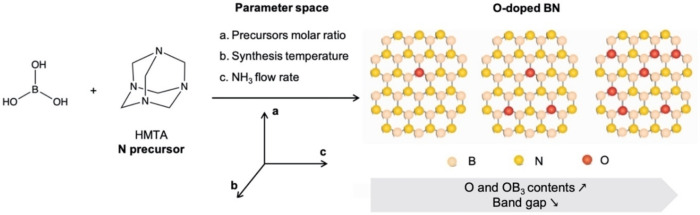
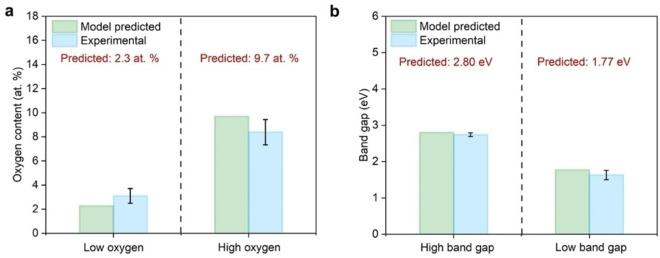
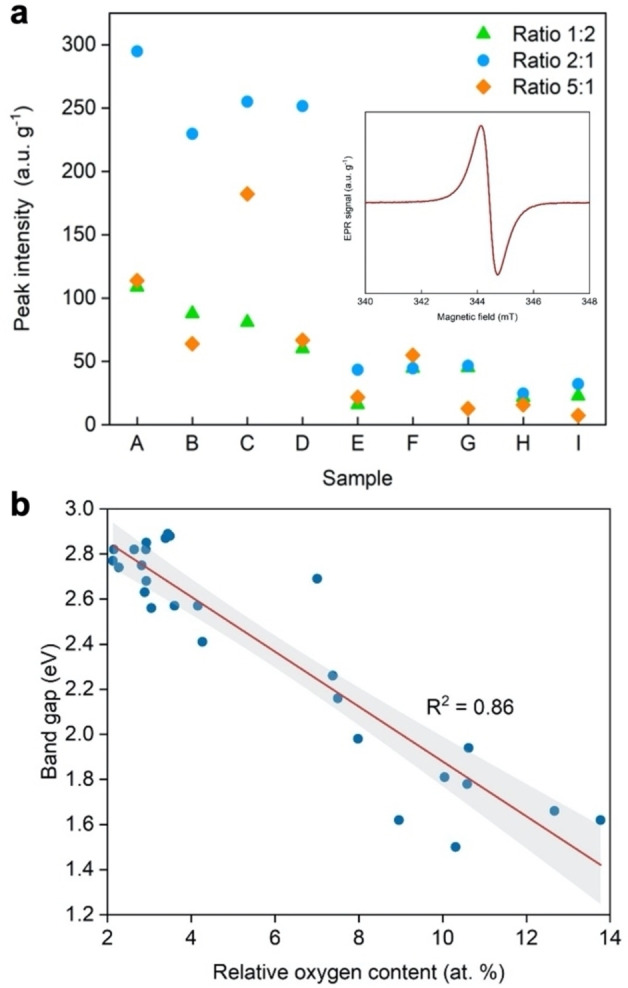
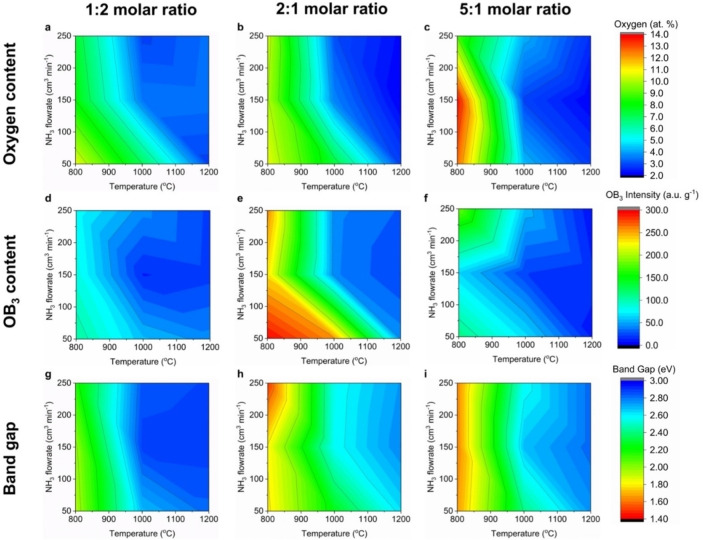
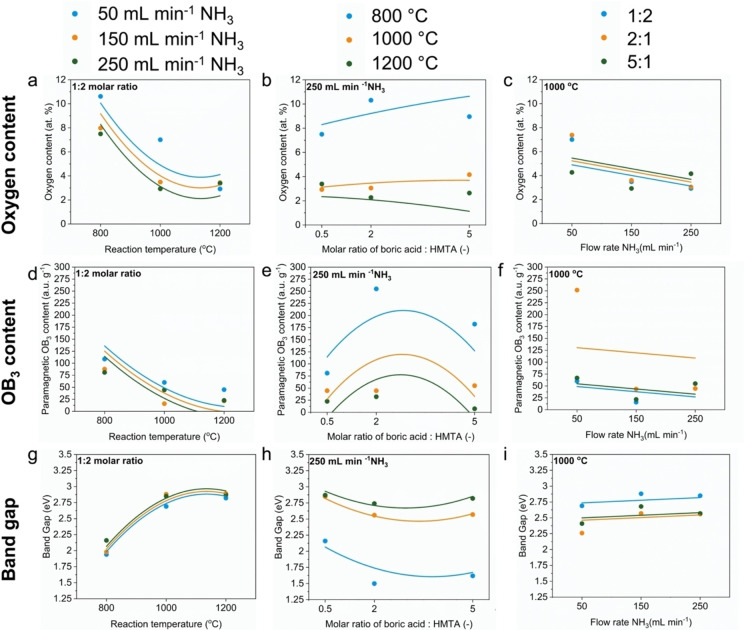
Porous boron nitride (BN), a combination of hexagonal, turbostratic and amorphous BN, has emerged as a new platform photocatalyst. Yet, this material lacks photoactivity under visible light. Theoretical studies predict that tuning the oxygen content in oxygen-doped BN (BNO) could lower the band gap. This is yet to be verified experimentally. We present herein a systematic experimental route to simultaneously tune BNO's chemical, magnetic and optoelectronic properties using a multivariate synthesis parameter space. We report deep visible range band gaps (1.50-2.90 eV) and tuning of the oxygen (2-14 at.%) and specific paramagnetic OB contents (7-294 a.u. g ). Through designing a response surface via a design of experiments (DOE) process, we have identified synthesis parameters influencing BNO's chemical, magnetic and optoelectronic properties. We also present model prediction equations relating these properties to the synthesis parameter space that we have validated experimentally. This methodology can help tailor and optimise BN materials for heterogeneous photocatalysis.
多孔氮化硼(BN)是由六方、乱层和无定形 BN 组成的新型光催化剂平台。然而,这种材料在可见光下缺乏光活性。理论研究预测,在掺氧氮化硼(BNO)中调节氧含量可以降低带隙。这仍有待实验验证。我们在此提出了一种系统的实验方法,通过多元合成参数空间同时调节 BNO 的化学、磁性和光电性质。我们报道了深可见范围的带隙(1.50-2.90 eV)和氧(2-14 原子%)以及特定顺磁 OB 含量(7-294 原子单位/g)的调谐。通过设计实验设计(DOE)过程中的响应面,我们确定了影响 BNO 化学、磁性和光电性质的合成参数。我们还提出了将这些性质与我们通过实验验证的合成参数空间相关联的模型预测方程。这种方法可以帮助为异质光催化量身定制和优化 BN 材料。