Department of Neurology, State University of New York, Upstate Medical University, Syracuse, New York, 13210, USA.
Department of Pathology, State University of New York, Upstate Medical University, Syracuse, New York, 13210, USA.
Ann Clin Transl Neurol. 2022 Jun;9(6):778-785. doi: 10.1002/acn3.51557. Epub 2022 Apr 8.
The association between autonomic dysfunction and long-COVID syndrome is established. However, the prevalence and patterns of symptoms of dysautonomia in long-COVID syndrome in a large population are lacking.
To evaluate the prevalence and patterns of symptoms of dysautonomia in patients with long-COVID syndrome.
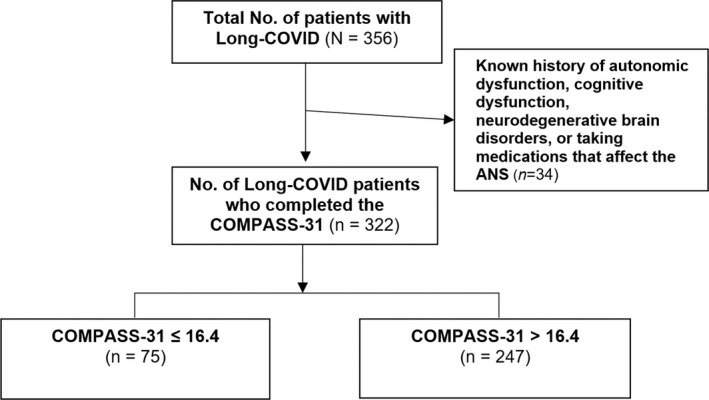
We administered the Composite Autonomic Symptom Score 31 (COMPASS-31) questionnaire to a sample of post-COVID-19 patients who were referred to post-COVID clinic in Assiut University Hospitals, Egypt for symptoms concerning for long-COVID syndrome. Participants were asked to complete the COMPASS-31 questionnaire referring to the period of more than 4 weeks after acute COVID-19.
We included 320 patients (35.92 ± 11.92 years, 73% females). The median COMPASS-31 score was 26.29 (0-76.73). The most affected domains of dysautonomia were gastrointestinal, secretomotor, and orthostatic intolerance with 91.6%, 76.4%, and 73.6%, respectively. There was a positive correlation between COMPASS-31 score and long-COVID duration (p < 0.001) and a positive correlation between orthostatic intolerance domain score and post-COVID duration (p < 0.001). There was a positive correlation between orthostatic intolerance domain score and age of participants (p = 0.004). Two hundred forty-seven patients (76.7%) had a high score of COMPASS-31 >16.4. Patients with COMPASS-31 >16.4 had a longer duration of long-COVID syndrome than those with score <16.4 (46.2 vs. 26.8 weeks, p < 0.001).
Symptoms of dysautonomia are common in long-COVID syndrome. The most common COMPASS-31 affected domains of dysautonomia are gastrointestinal, secretomotor, and orthostatic intolerance. There is a positive correlation between orthostatic intolerance domain score and patients' age.
自主神经功能障碍与长新冠综合征之间存在关联。然而,在大量人群中,长新冠综合征患者自主神经功能障碍的症状的患病率和模式尚不清楚。
评估长新冠综合征患者自主神经功能障碍症状的患病率和模式。
我们向埃及 Assiut 大学医院的新冠后诊所就诊的新冠后患者样本发放了复合自主症状评分 31 问卷(COMPASS-31),这些患者的症状提示长新冠综合征。参与者被要求在急性新冠后超过 4 周的时间段内填写 COMPASS-31 问卷。
我们纳入了 320 名患者(35.92±11.92 岁,73%为女性)。COMPASS-31 评分中位数为 26.29(0-76.73)。自主神经功能障碍受影响最严重的领域是胃肠道、分泌运动和体位不耐受,分别为 91.6%、76.4%和 73.6%。COMPASS-31 评分与长新冠持续时间呈正相关(p<0.001),体位不耐受域评分与新冠后持续时间呈正相关(p<0.001)。体位不耐受域评分与参与者年龄呈正相关(p=0.004)。247 名患者(76.7%)的 COMPASS-31 评分>16.4,这些患者的长新冠综合征持续时间长于评分<16.4 的患者(46.2 周 vs. 26.8 周,p<0.001)。
自主神经功能障碍症状在长新冠综合征中很常见。COMPASS-31 受影响最严重的自主神经功能障碍领域是胃肠道、分泌运动和体位不耐受。体位不耐受域评分与患者年龄呈正相关。