Chang Kun-Chia, Chang Yun-Husan, Yen Cheng-Fang, Chen Jung-Sheng, Chen Po-Jen, Lin Chung-Ying, Griffiths Mark D, Potenza Marc N, Pakpour Amir H
1 Department of General Psychiatry, Jianan Psychiatric Center, Ministry of Health and Welfare, Tainan, Taiwan.
2 Institute of Genomics and Bioinformatics, National Chung Hsing University, Taichung, Taiwan.
J Behav Addict. 2022 Apr 7;11(2):567-76. doi: 10.1556/2006.2022.00012.
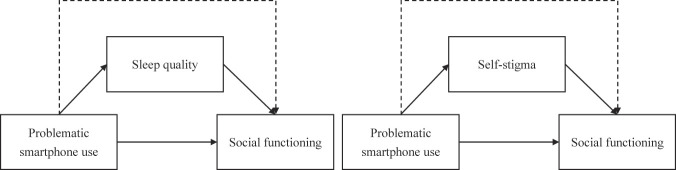
Individuals with schizophrenia may often experience poor sleep, self-stigma, impaired social functions, and problematic smartphone use. However, the temporal relationships between these factors have not been investigated. The present study used a longitudinal design to examine potential mediating roles of poor sleep and self-stigma in associations between problematic smartphone use and impaired social functions among individuals with schizophrenia.
From April 2019 to August 2021, 193 individuals with schizophrenia (mean [SD] age = 41.34 [9.01] years; 88 [45.6%] males) were recruited and asked to complete three psychometric scales: the Smartphone Application-Based Addiction Scale to assess problematic smartphone use; the Pittsburgh Sleep Quality Index to assess sleep quality; and the Self-Stigma Scale-Short Scale to assess self-stigma. Social functioning was evaluated by a psychiatrist using the Personal and Social Performance Scale. All measures were assessed five times (one baseline and four follow-ups) at three-month intervals between assessments.
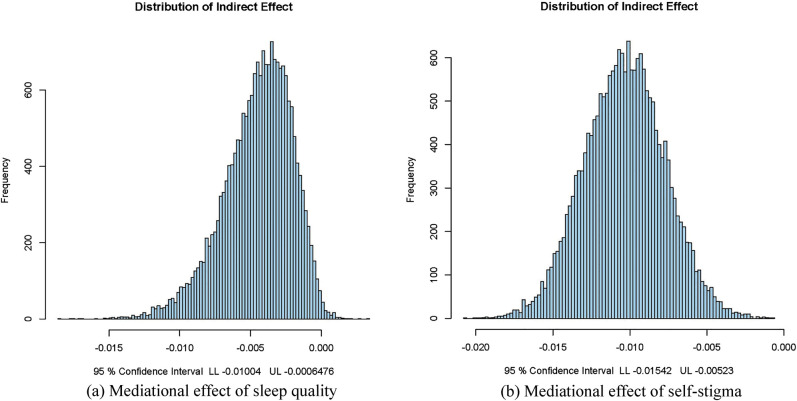
General estimating equations found that problematic smartphone use (coefficient = -0.096, SE = 0.021; P < 0.001), sleep quality (coefficient = -0.134, SE = 0.038; P < 0.001), and self-stigma (coefficient = -0.612, SE = 0.192; P = 0.001) were significant statistical predictors for social functioning. Moreover, sleep quality and self-stigma mediated associations between problematic smartphone use and social functioning.
Problematic smartphone use appears to impact social functioning longitudinally among individuals with schizophrenia via poor sleep and self-stigma concerns. Interventions aimed at reducing problematic smartphone use, improving sleep, and addressing self-stigma may help improve social functioning among individuals with schizophrenia.
精神分裂症患者常常睡眠质量差、存在自我污名化、社交功能受损以及智能手机使用问题。然而,这些因素之间的时间关系尚未得到研究。本研究采用纵向设计,以检验睡眠质量差和自我污名化在精神分裂症患者智能手机使用问题与社交功能受损之间的关联中可能起到的中介作用。
2019年4月至2021年8月,招募了193名精神分裂症患者(平均[标准差]年龄 = 41.34[9.01]岁;88名[45.6%]男性),并要求他们完成三个心理测量量表:基于智能手机应用的成瘾量表,用于评估智能手机使用问题;匹兹堡睡眠质量指数,用于评估睡眠质量;自我污名化量表简版,用于评估自我污名化。社交功能由精神科医生使用个人和社会表现量表进行评估。所有测量在评估之间每隔三个月进行五次(一次基线测量和四次随访测量)。
广义估计方程发现,智能手机使用问题(系数 = -0.096,标准误 = 0.021;P < 0.001)、睡眠质量(系数 = -0.134,标准误 = 0.038;P < 0.001)和自我污名化(系数 = -0.612,标准误 = 0.192;P = 0.001)是社交功能的显著统计学预测因素。此外,睡眠质量和自我污名化在智能手机使用问题与社交功能之间的关联中起中介作用。
智能手机使用问题似乎通过睡眠质量差和自我污名化问题在精神分裂症患者中对社交功能产生纵向影响。旨在减少智能手机使用问题、改善睡眠和解决自我污名化问题的干预措施可能有助于改善精神分裂症患者的社交功能。