
网络成瘾障碍与由恢复力受损和睡眠困扰介导的抑郁:一项针对中国青少年的三波纵向研究。
Internet gaming disorder and depression mediated by impaired resilience and sleep distress: a three-wave longitudinal study among Chinese adolescents.
作者信息
Peng P, Chen Z M, Ren S L, He Y, Li J G, Liao A J, Zhao L L, Shao X, Chen S S, He R N, Liang Y D, Tan Y G, Chen X G, Liao Y H, Tang J S
机构信息
Department of Psychiatry, Sir Run Run Shaw Hospital, Zhejiang University School of Medicine, Hangzhou, ZJ, China.
Department of Psychiatry, Zigong Mental Health Center, Zigong, SC, China.
出版信息
Epidemiol Psychiatr Sci. 2025 Feb 19;34:e11. doi: 10.1017/S2045796025000046.
AIMS
While the cross-sectional relationship between internet gaming disorder (IGD) and depression is well-established, whether IGD predicts future depression remains debated, and the underlying mechanisms are not fully understood. This large-scale, three-wave longitudinal study aimed to clarify the predictive role of IGD in depression and explore the mediating effects of resilience and sleep distress.
METHODS
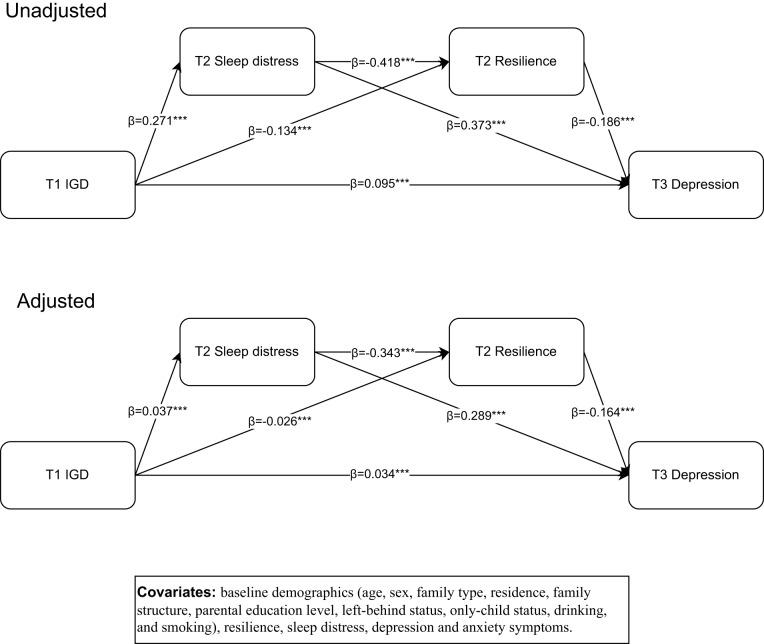
A cohort of 41,215 middle school students from Zigong City was assessed at three time points: November 2021 (T1), November 2022 (T2) and November 2023 (T3). IGD, depression, sleep distress and resilience were measured using standardized questionnaires. Multiple logistic regression was used to examine the associations between baseline IGD and both concurrent and subsequent depression. Mediation analyses were conducted with T1 IGD as the predictor, T2 sleep distress and resilience as serial mediators and T3 depression as the outcome. To test the robustness of the findings, a series of sensitivity analyses were performed. Additionally, sex differences in the mediation pathways were explored.
RESULTS
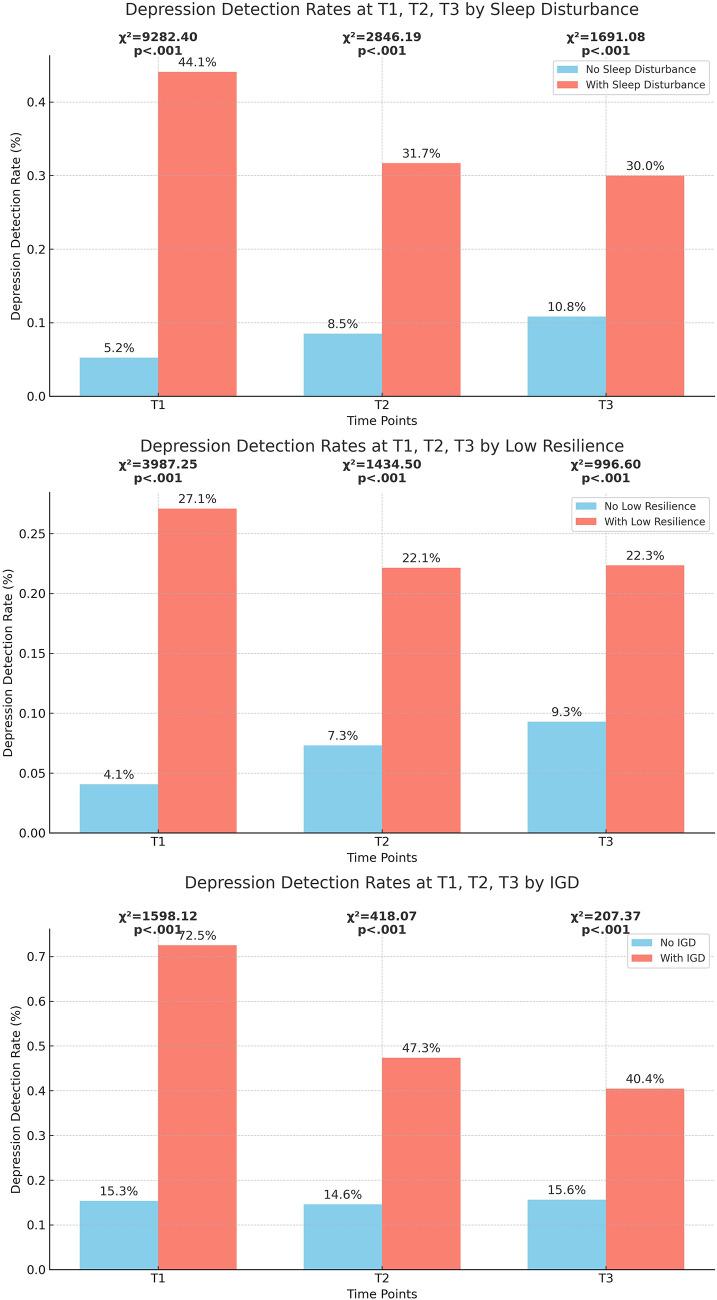
(1) IGD was independently associated with depression at baseline (T1: adjusted odds ratio [AOR] = 4.76, 95% confidence interval [CI]: 3.79-5.98, < 0.001), 1 year later (T2: AOR = 1.42, 95% CI: 1.16-1.74, < 0.001) and 2 years later (T3: AOR = 1.24, 95% CI: 1.01-1.53, = 0.042); (2) A serial multiple mediation effect of sleep distress and resilience was identified in the relationship between IGD and depression. The mediation ratio was 60.7% in the unadjusted model and 33.3% in the fully adjusted model, accounting for baseline depression, sleep distress, resilience and other covariates. The robustness of our findings was supported by various sensitivity analyses; and (3) Sex differences were observed in the mediating roles of sleep distress and resilience, with the mediation ratio being higher in boys compared to girls.
CONCLUSIONS
IGD is a significant predictor of depression in adolescents, with resilience and sleep distress serving as key mediators. Early identification and targeted interventions for IGD may help prevent depression. Intervention strategies should prioritize enhancing resilience and improving sleep quality, particularly among boys at risk.
目的
虽然网络成瘾障碍(IGD)与抑郁症之间的横断面关系已得到充分证实,但IGD是否能预测未来的抑郁症仍存在争议,其潜在机制也尚未完全了解。这项大规模的三波纵向研究旨在阐明IGD在抑郁症中的预测作用,并探讨心理弹性和睡眠困扰的中介作用。
方法
对来自自贡市的41215名中学生进行了三个时间点的评估:2021年11月(T1)、2022年11月(T2)和2023年11月(T3)。使用标准化问卷测量IGD、抑郁症、睡眠困扰和心理弹性。采用多元逻辑回归分析基线IGD与同时期及后续抑郁症之间的关联。以T1时的IGD作为预测变量,T2时的睡眠困扰和心理弹性作为连续中介变量,T3时的抑郁症作为结果进行中介分析。为检验研究结果的稳健性,进行了一系列敏感性分析。此外,还探讨了中介路径中的性别差异。
结果
(1)IGD在基线时(T1:调整后的优势比[AOR]=4.76,95%置信区间[CI]:3.79-5.98,<0.001)、1年后(T2:AOR=1.42,95%CI:1.16-1.74,<0.001)和2年后(T3:AOR=1.24,95%CI:1.01-1.53,=0.042)均与抑郁症独立相关;(2)在IGD与抑郁症的关系中发现了睡眠困扰和心理弹性的连续多重中介效应。在未调整模型中的中介比例为60.7%,在完全调整模型中的中介比例为33.3%,该中介效应在纳入基线抑郁症、睡眠困扰、心理弹性和其他协变量后仍然存在。各种敏感性分析支持了我们研究结果的稳健性;(3)在睡眠困扰和心理弹性的中介作用中观察到性别差异,男孩的中介比例高于女孩。
结论
IGD是青少年抑郁症的重要预测因素,心理弹性和睡眠困扰是关键中介变量。对IGD进行早期识别和针对性干预可能有助于预防抑郁症。干预策略应优先增强心理弹性和改善睡眠质量,尤其是对有风险的男孩。
 Zotero 插件