Blood Transfusion Research Center, High Institute for Research and Education in Transfusion Medicine, Tehran, Iran.
Blood Transfusion Research Center, High Institute for Research and Education in Transfusion Medicine, Tehran, Iran.
Thromb Res. 2022 May;213:179-194. doi: 10.1016/j.thromres.2022.03.022. Epub 2022 Mar 31.
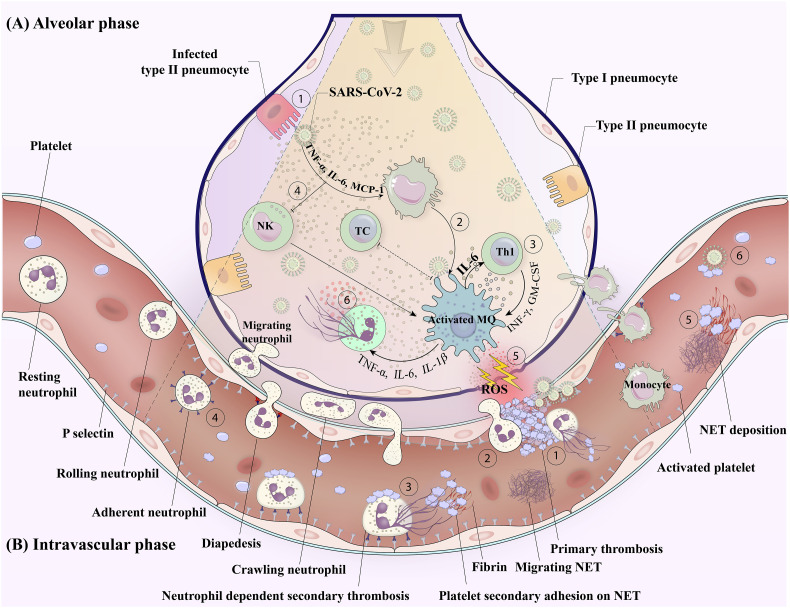
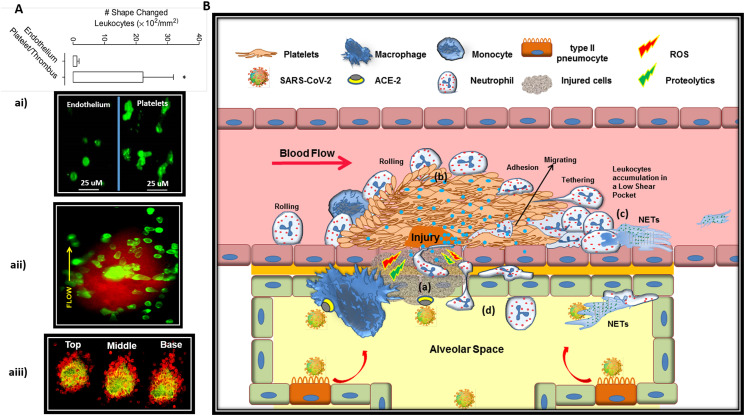
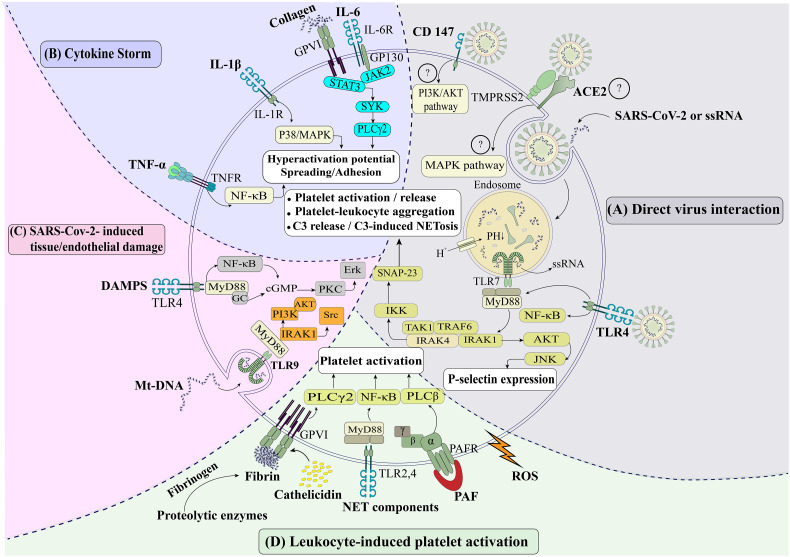
Platelet-leukocyte crosstalk is commonly manifested by reciprocal links between thrombosis and inflammation. Platelet thrombus acts as a reactive matrix that recruits leukocytes to the injury site where their massive accumulation, activation and migration promote thrombotic events while triggering inflammatory responses. As a life-threatening condition with the associations between inflammation and thrombosis, COVID-19 presents diffuse alveolar damage due to exaggerated macrophage activity and cytokine storms. These events, together with direct intracellular virus invasion lead to pulmonary vascular endothelialitis, cell membranes disruption, severe endothelial injury, and thrombosis. The developing pre-alveolar thrombus provides a hyper-reactive milieu that recruits circulating leukocytes to the injury site where their activation contributes to thrombus stabilization and thrombosis propagation, primarily through the formation of Neutrophil extracellular trap (NET). NET fragments can also circulate and deposit in further distance where they may disseminate intravascular thrombosis in severe cases of disease. Thrombi may also facilitate leukocytes migration into alveoli where their accumulation and activation exacerbate cytokine storms and tissue damage, further complicating the disease. Based on these mechanisms, whether an effective anti-inflammatory protocol can prevent thrombotic events, or on the other hand; efficient antiplatelet or anticoagulant regimens may be associated with reduced cytokine storms and tissue damage, is now of interests for several ongoing researches. Thus shedding more light on platelet-leukocyte crosstalk, the review presented here discusses the detailed mechanisms by which platelets may contribute to the pathogenesis of COVID-19, especially in severe cases where their interaction with leukocytes can intensify both inflammatory state and thrombosis in a reciprocal manner.
血小板-白细胞相互作用通常表现为血栓形成和炎症之间的相互联系。血小板血栓作为一种反应性基质,招募白细胞到损伤部位,在那里它们的大量聚集、激活和迁移促进血栓形成事件,同时触发炎症反应。COVID-19 是一种危及生命的疾病,其炎症和血栓形成之间存在关联,表现为弥漫性肺泡损伤,这是由于巨噬细胞活性和细胞因子风暴的过度放大。这些事件,加上病毒直接在细胞内入侵,导致肺血管内皮炎、细胞膜破裂、严重的内皮损伤和血栓形成。正在形成的肺泡前血栓提供了一个高反应性的环境,招募循环中的白细胞到损伤部位,它们的激活有助于血栓的稳定和血栓的传播,主要是通过中性粒细胞细胞外陷阱(NET)的形成。NET 片段也可以循环并沉积在更远的距离,在严重的疾病中,它们可能会传播血管内血栓形成。血栓也可能促进白细胞迁移到肺泡中,在那里它们的聚集和激活加剧了细胞因子风暴和组织损伤,进一步使疾病复杂化。基于这些机制,目前正在进行的几项研究关注的是,有效的抗炎方案是否可以预防血栓形成事件,或者另一方面,有效的抗血小板或抗凝方案是否与减少细胞因子风暴和组织损伤有关。因此,为了更好地了解血小板-白细胞相互作用,本文综述讨论了血小板可能导致 COVID-19 发病机制的详细机制,特别是在严重情况下,血小板与白细胞的相互作用可以以相互的方式加剧炎症状态和血栓形成。